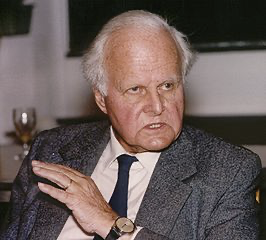
Carl Friedrich Freiherr von Weizsäcker:
(Kiel, 28 June 1912 – Starnberg, 28 April 2007).
German physicist and philosopher. He was a son of Ernst von Weizsäcker, secretary of state for foreign affairs under Hitler, and a brother of German Federal President Richard von Weizsäcker.
You can only continue to live in this world as it is if you deeply believe that it will not remain as it is, but will become as it should be.
Freedom is a good that grows through use and diminishes through disuse.
How are you supposed to change the world when you know how difficult it is to change a person?
Research is the simple pleasure of finding out something you didn’t know before.
You should always speak in such a way that the result is courage to act and not despondency.
Freedom is a virtue that grows with use and fades away when not used.
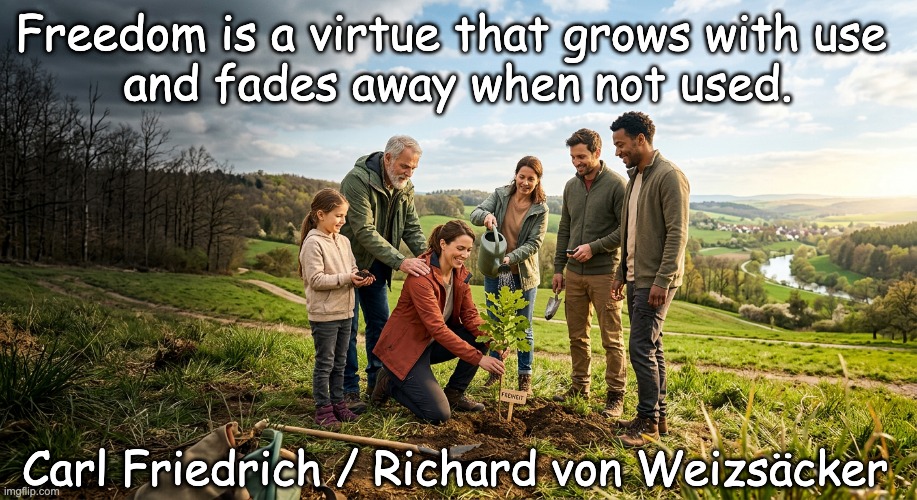
This sentence describes freedom not as a static possession, but as something dynamic: It is not a state that one achieves once and then permanently “has,” but a good that must be actively lived and exercised in order to exist. Those who do not make use of their freedoms—such as freedom of opinion, choice, or action—risk losing them over time, whether through their own passivity, by adapting to external pressure, or because unused rights can be more easily curtailed politically. The idea is similar to the classic “use it or lose it” motif and can be found in similar form in the works of other thinkers on freedom (for example, in the notion that civil rights must be “vigilantly defended”).
Authorship:
This is where it gets interesting, because the sources are indeed inconsistent. The quote is attributed on the German-language internet to “two different members of the same family”:
– Carl Friedrich von Weizsäcker (1912–2007), physicist, philosopher. And peace researchers, uncle of Richard von Weizsäcker, and numerous quotations confirm this.
– Richard von Weizsäcker (1920–2015), Federal President from 1984 to 1994, nephew of Carl Friedrich – also very frequently cited as the source, sometimes even on seemingly reputable websites.
Both names appear with roughly equal frequency, often even on different pages of the same provider with contradictory attributions. I could not find a clear primary source – such as a specific speech, book, or essay with a page reference – in the search results; it circulates practically only as a loose quotation on quotation collection websites, without any source.
This is no coincidence in the case of the two Weizsäckers: They are frequently confused in quotation databases because they share the same surname, both were publicly influential, statesmen with intellectual profiles, and both liked to speak about freedom, democracy, and responsibility. Richard von Weizsäcker is also known for his famous speech on May 8, 1985, in which similar themes of freedom and responsibility resonate, making the attribution to him seem plausible, even without the exact wording being found there.
