Henry Rollins:
Born as Henry Lawrence Garfield.
(Washington, 13 February 1961)
American singer, actor, poet, writer and all-round artist.
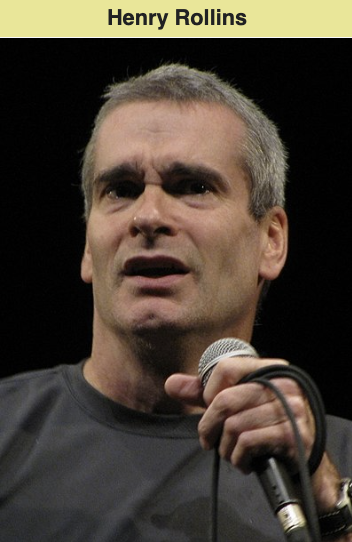
I have come to regard November as the older, harder man’s October. I appreciate the early darkness and cooler temperatures. It is a month for a quieter, slightly more subdued celebration of summer’s death as winter tightens its grip.
The month of November makes me feel that life is passing more quickly. In an effort to slow it down, I try to fill the hours more meaningfully.
We know that in September, we will wander through the warm winds of summer’s wreckage. We will welcome summer’s ghost.
The passage treats ‘September as the lingering aftermath of summer’:
– “Warm winds” suggest that summer’s heat has not completely disappeared.
– “Summer’s wreckage” evokes what summer leaves behind—spent days, fading light, dry landscapes, memories and emotional residue.
– “Summer’s ghost” means that summer is gone in a literal sense, yet its warmth and atmosphere still haunt early autumn.
The tone is both ‘melancholic and welcoming’:
rather than resisting the end of summer, the speaker accepts and even embraces its fading presence.
✍️ Author and origin:
The quotation is generally attributed to Henry Rollins, the American writer, spoken-word performer and former Black Flag singer. It is commonly cited as coming from his prose collection:
> “Solipsist” (1998), published by Rollins’s imprint 2.13.61
‘It is not an old proverb or traditional saying, but a piece of poetic prose.’ Online versions sometimes vary between “I know” and “We know”, so the exact wording may depend on the transcription or edition.
🍂 In simpler terms:
> ‘When September arrives, summer will technically be over, but we will still feel its warmth and remember what it left behind—and we will welcome that bittersweet reminder.’
August used to be a sad month for me. As the days went on, the thought of school starting weighed heavily upon my young frame.
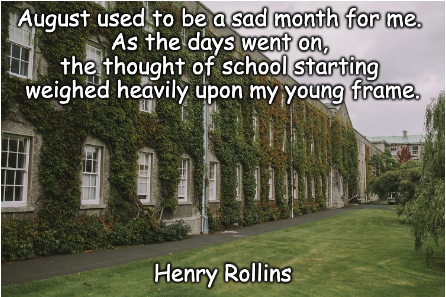
– ‘August felt sad because summer was ending’ 🌤️➡️📚
– As the month progressed, the speaker felt increasing ‘dread or anxiety about returning to school’.
– “Weighed heavily upon my young frame” is a poetic way of saying the thought felt emotionally burdensome to him as a child.
In simpler words:
> “When I was young, August made me sad because every passing day brought school closer, and that thought really stressed me out.”
✍️ Author: Henry Rollins.
Henry Rollins is an American:
– musician and former frontman of “Black Flag”:
– spoken-word performer
– writer
– actor and commentator
📖 Origin:
This is ‘not an old proverb or traditional saying’. It is a literary/personal reflection by Henry Rollins.
It is commonly sourced to Rollins’s writing, especially his book “Solipsist” published by 2.13.61 Publications in the late 1990s. It also circulates widely in quotation collections online, often without a full page citation.
🧠 Tone and Context:
The quote captures a common childhood feeling:
– the melancholy of late summer
– fear or dislike of school
– the emotional weight children can feel even over ordinary life changes
It is nostalgic, slightly dramatic, and emotionally honest — very much in keeping with Henry Rollins’s reflective prose style.
Every year, August lashes out in volcanic fury, rising with the din of morning traffic. Its great metallic wings smashing against the ground, heating the air with ever-increasing intensity.
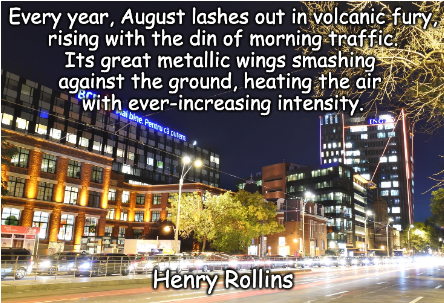
The passage is ‘a vivid, metaphorical description of August as brutally hot, noisy, and aggressive’—especially in an urban setting.
> “Every year, August lashes out in volcanic fury…”
> = August arrives like an eruption: violent, scorching, overwhelming.
> “rising with the din of morning traffic”
> = the heat and hostility of the day begin early, alongside city noise.
> “great metallic wings smashing against the ground”
> = likely an image of ‘cars, trucks, machinery, asphalt, and urban heat’—the city itself becoming a giant metal creature beating the air hotter and hotter.
In plain English:
It means something like:
> Every August, the city becomes unbearably hot and loud; the heat rises from the streets and traffic until the whole atmosphere feels hostile and explosive.
It is ‘not really a “saying” or proverb’ with a moral lesson. It is more of a ‘literary image’ or prose-poem line.
✍️ Author: Henry Rollins.
– The American musician, spoken-word performer, and writer.
Rollins often writes in this intense, physical, urban style—using images of heat, metal, anger, pressure, traffic, and bodily endurance.
📚 Origin:
The quote is usually associated with a prose piece often cited as “August” by Henry Rollins, and it appears in circulation among excerpts from his written/spoken-word work.
However, many online quote sources repeat the line ‘without a precise page citation’.
🔥 Overall interpretation:
The passage personifies August as a violent creature or force of nature:
– 🌋 “volcanic fury” = extreme heat and explosive force
– 🚗 “morning traffic” = urban noise and stress
– 🪽 “metallic wings” = machines, vehicles, city infrastructure
– ☀️ “heating the air’ = the oppressive buildup of summer heat
So the mood is ‘claustrophobic, industrial, angry, and overheated’—very much in line with Henry Rollins’s style.
August, the summer’s last messenger of misery, is a hollow actor.
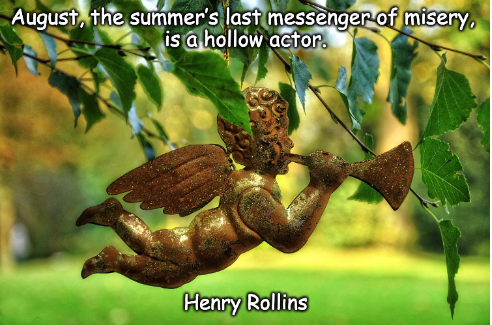
This means that ‘August’ is being described as the final stage of summer, but not in a happy way.
– “Summer’s last messenger” = August comes near the end of summer.
– “Messenger of misery” = it brings exhaustion, heat, boredom, sadness, or a sense of decay.
– “A hollow actor” = August is only pretending to still be full summer; it looks like summer, but feels empty and worn out.
In simple words:
‘August is the tired, empty end of summer — still hot, but no longer joyful.’
Origin 📚:
The quotation is usually found online in connection with Henry Rollins’s writings, especially his intense prose/diary-style works.
It is often linked to his book:
– ‘Solipsist’
– Published by ‘2.13.61 Publications’
However, many online quote sources do ‘not’ give an exact page number or full citation.’
Author ✍️:
The saying is ‘commonly attributed to Henry Rollins’.
Henry Rollins is:
– An American singer, writer, actor, and spoken-word performer
– Former frontman of ‘Black Flag’
– Known for dark, intense, introspective prose.
August brings into sharp focus and a furious boil everything I’ve been listening to in the late spring and summer.
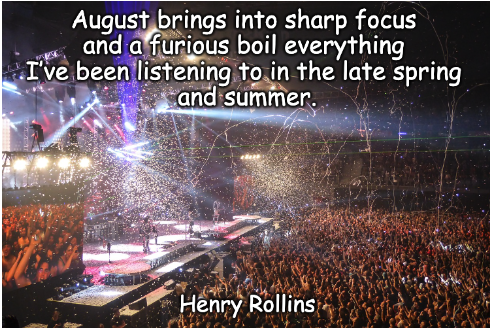
> ‘By August, all the music I’ve been listening to during late spring and summer becomes clearer, more intense, and reaches a kind of emotional peak.’
In simpler words:
– “brings into sharp focus”
= makes something clear, vivid, easy to understand or feel.
– “a furious boil”
= makes something intensely energetic, heated, or emotionally powerful.
– “everything I’ve been listening to…”
= the music, moods, ideas, or impressions gathered over the previous months.
So the whole phrase suggests that ‘August intensifies and clarifies the music experience of the season’.
It is a ‘literary/metaphorical expression’ combining two common figurative phrases:
– ‘bring into sharp focus’
— from photography/vision, meaning “make clear”
– ‘bring to a boil’
— from cooking, meaning “bring to a point of intensity or climax”
– “a furious boil” is a vivid, creative variation.
Origin 🧾:
The phrase appears to come from ‘music writing or radio-show commentary’, and it is very much in the style of Henry Rollins
— intense, physical, seasonal, and music-centered.
However, the expression itself does ‘not’ have an ancient or fixed idiomatic origin. It is likely an ‘original descriptive sentence’, not a proverb or established idiom.
Author: Henry Rollins 🎤
– the American musician, writer, spoken-word performer, and radio host.
He has written many music-related notes and columns in which he addresses listeners and describes seasonal listening habits in this kind of language. The line sounds like something from his ‘radio-show notes, playlists, or music column’ rather than from a famous literary work.
Plain paraphrase ✍️:
> “In August, all the music I’ve been absorbing since late spring suddenly feels clearer, stronger, and more urgent.”
Or even more simply:
> “By August, my summer listening reaches its peak.”
