Ethel Watts Mumford:
(1876/1878 – 1940).
American author from New York City.
The surname Mumford came from her first husband, George D. Mumford, a lawyer (married 1894–1901).
After her first husband grew intolerant of her prolific writing and art career, she fled to San Francisco in 1899 with their only child, a son. She sued for divorce on grounds of desertion. After the divorce was granted in 1901, she returned to New York, vowing never to remarry unless her husband accepted her career. On June 4, 1906, she married Peter Geddes Grant of Grantown, Morayshire, Scotland.
The daughter of a wealthy businessman, she was given a fine education, topped by her study of painting at the Julian Academy of Paris. She traveled extensively in Europe, the Far East, and North America, experience that is well-reflected in her work.
Most of her early published works were written in San Francisco including her first novel, Dupes. She was a heavy producer of plays, vaudeville sketches, novels, short stories, joke collections, songs, poems, and articles. She also painted and illustrated books.
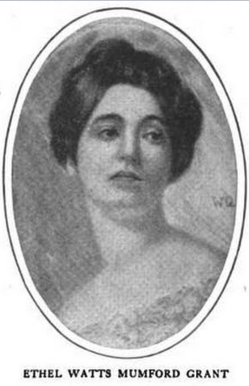
The doors of opportunity are marked ‘Push’ and ‘Pull.

The saying is a play on the signs found on ordinary doors:
> “The doors of opportunity are marked ‘Push’ and ‘Pull.’”
Metaphorically, it means that opportunities do not usually open by themselves. Success requires ‘initiative and effort’—pushing forward, pulling resources or people together, and trying another approach when the first one fails.
The version with “success” conveys the same idea, although “opportunity” appears to be the earlier and better-attested wording.
✍️ Author and origin:
The quotation is generally attributed to Ethel Watts Mumford (1876–1940), an American writer and humorist.
It was published in:
> “The Cynic’s Calendar of Revised Wisdom for 1903”
> by Oliver Herford, Ethel Watts Mumford, and Addison Mizner, issued around 1902–1903.
The wording associated with Mumford is:
> “The doors of opportunity are marked ‘Push’ and ‘Pull.’”
Because “The Cynic’s Calendar” was a collaborative collection, some bibliographical references credit the book’s three authors collectively. Nevertheless, quotation dictionaries and later sources commonly identify Mumford as the author of this particular aphorism.
