Virginia Woolf:
(South Kensington (London), 25 January 1882 – Lewes (Sussex), 28 March 1941).
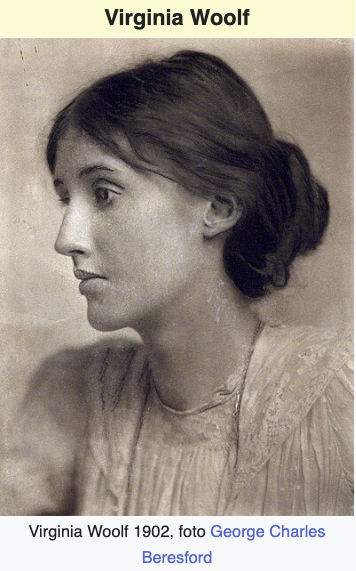
British writer and feminist. She was a founding member of the Bloomsbury group and became an important figure in London’s literary life in the interwar years.
In case you ever foolishly forget: I am never not thinking of you.
All the months are crude experiments, out of which the perfect September is made.

The saying means that ‘September is seen as the perfect month’, as if all other months were merely trials that eventually led to September.
Possible interpretations:
– 🌿 ‘September as balance’:
no longer the full heat of summer, not yet the cold of winter.
– 🍂 Transition and maturity:
September often symbolizes adulthood, harvest, reflection, and gentle beauty.
– 🧪 Experiment metaphor:
the earlier months are “rough trials” — imperfect, searching — while September is the successful result.
– ✨ Poetic appreciation of autumn: Woolf emphasizes the special atmosphere, clarity, and tranquility of September.
In short:
The quote expresses that ‘September is the most beautiful, most refined outcome of the year’ — as if nature needed all the preceding months to create this one perfect month. 🌍 Origin:
– The quote is usually attributed to Virginia Woolf.
– It comes from or is associated with her ‘diaries / literary notes’, later published in collections such as “A Writer’s Diary” or “The Diary of Virginia Woolf”.
– It is therefore ‘not an old folk saying’, but rather a ‘literary statement’.
✍️ Author:
– Virginia Woolf
— British writer, essayist, and modernist author
– Lived from 1882–1941
– Known for, among others, “Mrs Dalloway”, “To the Lighthouse”, and “A Room of One’s Own”
You cannot find peace by avoiding life.

If you do not tell the truth about yourself, you cannot tell it about other people.
To enjoy freedom we have to control ourselves.
No need to hurry. No need to sparkle. No need to be anybody but yourself.

A perfect September morning when every shadow is sharp and every colour bright after a night of storm and thunder.
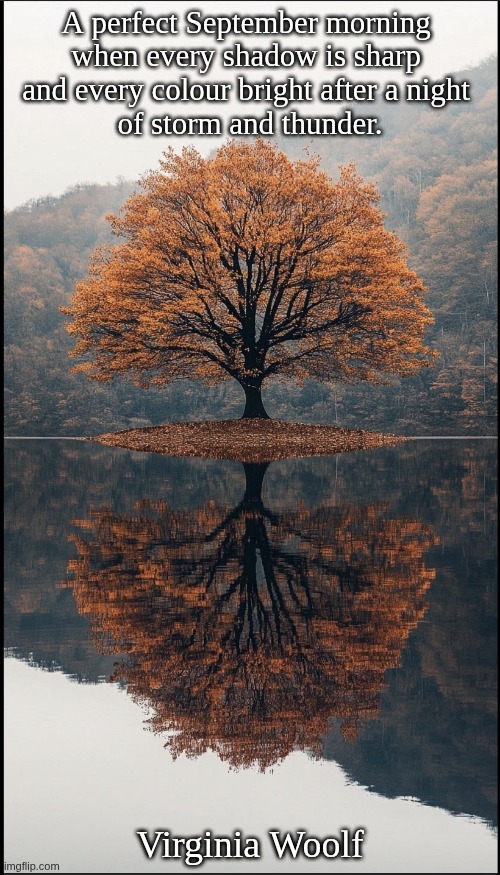
Woolf uses the image as a simile, not a nature observation in its own right. She’d just been discussing dense, murky psychological novelists (Dostoevsky, Proust’s Guermantes, Dostoevsky’s Stavrogin), and describes the relief of turning to Thomas Love Peacock’s witty, lucid satire as feeling like that clean, sharp-edged morning after a storm — everything suddenly clear, simplified, and vivid instead of tangled and ambiguous. The “storm and thunder” stands for the heaviness of psychological fiction; the “sharp shadow, bright colour” morning stands for the clarity of satire.
Origin:
From Woolf’s essay “The Satirists and Fantastics,” a section of her longer essay “Phases of Fiction,” collected in “Granite and Rainbow” (London, 1958), a posthumous essay collection. It originally appeared serialized in “The Bookman” in April, May, and June 1929.
Author: Virginia Woolf.
June had drawn out every leaf on the trees.
– By “June”, the trees were in ‘full leaf’.
– Summer had ‘brought forth’, ‘unfolded’, or ‘coaxed out’ all the leaves.
– It personifies June as if the month itself were an artist or force of nature “drawing out” the leaves.
Here “drawn out” does ‘not’ mainly mean “made longer” or “delayed.” It means something closer to:
> ‘brought out / caused to emerge / unfurled’
So the sentence evokes the fullness and vitality of early summer.
Author 📚: Virginia Woolf.
Origin: It appears in her novel “Mrs Dalloway”, first published in 1925.
The fuller passage is from the opening part of the novel, as Clarissa Dalloway walks through London on a June morning:
> “June had drawn out every leaf on the trees.”
Is it a proverb or saying? 💬
Not really. It is ‘not a traditional proverb’ or common saying. It is a ‘literary sentence’ from Woolf’s prose, admired for its vivid, compressed description of summer.
