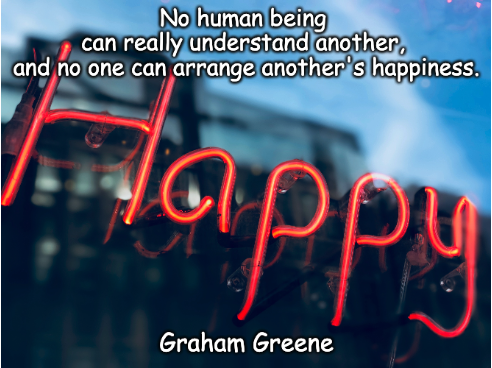
No human being can really understand another, and no one can arrange another’s happiness.
Photo by Stan B
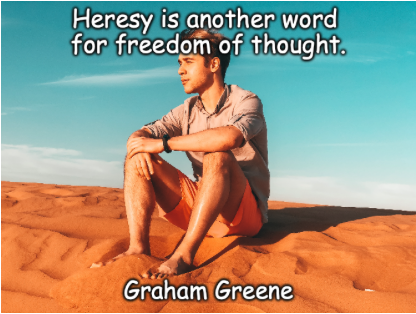
Heresy is another word for freedom of thought.
Photo: Pavel Kalenik. Meaning 🤔: The core of this statement lies in the relationship between “heresy” and “freedom of thought”. Heresy: Traditionally, this refers to views or doctrines that differ from established or orthodox teaching, especially within religious contexts. A “heretic” was someone who deviated from prevailing dogma and was often seen as a threat to authority. Freedom of Thought: This is a fundamental right that states that every individual has the right to have his or her own thoughts, beliefs, opinions and ideas without fear of censorship, punishment or coercion. The statement suggests that what is labeled “heresy” in one context is simply the expression of independent thinking in another. It implies that questioning established norms and forming divergent ideas is not inherently bad, but rather a manifestation of intellectual freedom and independence. It can be seen as a plea for critical thinking and against conformity. Origin and Author ✒️: Indeed, the quote “Heretics are another word for freethinkers” (or a similar formulation) is often attributed to Graham Greene. However, it is important to qualify that it is not a direct, explicit quote that you will find in those exact words in one of his novels or essays. It is more of a paraphrase or interpretation of the ideas that Greene often explored in his works, especially in novels in which he tested the boundaries of faith, morality and human nature. Greene was fascinated by figures who fell outside social or religious norms—the “heretics” in various forms—and often sympathized with their struggles and unconventional thinking. Why the association with Greene? Character Analysis: Greene’s characters are rarely black and white. Many of them are morally ambiguous, struggling with faith, doubt and sin, but often find their own form of truth or salvation outside the box. This fits well with the idea that a “heretic” is simply a “freethinker.”Theological Themes: Although Greene was Catholic, he often explored the dark sides of faith, doubt and apostasy. He challenged conventional views of holiness and sin, creating space for redefining “heresy.” Influential thinkers: Greene stood in a tradition of thinkers who pushed the boundaries of orthodoxy. Thus, it is more likely that this quote is a succinct summary of Greene’s philosophy and the themes in his work, rather than a literal statement. It captures the spirit of his research into the complexity of faith and human autonomy.
A pretty reason perhaps why novelists more and more try to keep a distance from journalists is that novelists are trying to write the truth and journalists are trying to write fiction.
Photo by Ivan Samkov
Champagne, if you seeking the truth, is better than a lie detector.
Photo by Cottonbro
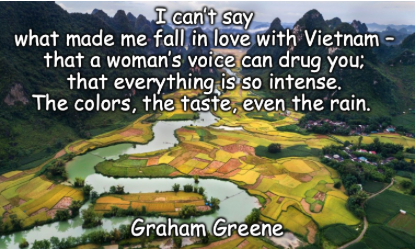
I can’t say what made me fall in love with Vietnam – that a woman’s voice can drug you; that everything is so intense. The colors, the taste, even the rain.
Photo by quotes-about-vietnam
Door Pieter
Mensenmens, zoon, echtgenoot, vader, opa.
Spiritueel, echter niet religieus.
Ik hou van golf, wandelen, lezen en de natuur in veel opzichten.
Onderzoeker, nieuwsgierig, geen fan van de mainstream media (MSM).