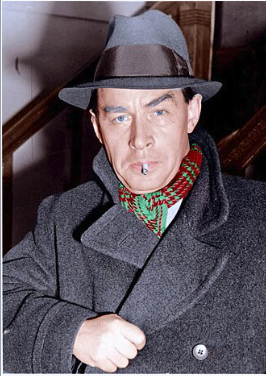
Erich Maria Remarque, whose real name was Erich Paul Remark (Osnabrück, 22 June 1898 – Locarno, 25 September 1970).
German novelist, best known for “Im Westen nichts Neues” (“All Quiet on the Western Front”; 1929) and other (anti-)war novels. After his German citizenship was revoked by the Nazi regime in 1938, he acquired that of the United States of America in 1947. In 1967, his country of birth awarded him the Großes Bundesverdienstkreuz.
Only the hospital shows what war is.
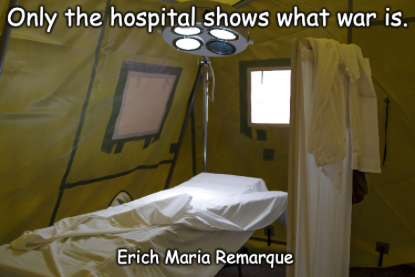
– On the battlefield, war often appears as ‘fight, command, survive, move’.
– In the ‘hospital’, however, you see the actual truth of the war:
– mutilated bodies,
– pain,
– amputations,
– dying,
– psychological destruction,
– the long-term suffering of the soldiers.
The sentence therefore debunks any romantic or heroic idea of war. He says: ‘The true balance of the war is not seen in reports of victory, but in the wounded and dying.
📖 Origin:
The sentence comes from Erich Maria Remarque’s novel:
> “Nothing new in the West”
> published 1928/1929
There the first-person narrator Paul Bäumer experiences the First World War as a young German soldier. In a hospital scene it becomes particularly clear to him what war really means.
The sentence is essentially related to Paul’s stay in the hospital, where he is confronted with the massive suffering of wounded soldiers.
✍️ The literary author is:
> Erich Maria Remarque
> 1898–1970
Within the novel, the insight is attributed to the narrator Paul Bäumer.
Important: It is ‘not actually an old saying’, but a ‘literary quote’ that can be used like a proverb.
🪖 Relation to Remarque’s life:
Remarque himself was a soldier in the First World War. He was wounded on the Western Front in 1917 and was taken to a hospital. These experiences probably flowed into his novel.
That’s why the sentence is so powerful: it is not just an abstract anti-war statement, but is based on the experience of a generation that experienced war in a physically and mentally destructive way.
I used to think everyone was against war until I found out there were some for it; especially the ones that don’t have to go.
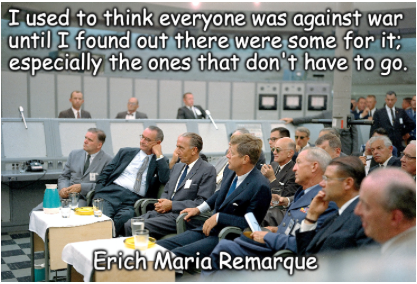
‘The sentence thrives on the contrast between expectation and reality.’ One would assume that aversion to war is universal—who would willingly condone suffering, death, and destruction? However, Remarque exposes a bitter truth: there are indeed proponents of war, and disproportionately so among those who don’t have to go to the front themselves—for example, politicians, military strategists, or decision-makers who decide on or fuel wars without experiencing the consequences firsthand.
The crux of the matter, therefore, lies in the ‘contrast between abstract approval from a safe distance and concrete suffering in the trenches.’ This ties in with Remarque’s central theme: the discrepancy between the war enthusiasm of those who stay home and the actual horrors faced by soldiers at the front.
Origin:
The quote is not from a novel, but from a television interview. Remarque uttered it on January 28, 1963, in conversation with Friedrich Luft on Sender Freies Berlin (SFB). It was broadcast on February 3, 1963, as part of the television series “Das Profil.” It is therefore a spontaneous, spoken statement by the then 64-year-old, not a literary phrase from one of his works.
The exact wording varies slightly online (sometimes “have to go there,” sometimes “must go there,” sometimes “have to go inside”) – typical of orally transmitted quotes that were later written down and copied many times. The most widespread version is “…especially those who don’t have to go there.”
Author: Erich Maria Remarque (1898–1970), German writer. He himself fought as a young soldier in the First World War and processed this trauma in his famous anti-war novel “All Quiet on the Western Front” (1929). The later interview quote can be read as a pointed, aphoristic summary of this lifelong conviction – the attribution to Remarque is therefore authentic and not a misattribution, as often occurs with internet quotes.
