Nachman of Breslov:
(Hebrew: רַבִּי נַחְמָן מִבְּרֶסְלֶב Rabbī Naḥmān mīBreslev), also known as Rabbi Nachman of Breslev, Rabbi Nachman miBreslev, Reb Nachman of Bratslav, Reb Nachman Breslover (Yiddish: רבי נחמן ברעסלאווער Rebe Nakhmen Breslover), and Nachman from Uman (April 4, 1772 – October 16, 1810).
Founder of the Breslov Hasidic movement. He was particularly known for his creative parables, drawing on Eastern European folktales to infuse his teaching with deeply kabbalistic yet universally accessible remedies, pieces of advice, and parabolic stories. He emphasized finding and expressing one’s uniqueness while steering away from despair in a world he saw as becoming more and more uniform. Through Martin Buber’s translation, his teaching is thought to have influenced some 20th-century writers, including Franz Kafka.
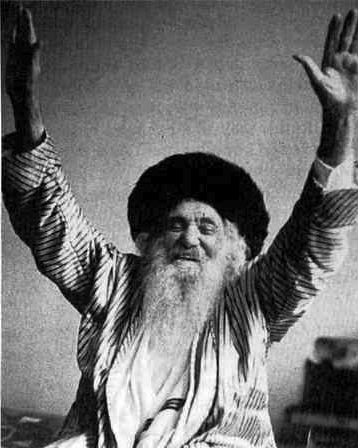
Whenever a treaty of peace is signed, God is present.
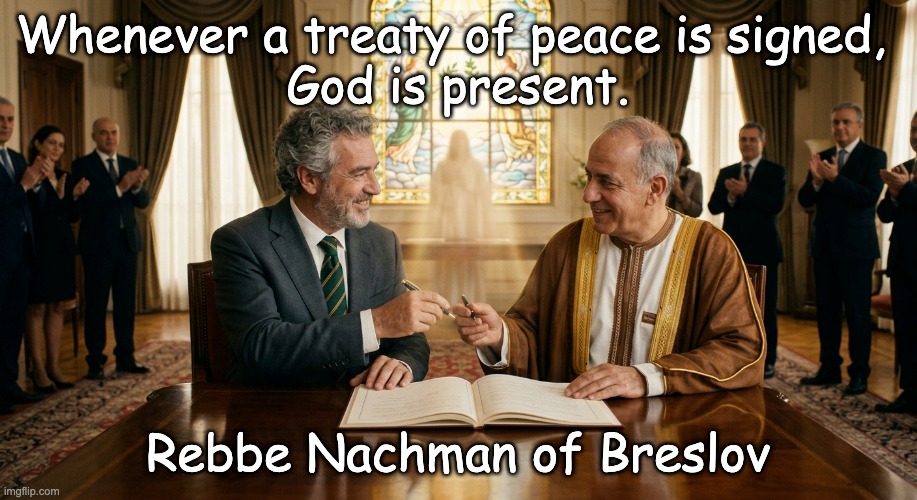
The saying reflects a core idea in Rebbe Nachman’s thought:
That peace (‘shalom’) is not merely a human political arrangement but carries a spiritual, sacred dimension. For Nachman, peace was one of the highest values, closely tied to truth and to the presence of the Divine (the Shechinah) in the world. He taught elsewhere that “the essence of peace is to merge two opposites” and that “where there is no peace, prayers are not heard.” In that context, saying God is “co-signed” onto a peace treaty means that genuine reconciliation between enemies is itself a sacred act — one in which the Divine presence becomes manifest. Peace-making mirrors God’s own unifying, reconciling nature, so a peace treaty carries not just legal but sacred weight.
Origin:
The saying circulates in English as:
“Whenever a treaty of peace is signed, God is present” (sometimes rendered as “A peace treaty is always co-signed by God”).
It’s often labeled a “Yiddish saying” because Nachman taught and spoke in Yiddish in daily life, but strictly speaking it isn’t an anonymous Yiddish folk proverb (unlike something like “Man plans, God laughs”). Rather, it comes from the corpus of Hasidic teachings attributed to him, recorded chiefly in Hebrew by his scribe and chief disciple, Reb Nathan of Breslov (Nathan Sternhartz), in works like “Likutei Moharan” and related collections of his sayings and stories.
– A caution:
I could not trace this specific line to an exact passage in “Likutei Moharan” or “Sichot HaRan” — it circulates widely on quote-aggregator sites with this attribution, but it may be a later paraphrase or loose translation of his teachings on peace rather than a verbatim quotation. Treat the precise wording/sourcing with some caution, even though the general attribution is fairly consistent across sources.
Author:
Rebbe Nachman of Breslov (1772–1810)
— Hasidic master, great-grandson of the Baal Shem Tov, and founder of the Breslov Hasidic movement, active in Ukraine.
