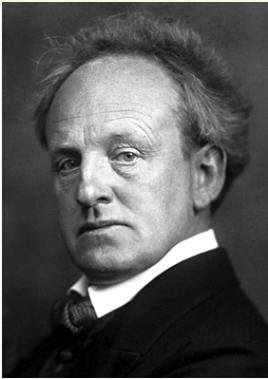
Gerhard Johann Robert (Gerhart) Hauptmann:
(Obersalzbrunn (Lower Silesia), November 15, 1862 – Agnetendorf near Hirschberg, Polish occupation zone, June 6, 1946).
German playwright. Initially, he wrote realistic dramas, in which he focused on the dire situation of the poor; later, he also wrote more symbolic plays and works based on Greek mythology. He is considered a co-founder of German naturalism. In 1912, he received the Nobel Prize for Literature. For some time, he belonged to the Friedrichshagener Kreis, a circle of intellectuals in Berlin.
Civilization is coercion, culture: freedom.
You best recognize by his questions whether a person is smart.
The saying states: It is not a person’s answers that reveal their intelligence, but the questions they ask. Asking good, precise, insightful questions demonstrates that one has grasped a topic, recognizes connections, and knows where the real uncertainties lie. A clever answer can be memorized or chosen by chance – a clever question, however, requires genuine understanding because it necessitates recognizing what one doesn’t yet know.
Author: Gerhart Hauptmann
This quote is indeed attributed to Gerhart Hauptmann, the German playwright and novelist (1862–1946), who received the Nobel Prize in Literature in 1912, in almost all German quotation collections.
However – and this is important – the relevant quotation portals (which all list this sentence in virtually identical wording) do not provide a precise source: no title of the work, no year, no context. This is a common problem with aphorism collections on the internet: A sentence has been circulating for decades attributed to a well-known author, without any way to definitively prove its precise origin within the complete works. I would therefore classify the attribution to Hauptmann as “common, but not verified by primary sources.”
Related/parallel versions:
Interestingly, there are almost identical versions attributed to other authors:
– Gaston de Lévis (French aristocrat and aphorist, 1764–1830): “Whether a person is wise can be judged much better by their questions than by their answers.” This formulation likely originates from his “Maximes et réflexions” (1808) – in the French original, a similar idea (“On peut juger de l’esprit d’un homme par ses questions…”) is documented much earlier than the German collections would suggest.
– Naguib Mahfouz (Egyptian Nobel laureate): “Whether a person is wise can be recognized by their questions.”
– There is even a contrasting version: “Whether a person is clever can be recognized by their answers.”
This suggests that it is a “migratory thought”—an idea that has been reformulated in different languages and eras and attributed to various prominent figures, similar to many other popular quotations (see, for example, the phenomenon of so-called “quotation migration,” where a thought is attached to different authors over centuries).
Conclusion: The attribution to Hauptmann is the dominant one in German-language sources and should be unproblematic for everyday purposes (speeches, essays, quotations). However, for a scientifically sound reference (e.g., in a philological work), I would recommend searching for the original passage in a critical edition of Hauptmann’s works or an index of his aphorisms/diaries, as the online quotation collections themselves do not provide a reliable source.
There are productive errors and unproductive truths.

This sentence paradoxically reverses the usual value system of truth and error: A ‘productive error’ is a false assumption that nevertheless leads us forward—it stimulates new questions, provokes refutation, and advances knowledge. An ‘unproductive truth’ is correct, but banal and inconsequential—a truism without any cognitive value. The point: The value of a statement is not measured by its truth content, but by its fruitfulness for thought.
Origin:
The circulating short form “There are productive errors and unproductive truths” is presumably a later refinement of an original sentence that read differently:
> “There are very few productive truths, but all the more productive lies and errors.”
The likely source is the later collection of aphorisms “Insights and Perspectives. Aphorisms” (first published in 1942).
Author:
Gerhart Hauptmann (1862–1946)
German dramatist and novelist, Nobel laureate in Literature 1912. The attribution is consistently supported by several independent sources and fits with related Hauptmann aphorisms of the same motif, such as “He who errs more deeply, also becomes more deeply wise.”
