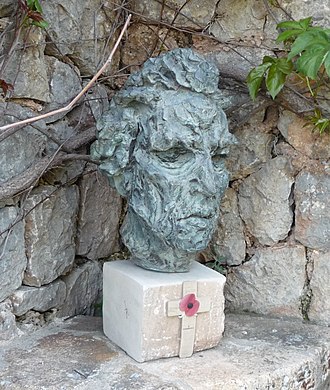
Robert Graves:
(Wimbledon (London), 24 July 1895 – Deià in Majorca, 7 December 1985).
English poet and writer. In his long life, he accounted for 140 works. His best-known work is the historical novel I, Claudius, but Graves considered himself first and foremost a poet.
No need for a bowl or silver spoon, sugar or spice or cream. Has the wild berry plucked in June beside the trickling stream.
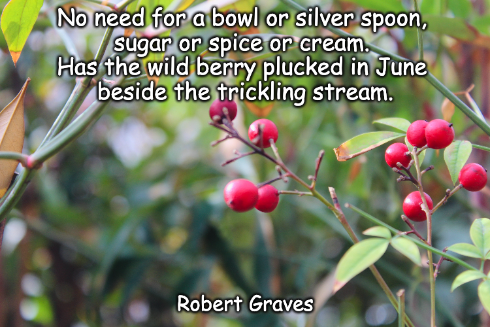
The poem extols the superiority of the wild and unadulterated over the cultivated and refined. A wild berry, picked in June beside a brook, needs no bowl, spoon, sugar, spices, or cream — it is naturally perfect. One such berry, melting on the tongue, surpasses an entire basket of garden fruit. The message is simultaneously a broader philosophy of life: the real and simple triumphs over the polished and artificially dressed.
Origin:
The text is a stanza from the poem “Strawberries,” published in the collection “Country Sentiment” (1920). Graves wrote this lyrical, rural poetry shortly after the First World War, as a counterweight to the horrors of war he had experienced as a soldier. Simple country life and fresh nature are a recurring theme of solace and purity in that collection.
Author:
Robert Graves (1895–1985), British poet, novelist, and classicist. He is best known for his war memoirs “Goodbye to All That” (1929) and the historical novel “I, Claudius” (1934), but was also regarded in his time as one of the most important English-language lyricists.
