Samuel Butler:
(Strensham, Worcestershire, 3 February 1612 – London, 25 September 1680).
English poet who gained fame primarily for his satirical work “Hudibras”. Little is known about his life. He appears to have served as secretary to various gentlemen, including Samuel Luke, a Puritan colonel under Oliver Cromwell and commander of, amongst others, John Bunyan.

In law, nothing is certain but the expense.
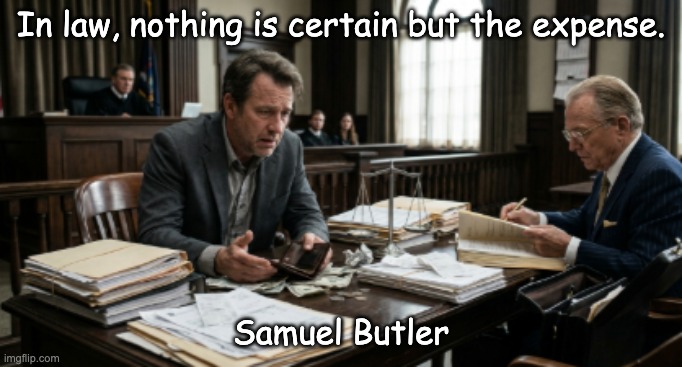
– ⚖️ ‘Legal matters are unpredictable’ — the outcome of a lawsuit or legal dispute is often uncertain.
– 💸 ‘The one thing you can count on is cost’ — lawyers’ fees, court costs, delays, and related expenses are almost guaranteed.
– 😏 It is a ‘wry or cynical comment’ on the legal system, suggesting that litigation often becomes expensive regardless of who wins.
In simple words:
> ‘You may or may not win in court, but you will almost certainly have to spend money.’
✍️ Author:
The saying is generally attributed to Samuel Butler (1612–1680), the English poet and satirist.
👤 Author: Samuel Butler
– 📖 Work: “Hudibras”
– 🗓️ Date: commonly linked to the later part of the poem, published in the 17th century (Part III in 1678)
🏛️ Origin:
The quotation is usually traced to Butler’s satirical poem “Hudibras”.
– “Hudibras” is a mock-heroic poem that often pokes fun at society, politics, and institutions.
– The line is remembered in the form:
> “In law, nothing is certain but the expense.”
⚠️ Note:
This is often cited as a ‘standard modern wording’. With older quotations, the exact phrasing can vary slightly across editions and later retellings.
💡 Interpretation:
The proverb reflects a long-standing public attitude toward the law:
– 📂 cases can drag on
– 🧾 legal procedures can be complex
– ⏳ justice may take time
– 💰 the financial burden can be heavy
So the saying warns that ‘going to law may cost a great deal, even if the result is unclear’.
