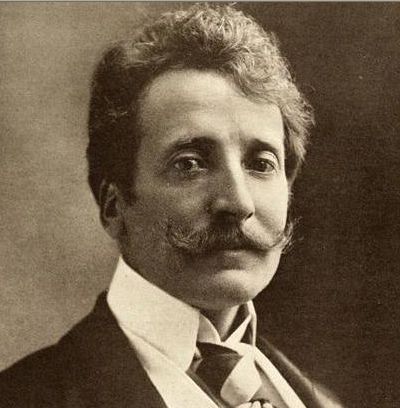
Georges Rodenbach:
(Tournai, 16 July 1855 – Paris, 25 December 1898),
French-speaking Belgian writer and poet. Georges Rodenbach was one of the first prominent Belgian literary figures to embrace French symbolist poetry. Although he died at the age of forty-three, Georges Rodenbach occupies a prominent place in the history of international symbolism, with his poetry collections Le Règne du Silence (1891), Les Vies encloses (1896), Le Miroir du ciel natal (1898), and his famous novel Bruges-la-Morte from 1892. He was a cousin of Albrecht Rodenbach.
The widower reviewed his past in a sunless light which was intensified by the greyness of the November twilight, whilst the bells subtly impregnated the surrounding atmosphere with the melody of sounds that faded like the ashes of dead years.
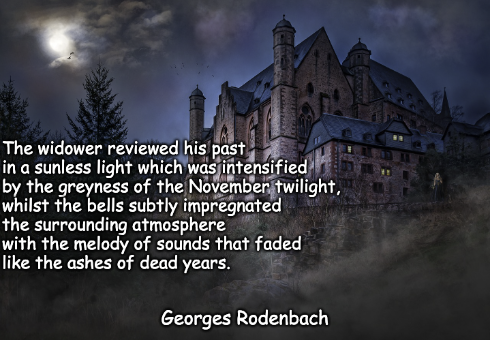
The passage describes how the setting intensifies the widower’s grief:
– “Sunless light” and “the greyness of the November twilight”:
evoke emotional darkness, age, loss and approaching death.
– The ‘bells permeating the atmosphere’:
suggest that the whole city participates in his mourning.
– Their fading notes are imagined as ‘dust or ashes’: symbolizing the remains of the years he spent with his dead wife.
– Past happiness has been consumed by time; only memories remain, like ashes after a fire.
This is characteristic of Rodenbach’s ‘Symbolism’: Bruges is not merely a background but a reflection—or psychological double—of Hugues’s bereavement. The silent canals, grey streets, churches and bells embody his interior world.
📖 Origin and author:
The sentence derives from Georges Rodenbach’s Symbolist novel “Bruges-la-Morte” (“Bruges-the-Dead”), first published in 1892. It occurs near the beginning of Chapter I and refers to the protagonist, Hugues Viane, a widower mourning his wife.
Rodenbach’s French reads:
> “Ce jour-là, le veuf évoquait plus douloureusement son passé, à cause du temps gris de novembre où les cloches, semblait-il, épandaient dans l’air des poussières de sons, la cendre morte des années.”
A fairly literal translation would be:
> “That day, the widower recalled his past more painfully because of the grey November weather, in which the bells seemed to scatter particles of sound through the air—the dead ashes of the years.”
The English sentence you quote is therefore an ‘expansive literary translation or paraphrase’, not Rodenbach’s exact wording. The translator cannot be identified with certainty without knowing the edition or source in which that wording appeared.
