Friendships are the family we make – not the one we inherit. I’ve always been someone to whom friendship, elective affinities, is as important as family.
Photo by Anemone123
One of the problems with defending free speech is you often have to defend people that you find outrageous and unpleasant and disgusting.
Photo by ivabalk
It seems that the right of freedom of speech that was enshrined in numerous constitutions is now under attack by religious institutions.
Photo by Enrique
Something was badly amiss with the spiritual life of the planet. Too many demons inside people claiming to believe in God.
Photo by Leopictures
The moment you declare a set of ideas to be immune from criticism, satire, derision, or contempt, freedom of thought becomes impossible.
Photo: Gundula Vogel. Meaning💡: The quote means that free thinking is only possible if ideas may be criticized, ridiculed, or questioned. As soon as certain beliefs or ideologies are ‘placed above criticism’, open debate is restricted. The statement therefore makes a distinction between: respect for individuals, and the openness to criticism of ideas. 📰 Origin: The quote appeared in English as: “The moment you declare a set of ideas to be immune from criticism, satire, derision, or contempt, freedom of thought becomes impossible.” It was published in the ‘Los Angeles Times’ on February 7, 2005. It came from the opinion piece: “Democracy Is No Polite Tea Party”. The context is the debate regarding: freedom of speech, satire, criticism of religion and ideology, and democratic public access. 👤 Author: The author of this quote is Salman Rushdie. He is an Indian-born British writer, born in 1947. This specific quote is sometimes incorrectly attributed to Rowan Atkinson, but the correct source is Rushdie.
Two things form the bedrock of any open society – freedom of expression and rule of law. If you don’t have those things, you don’t have a free country.
Photo: Gerd Altmann. Meaning:The quote contains two inextricably linked pillars: “Freedom of speech” — the space to express ideas, even controversial ones, without fear of persecution or violence. Without this, public debate is stifled and power cannot be criticized. “The rule of law” — the principle that everyone, including the government itself, is bound by the law. This protects citizens against arbitrariness and abuse of power. Rushdie argues that these two things ’together’ form the foundation: freedom of speech without the rule of law leads to chaos or impunity for threats; a rule of law without free speech can become an instrument of oppression. Only in combination do they make a society truly free. Origin: Rushdie speaks here from personal experience. He has experienced firsthand, like no other, what happens when freedom of speech and the rule of law are threatened — not abstractly as a philosopher, but as someone who was on a hit list for decades. His statement is not an academic proposition, but a conclusion drawn from a life full of personal danger. Source:“The Satanic Verses” (1988). That novel led to an infamous ‘fatwa’ — a religious death curse — pronounced by Ayatollah Khomeini of Iran in 1989. Author:Salman Rushdie (born 1947 in Mumbai) is a British-Indian writer, best known for his . Rushdie lived in hiding for years under police protection. In 2022, he was stabbed during a lecture in New York and lost an eye.
Free speech is the whole thing, the whole ball game. Free speech is life itself.
Photo: Tumisu. 💡 Meaning✅: The saying means that ‘free speech is not just one political right among many — it is central to human freedom and society itself’. In simpler terms: – 🗣️ ‘Free speech allows people to think, question, criticize, create, and dissent.’ – ⚖️ Without it, democracy, literature, art, journalism, and intellectual life are weakened. – 🎯 “The whole ball game” is an idiom meaning ’the most important thing; the central issue’. – ❤️ “Free speech is life itself” suggests that the ability to express oneself is essential to living fully as a human being. 🧠 Overall Interpretation: Rushdie is saying that ‘freedom of expression is foundational’. If people cannot speak freely — including saying unpopular, controversial, or offensive things — then true freedom cannot exist. 📚 Origin / Context: – The quotation is widely attributed to Salman Rushdie. – It is usually connected with Rushdie’s writings and speeches defending ‘freedom of expression’, especially after the controversy surrounding his 1988 novel “The Satanic Verses”. – The line is often cited from or associated with his essay/lecture “Is Nothing Sacred?”, collected in “Imaginary Homelands: Essays and Criticism 1981–1991”. 👤 Author: – Salman Rushdie – Indian-born British-American novelist and essayist – Best known for works such as “Midnight’s Children” and “The Satanic Verses”.
What is freedom of expression? Without the freedom to offend, it ceases to exist.
Photo by Steve Buissinne
Freedom to reject is the only freedom.
Photo by Luisella Planeta
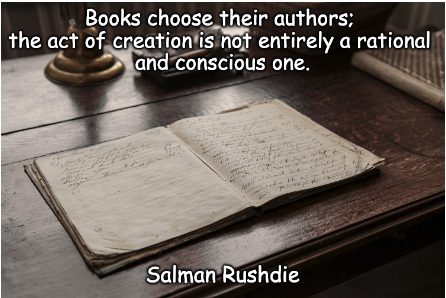
Books choose their authors; the act of creation is not entirely a rational and conscious one.
Photo by Dim Hou
Door Pieter
Mensenmens, zoon, echtgenoot, vader, opa.
Spiritueel, echter niet religieus.
Ik hou van golf, wandelen, lezen en de natuur in veel opzichten.
Onderzoeker, nieuwsgierig, geen fan van de mainstream media (MSM).