Cecil Day-Lewis:
(Ballintubber, County Mayo, Ireland, 27 April 1904 – Hadley Wood, Enfield, England, 22 May 1972).
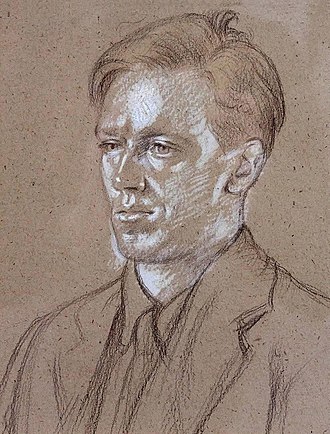
Irish-English poet and prose writer. In 1968, he was appointed British Poet Laureate to succeed John Masefield. He published under the name C. Day Lewis; under the pseudonym Nicholas Blake, he wrote 20 detective novels.
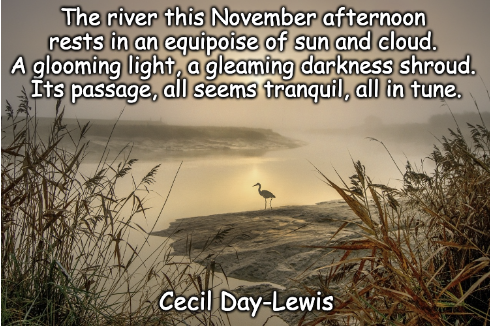
The river this November afternoon rests in an equipoise of sun and cloud. A glooming light, a gleaming darkness shroud. Its passage, all seems tranquil, all in tune.
In June, we picked the clover. And seashells in July. There was no silence at the door, no word from the sky.
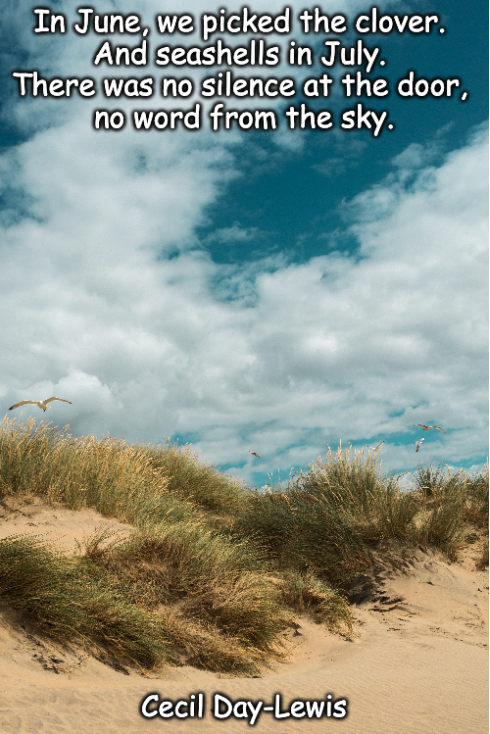
This is an elegy, almost certainly written for a child or young person whose death came suddenly. The poem uses the calendar as a kind of countdown — innocent summer activities (picking clover, gathering shells) give way to an abrupt, silent death in August. The absence of “silence at the door” and “word from the sky” emphasizes that there was no omen, no divine warning — death simply arrived, unannounced and unnegotiable. The closing lines (in the original) underscore the swiftness of the loss: there wasn’t even time for the ordinary human responses to grief — bargaining, self-pity, moral reflection, or prayer. It’s a meditation on the arbitrariness and suddenness of mortality.
Origin:
The stanza comes from the collection “Overtures to Death and Other Poems” (1938). The book’s title signals its overall preoccupation with mortality, written in the years just before the Second World War, against a backdrop of encroaching conflict and personal loss. Your quoted version is a slightly altered rendering — the wording is very close to the original but not word-for-word identical.
Author:
Cecil Day-Lewis (1904–1972), often written as C. Day-Lewis, was an Anglo-Irish poet who served as British Poet Laureate from 1968 until his death in 1972. He also wrote detective novels under the pen name Nicholas Blake. He was the father of actor Daniel Day-Lewis and of documentary filmmaker/chef Tamasin Day-Lewis.
