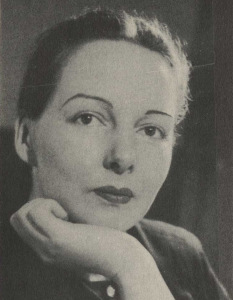
Mary Frances Kennedy Fisher Parrish Friede:
(July 3, 1908 – June 22, 1992).
Writing as M.F.K. Fisher, was an American food writer.
She was a founder of the Napa Valley Wine Library. Over her lifetime she wrote 27 books, among them Consider the Oyster (1941), How to Cook a Wolf (1942), The Gastronomical Me (1943) and a translation of Brillat-Savarin’s The Physiology of Taste. Fisher believed that eating well was just one of the “arts of life” and explored this in her writing. W. H. Auden once remarked, “I do not know of anyone in the United States who writes better prose.”
In 1991 the New York Times editorial board went so far as to say, “Calling M.F.K. Fisher, who has just been elected to the American Academy and National Institute of Arts and Letters, a food writer is a lot like calling Mozart a tunesmith. At the same time that she is celebrating, say, oysters (which lead, she says, ‘a dreadful but exciting life’) or the scent of orange segments drying on a radiator, she is also celebrating life and loneliness, sense and sensibility.”
Wine and cheese are ageless companions, like aspirin and aches, or June and moon, or good people and noble ventures.
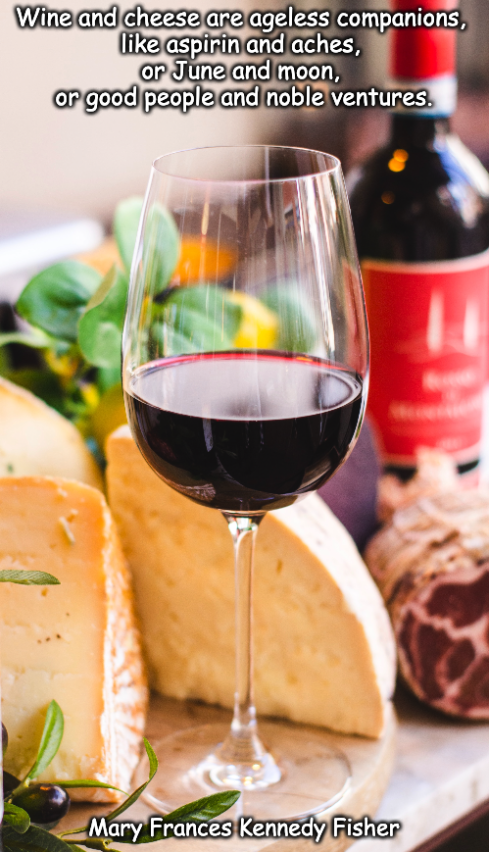
The saying means that ‘wine and cheese naturally belong together’: it is a classic, almost self-evident combination.
The comparison works with pairs that “fit together”:
– “aspirin and aches and pains” → one functionally belongs with the other: aspirin for pain.
– “June and moon” → in English ‘June and moon’: an old-fashioned, romantic rhyming combination from songs and poetry.
– “good people and noble enterprises” → good people fit good, lofty goals.
In short: ‘wine and cheese are timeless partners; their combination feels natural, traditional, and harmonious.’
✍️ Author:
The saying is generally attributed to: M. F. K. Fisher. Full name: Mary Frances Kennedy Fisher
Lived: 1908–1992
Nationality: American
Known as: culinary writer, essayist, and one of the most influential English-language authors on food and gastronomy.
📚 Origin:
It is ‘not an old folk saying’, but rather a ‘literary-culinary aphorism’ from the twentieth century. It originates from, or is at least associated with, the gastronomic essays of M. F. K. Fisher, particularly her work on food, taste, and table culture, as collected in books such as “The Art of Eating”.
