William Morris

William Morris:

(Walthamstow, London, 24 March 1834 – London, 3 October 1896).
Chief designer and utopian thinker of 19th-century England. He is widely regarded as the founder of the fantasy genre. He is best known as the spiritual father of the arts-and-crafts movement. He was a versatile man: he was involved in literature, designing, printing and publishing books, designing wallpaper, textiles, tiles, carpets, furniture, stained glass and interiors.
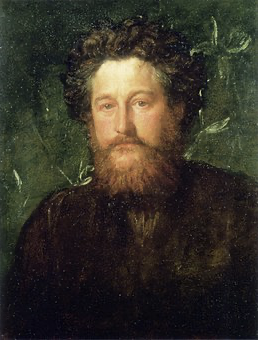
William Morris. Photo: wikipedia.org

How the wind howls this morn / About the end of May, / And drives June on apace / To mock the world forlorn / And the world’s joy passed away…
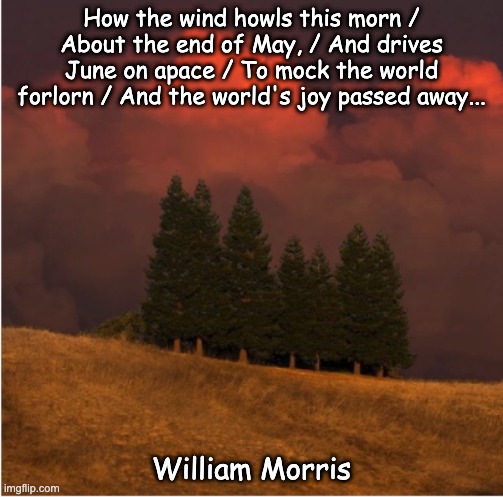
Image: Peter van Geest AI. Meaning:
The poem is a meditation on ‘melancholy and the cruelty of seasonal transition’. The howling wind at the end of May isn’t joyful spring energy — it’s driving June in too fast, as if mocking a speaker who feels out of step with the world’s renewal. Key themes:
‘Alienation’: the speaker’s face is “unlonged-for” — he feels unwanted, invisible to the world’s joy.
‘Sleep as false refuge’: dreams offer brief escape from grief, but waking only brings new delusions — “more lying tales to weave, more hope to perish soon.”
– ‘The bitter irony of hope’: the poem ends not with comfort but with the cycle of hope and disappointment repeating endlessly.
Origin:
The lines come from a poem titled “The End of May,” published in 1891 in the collection “Poems by the Way” — it is poem number 36. The collection was written during Morris’s period of deep involvement in socialist politics and the Arts and Crafts movement. The poem uses a ‘concatenation’ or chain-verse structure, where each stanza picks up the last line of the previous one, giving it a spiralling, obsessive quality that mirrors the mood.
Author:
William Morris (1834–1896) .
He is best known today as a designer, craftsman, and socialist activist, but he was also a prolific poet. This poem is characteristic of his literary voice: natural beauty (wind, dawn, the turning of seasons) thrown into sharp relief against inner desolation and longing.

Yes, May is come, and its sweet breath shall well-nigh make you weep today, and pensive with swift-coming death, shall ye be satiate of the May.
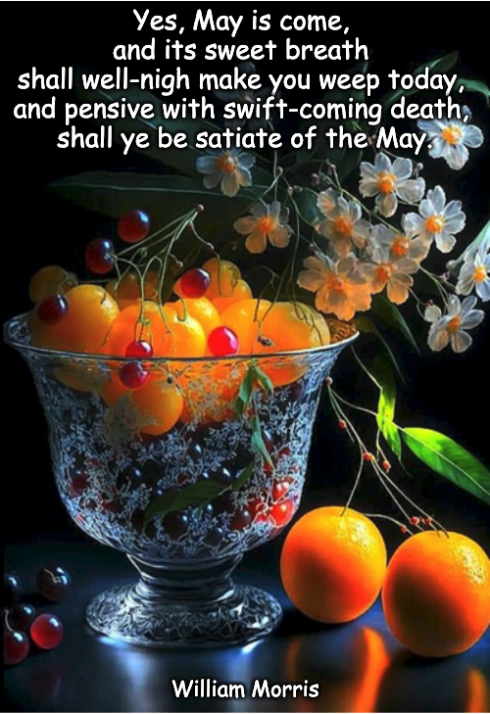
Photo by evangeliear

Late February days, and now, at last, might you have thought that winter’s woe was past so fair the sky was and so soft the air.
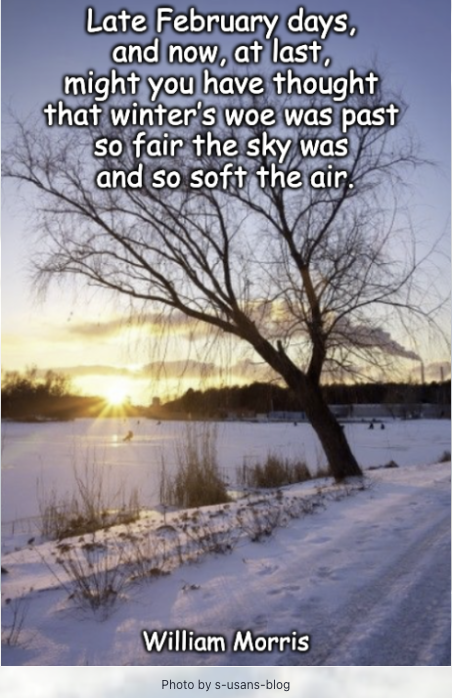
🧠 Meaning 🌤️: It is the end of February and the weather is so mild and the sky so clear that you could almost think: the winter misery is over. The phrasing “Might you have thought…” also suggests a nuance: you can think it, but it could still be an illusion (winter could return). ✅ Author: William Morris (1834–1896) is the author of the original passage. The attribution (Collected Works, Volume 6, p. 279) fits a reprint/edition of Morris’ work (often compiled/edited posthumously). 📚 Source: William Morris — Collected Works, Volume 6, p. 279. Original (English) passage: “The last February days; and now, at last, / Might you have thought that winter’s woe was past, / So fair the sky was, and so soft the air. …” March: Its motto, “Courage and strength in times of danger.”
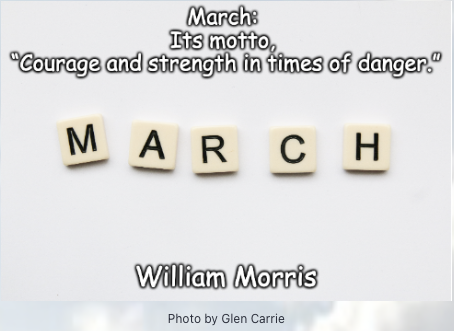
March: It’ s motto: “Courage and strength in times of danger.”


Meaning:  The gist is clear: March symbolizes a transitional period between winter and spring, a time of uncertain, harsh weather conditions — a metaphor for challenging times in life. The motto calls for remaining steadfast in such moments: not with bravado, but with true inner strength and courage. The quote is therefore not a standalone saying about courage in general, but specifically intended as a motto for the month of March. The double meaning—march  as both a month and “marching” —is perfectly suited to a motto about courage and strength in perilous times. Author:  William Morris (1834–1896). William Morris was a British artist, designer, writer, and social activist, and one of the founders of the Arts and Crafts movement. He was also politically active (a socialist) and a strong believer in courage as a civic virtue. It is likely that he wrote this motto as part of a calendar or essay about the months of the year, a popular genre in the Victorian era. Source note: This quote circulates widely on the internet as attributed to William Morris, but a primary source—a specific book, essay, or poem—is difficult to trace. The attribution seems reliable, but should be treated with some caution: as is often the case with Victorian quotes, the exact provenance (which work, which year) is not always documented.

Door Pieter

Mensenmens, zoon, echtgenoot, vader, opa. Spiritueel, echter niet religieus. Ik hou van golf, wandelen, lezen en de natuur in veel opzichten. Onderzoeker, nieuwsgierig, geen fan van de mainstream media (MSM).

Geef een reactie

Je e-mailadres wordt niet gepubliceerd. Vereiste velden zijn gemarkeerd met *