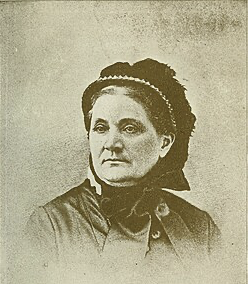
Lucy Larcom:
(March 5, 1824 – April 17, 1893).
American teacher, poet, and author.
She was one of the first teachers at Wheaton Female Seminary (now Wheaton College) in Norton, Massachusetts, teaching there from 1854 to 1862. During that time, she co-founded Rushlight Literary Magazine, a submission-based student literary magazine which is still published. From 1865 to 1873, she was the editor of the Boston-based Our Young Folks, which merged with St. Nicholas Magazine in 1874. In 1889, Larcom published one of the best-known accounts of New England childhood of her time, A New England Girlhood, commonly used as a reference in studying antebellum American childhood; the autobiographical text covers the early years of her life in Beverly Farms and Lowell, Massachusetts.
June falls asleep upon her bier of flowers. In vain are dewdrops sprinkled o’er her, in vain would fond winds fan her back to life, her hours are numbered on the floral dial.
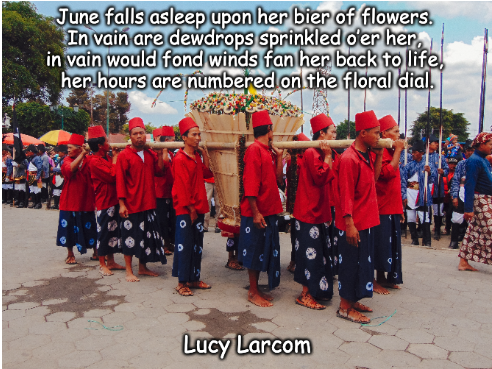
The poem personifies the month of June as a dying woman falling asleep on her own bier of flowers — a bier she made herself, for this is the most beautiful month of the year. The image is melancholic yet serene: June faces death without resistance.
The individual images:
– “Her bier of flowers” — June dies on the lush flowers she herself produced; the abundance is simultaneously her grave.
– “In vain are dewdrops sprinkled over her” — dew, the classic symbol of refreshment and new life, cannot save her.
– “In vain do winds try to awaken her to life” — the wind, symbol of breath and spirit, is equally powerless. – “Her hours are numbered on the floral dial” — this refers to the so-called ‘horologium florae’ or flower clock, a concept dating back to the Swedish botanist Linnaeus: he observed that various flowers open and close at fixed times of the day, so that, in theory, one can read time from nature.
It is essentially an elegy for the transience of the most beautiful month, in the spirit of nineteenth-century American transcendentalism: nature as an animated, dying queen, beautiful precisely ‘because’ she perishes.
Origin:
The text is the opening quatrain of the poem “The Death of June”. The poem continues with the arrival of her sister July — impatient, with glowing lips and outstretched arms — but her hot breath causes the blossoms to wither. June is dead, but it is a peaceful death: she has woven her most cheerful wreaths herself for her own funeral. What remains are wild geraniums by the brook, laurel in the woods, and water lilies that open barely in time to grant June one last glimpse. It appeared in prominent magazines such as “Harper’s” and “The Atlantic Monthly”.
Author: Lucy Larcom (1824–1893).
An American poet, abolitionist, and teacher from Beverly, Massachusetts. Her father, a sailor, died early, after which her mother moved the family to Lowell. Larcom began working in textile factories at the age of eleven, where her poems and stories first appeared in periodicals such as the “Lowell Offering”. Later, she became a teacher, first in Illinois and then at Wheaton Seminary in Norton, Massachusetts. She belonged to the circle of poet John Greenleaf Whittier and wrote from a deeply transcendentalist and religious sense of nature as a mirror of the divine.
When April steps aside for May, like diamonds, all the raindrops glisten, fresh violets open every day to some new bird, each hour we listen.
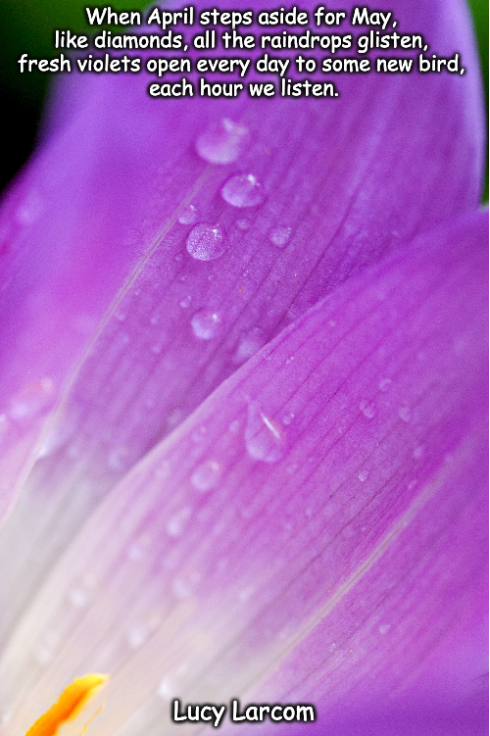
– “When April steps aside for May”
– April makes way for May;
– late spring transitions into a fuller, warmer flowering season.
– “all raindrops sparkle like diamonds”
– spring rain is not depicted gloomily, but as something beautiful and precious;
– a typical romantic image of nature.
– “fresh violets open every day”
– flowers represent renewal, growth, and daily blossoming.
– “for a new bird, every hour that we listen”
– every hour brings a new sound, a new birdsong;
– this emphasizes liveliness, anticipation, and attention to nature. 🖋️ Origin: As far as this quote can be traced:
– it is ‘probably a translation or paraphrase’ of an English verse line;
– it is ‘not really a proverb’ in the classical sense;
– it is usually associated with ’19th-century nature poetry’.
The probable English form reads roughly:
“When April steps aside for May,
like diamonds all the raindrops glisten;
fresh violets open every day;
to some new bird each hour we listen.”
👩🏫 Author: Lucy Larcom (1824–1893) fits well here.
Who was she?
– American poet, writer, and educator
– known for:
– nature lyric
– religious and moral poetry
– poems for younger readers and anthologies
Why this attribution is plausible:
– the tone is typically ’19th-century, melodious, and nature-oriented’
– Lucy Larcom indeed wrote a lot about ‘seasons, flowers, and birds’;
– these lines are often attributed to her poem ‘May’. ⚠️ Small nuance: Because such rules often end up in:
– anthologies,
– textbooks,
– quotation sites,
– and translated collections,
they sometimes circulate in ‘slightly deviating versions’. As a result:
– the precise wording may differ;
– the translation may be free;
– the source may sometimes be quoted without context.
So it is safest to say: It is probably not an old saying, but a poetic quote, usually attributed to Lucy Larcom, presumably from the poem “May”.
