Non tutti siamo nati per fare i dottori.
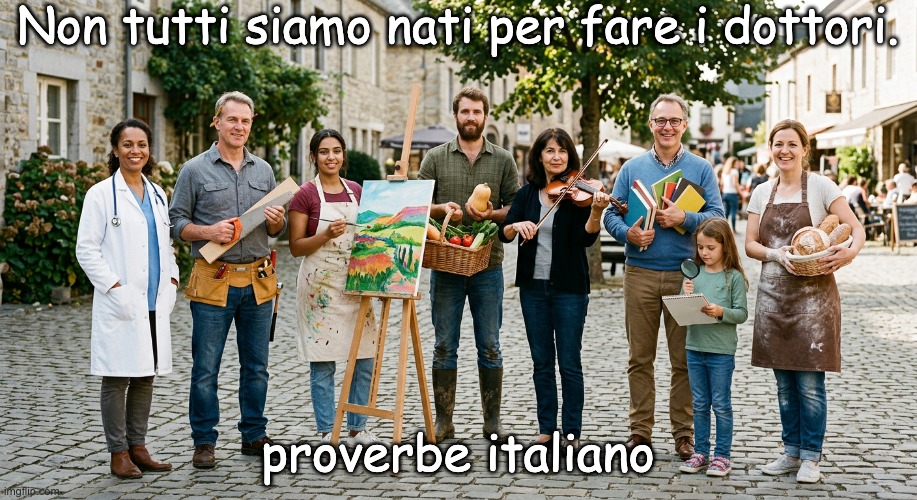
– non tutti hanno le stesse capacità, inclinazioni o possibilità;
– non tutti sono portati per lo studio, le professioni prestigiose o intellettuali;
– ogni persona può avere un talento diverso e un ruolo diverso nella vita.
In senso più ampio, il detto invita a riconoscere che ‘non esiste un’unica strada valida per tutti’: qualcuno può diventare medico, avvocato o professore, altri possono essere portati per lavori manuali, artistici, pratici o tecnici.
Può essere usato anche in modo un po’ autoironico, per dire:
> “Non sono un esperto, faccio quello che posso.”
📌 Origine:
L’origine è ‘popolare e proverbiale’. Non risulta appartenere a un’opera letteraria precisa né a un autore famoso.
Il termine “dottore” nella tradizione italiana non indicava solo il medico, ma più in generale una persona istruita, laureata o appartenente a una professione considerata prestigiosa. Per questo “fare il dottore” è diventato simbolo di una carriera colta, rispettata e socialmente elevata.
Il detto nasce probabilmente in ambiente familiare o popolare, dove si voleva sottolineare che ‘non tutti sono destinati agli studi o alle professioni alte’, ma che ogni mestiere ha dignità.
✍️ Autore: L’autore è da considerarsi ‘anonimo’.
È un modo di dire tramandato oralmente, con varianti simili come:
– “Non tutti possono fare i dottori.”
– “Non siamo mica tutti dottori.”
– “Ognuno è portato per qualcosa.”
– “Non tutti sono fatti per studiare.”
As soon as a law or rule is introduced, there’s a loophole.
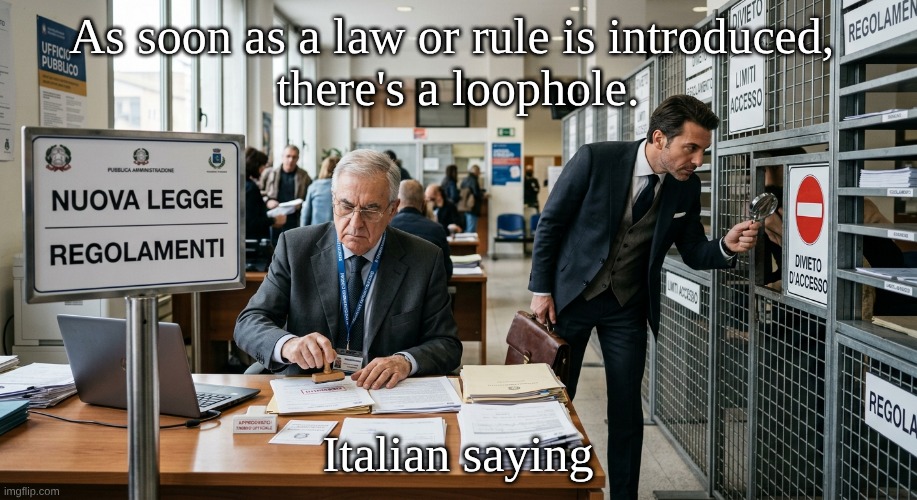
– “As soon as a rule or law is introduced,”
– “Someone immediately finds a way around it,”
– exploiting its loopholes, ambiguities, or exceptions.”
👉 In other words:
It means that human ingenuity is often used not only to comply with the rules, but also to circumvent them without openly violating them.
✅ Example:
– A new tax is introduced.
– Some people find a legal way to avoid paying it altogether.
➡️ “As soon as a law is made, there’s a loophole.”
🏛️ Origin:
The expression is a very old Italian proverb, born from observation of social and legal reality.
Some key points:
– It derives from the “popular proverbial tradition”;
– It reflects a centuries-old idea:
“Every rule also generates attempts to circumvent it”;
– It is linked to the culture of law, bureaucracy, and practical cunning.
📜 Historical context:
The proverb spread in an Italy where:
– There were many local and administrative rules;
– People were accustomed to dealing with prohibitions, taxes, and constraints;
– The “art of making do” was seen as a frequent response to impositions.
✍️ Author: “It has no specific author.”
It is, in fact, an “anonymous popular proverb,” therefore:
– It is not attributed with certainty to a specific writer or philosopher;
– It belongs to “popular wisdom”;
– It was passed down orally and then included in collections of proverbs.
⚠️ Note:
Sometimes similar proverbs are generically linked to legal tradition or ancient wisdom, but “there is no universally recognized author for this specific formula.”
💬 Modern paraphrase:
– “Every rule has those who try to exploit its loopholes.”
– “Where there’s a rule, there’s often a way around it.”
