Aristotle:
(Ancient Greek: Ἀριστοτέλης, Aristotélēs)
(Stageira, 384 BC – Chalkis, 322 BC).
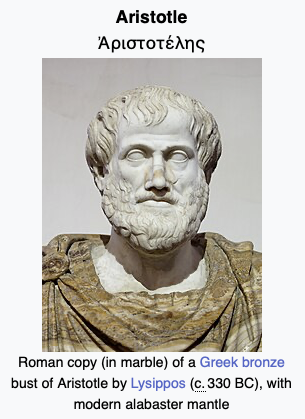
Greek philosopher and scholar who, with Socrates and Plato, is considered one of the most influential classical philosophers in the Western tradition. He was a member of Plato’s philosophical Akademeia, and his influence is therefore present in Aristotle’s work, but the philosophical movement represented by Aristotle, Aristotelianism, differs markedly from Platonism, Plato’s philosophical teaching. His teacher was Plato, but Aristotle founded or significantly influenced numerous disciplines, including philosophy of science, natural philosophy, logic, biology, medicine, physics , ethics , political theory and poetry theory .
To appreciate the beauty of a snowflake it is necessary to stand out in the cold.
Criticism is something you can easily avoid by saying nothing, doing nothing, and being nothing.
The worst form of inequality is to try to make unequal things equal.

Those that know, do. Those that understand, teach.
The purpose of knowledge is action, not knowledge.
it is necessary to be rather an arbitrator than a party to the dispute.
The least deviation from truth will be multiplied later.
Music serves for diversion, for education, for the stimulation of mind and heart, and for the liberation of the soul from the passions.
Poverty is the parent of revolution and crime.
Be a free thinker and don’t accept everything you hear a truth. Be critical and evaluate what you believe in.

Business, you know, may bring you money, but friendship hardly ever does.

Without friends no one would choose to live, though he had all other goods.

We are what we repeatedly do. Excellence, then, is not an act, but a habit.
We cannot change the wind, but we can set the sails differently.
And therefore justice is often thought to be the greatest of virtues, and ‘neither evening nor morning star’ is so wonderful; and proverbially ‘in justice is every virtue comprehended’.
Aristotle means that ‘justice is not just one virtue among others’. It is, in a special sense, the ‘complete virtue expressed toward other people’.
Why justice is “the greatest of virtues” ⚖️
For Aristotle:
– A person may be brave, temperate, generous, etc. in themselves.
– But ‘justice requires virtue in relation to others’.
– Justice governs how we treat fellow citizens, friends, strangers, and the community.
– Therefore, justice “contains” or “sums up” the other virtues when they are practiced socially.
So justice is “complete virtue” because it is virtue ‘put into action in human relationships’.
🌟 “Neither evening nor morning star…”
The phrase:
> “neither evening nor morning star is so wonderful”
refers to the beauty and brilliance of the ‘evening star’ and ‘morning star’ — both names for the planet Venus, known in Greek as Hesperus and Phosphorus/Eosphorus.
Aristotle uses this poetic image to say:
> Justice is more splendid, admirable, and precious than even the brightest star in the sky.
📚 Origin and author:
– Author: Aristotle
– Work: Nicomachean Ethics_
– Book: V / 5
– Chapter: 1
– Bekker number: 1129b25–30
🏛️ Is the proverb Aristotle’s own?
Not entirely. Aristotle introduces part of it as proverbial:
> “and proverbially we say…”
The line:
> “In justice is every virtue comprehended”
is usually connected with Theognis of Megara, an earlier Greek elegiac poet, especially Theognis, line 147:
> “In justice, all virtue is summed up.”
So:
– Aristotle is the source of the philosophical discussion.
– The proverb itself likely comes from ‘earlier Greek poetic tradition’, especially ‘Theognis’.
– The “evening and morning star” phrase is also probably a poetic or proverbial quotation, though its exact original source is uncertain.
All men by nature desire knowledge.
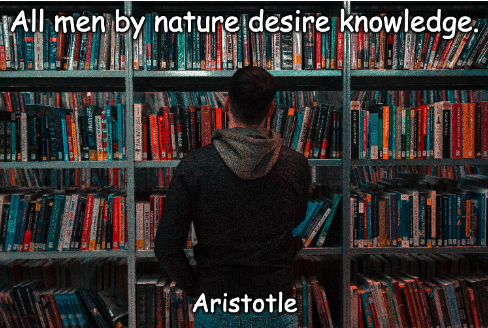
Aristotle is saying that the desire for knowledge is ‘natural to humans’.
In other words:
– Humans naturally want to ‘understand the world’.
– We seek knowledge not only for practical use, but also because knowing is satisfying in itself.
– Curiosity is part of human nature.
– Our love of learning begins with the senses, especially ‘sight’, because seeing helps us distinguish and understand things.
📚 Origin / Source:
The line appears at the very beginning of Aristotle’s work:
> “Metaphysics”, Book I, Chapter 1
> Greek reference: 980a21
In Greek, it is:
> **Πάντες ἄνθρωποι τοῦ εἰδέναι ὀρέγονται φύσει**
A common translation is:
> “All human beings by nature desire to know.”
Older translations often render “anthrōpoi” as “men,” but the meaning is closer to “human beings” or “people.”
🧠 Context in Aristotle:
Right after this opening sentence, Aristotle explains that humans delight in their senses, especially vision:
– We enjoy seeing things even when we do not need them for survival.
– Sight gives us more knowledge than the other senses.
– This shows that knowledge is valuable to us by nature, not only as a tool.
This idea sets up Aristotle’s larger discussion of ‘wisdom’, ‘causes’, and ‘first principles’ in the “Metaphysics”.
👤 Author:
– Aristotle
– Greek philosopher, 384–322 BCE
– Student of “Plato” and teacher of “Alexander the Great”
Man is by nature a political animal.
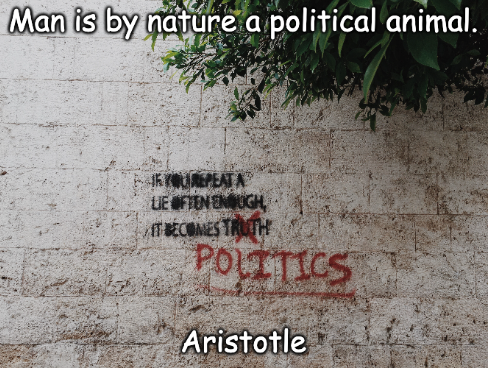
Aristotle does ‘not’ mean that humans naturally enjoy elections, parties, or modern politics.
He means:
– Humans are naturally ‘social beings’.
– We are meant to live in ‘communities’, not in isolation.
– Human life reaches its fullest form within a ‘polis’, or organized society.
– Because humans have ‘speech and reason’, they can discuss justice, morality, law, and the common good.
– Therefore, political/community life is part of human nature.
🏛️ Context:
For Aristotle, a person who lives completely outside society is either:
– ‘less than human’, like a beast, or
– ‘more than human’, like a god.
In other words, ordinary human beings need community to become fully human.
✨ Simple Explanation:
> Human beings naturally live together, form societies, make laws, and seek the common good. Politics, in Aristotle’s sense, is a natural part of human life.
📍 Origin:
– Original Greek idea: “anthrōpos physei politikon zōon.”
– Commonly translated as:
– “Man is by nature a political animal”
– “Human beings are by nature political animals”
– “A human being is naturally a social/political creature”
📖 Source:
– Aristotle, “Politics”, Book I, around 1253a.
– Aristotle writes that the ‘polis’ — the city-state or political community — exists by nature, and humans naturally live within such communities.
👤 Author:
– The saying is attributed to Aristotle — the ancient Greek philosopher.
Nature does nothing in vain.
‘Everything in nature has a purpose, function, or reason for being’.
In other words, nature does not create organs, instincts, behaviors, or forms uselessly or randomly.
It reflects a ’teleological’ view of nature — the idea that natural things are directed toward ends or purposes.
Example:
Aristotle argues that animals have certain body parts because those parts serve functions: eyes for seeing, wings for flying, teeth for chewing, etc.
👤 Author: Aristotle.
It is not always found as one single fixed English sentence, because it comes through translation from Greek, but Aristotle expresses this idea many times.
A common Greek form is:
> ‘ἡ φύσις οὐδὲν ποιεῖ μάτην’
> ‘hē physis ouden poiei matēn’
> “Nature does nothing in vain.”
📚 Origin / Sources:
1. Aristotle, “Politics”, Book I
One famous passage appears in “Politics” I.2, where Aristotle discusses why humans have speech:
> “Nature, as we say, does nothing in vain…”
He uses this to argue that because humans alone possess speech, speech must have a natural purpose — namely, to express ideas of justice, good and evil, and to enable political life.
📍 Reference: Aristotle, “Politics” 1253a
2. Aristotle, “Parts of Animals”
Aristotle also repeats the same principle in his biological writings, especially when explaining the functions of animal organs.
📍 Reference: Aristotle, “Parts of Animals”
Here the idea is central to his biology: animal structures exist because they serve some function.
3. Related Latin Form
In later medieval philosophy, especially among scholastic thinkers, the phrase was often rendered in Latin as:
> “Natura nihil frustra facit”
> “Nature does nothing in vain.”
or
> “Natura nihil agit frustra”
> “Nature does nothing without purpose.”
These Latin versions helped make the saying famous in European philosophy and theology.
🧠 Philosophical Significance
For Aristotle, nature is not merely mechanical or accidental. Natural things develop toward their proper ends:
– 🌱 An acorn naturally tends toward becoming an oak tree.
– 👁️ Eyes exist for seeing.
– 🐦 Wings exist for flight.
– 🗣️ Human speech exists for rational and social life.
This is part of Aristotle’s broader doctrine of ‘final causes’ — explanations based on purpose or end.
Poetry is finer and more philosophical than history for poetry expresses the universal, and history only the particular.
– ‘History’ tells us ‘what actually happened’ — specific events involving specific people at specific times.
– Example: “Alexander defeated Darius at the Battle of Issus.”
– ‘Poetry’ — by which Aristotle means imaginative literature, especially tragedy and epic — shows ‘what could or would happen’ according to human nature, probability, or necessity.
– Example: ‘A tragic hero falls because of pride, error, or fate.’
So poetry is “more philosophical” because it reveals ‘general truths about life, character, action, and human nature’, not merely isolated facts.
In short:
> ‘History records events; poetry reveals patterns and meanings.’
👤 Author: Aristotle.
📚 Origin / Source:
It comes from Aristotle’s “Poetics”, especially Chapter 9.
A common translation of the relevant passage is:
> “Poetry is more philosophical and more serious than history; for poetry speaks more of universals, history of particulars.”
Reference:
> Aristotle, “Poetics”, Chapter 9, 1451b
🏛️ Context in Aristotle’s “Poetics”:
Aristotle is discussing the nature of poetry and tragedy. He argues that the poet’s task is ‘not simply to say what happened’, but to present what ‘might happen’ according to:
– probability
– necessity
– human character
– universal patterns of action
That is why a poet may be “truer” in a philosophical sense than a historian, even when inventing events.
🔍 “Universal” vs. “Particular”:
– ‘The universal:
Means general truths such as:
– how ambitious people behave
– how pride can lead to downfall
– how jealousy, fear, love, or revenge affect human action
– how certain choices produce certain consequences
– ‘The particular’:
Means individual facts such as:
– what a named person did
– when a specific battle occurred
– what happened in one historical situation
⚠️ Important Note:
Aristotle is ‘not saying history is useless or false’. Rather, he is saying that poetry can reach a more general and philosophical kind of truth because it represents ‘human possibilities and universal patterns’, not just recorded facts.
So the idea is:
> ‘History tells us what happened once; poetry tells us what tends to happen always.’
Friendship is a single soul dwelling in two bodies.
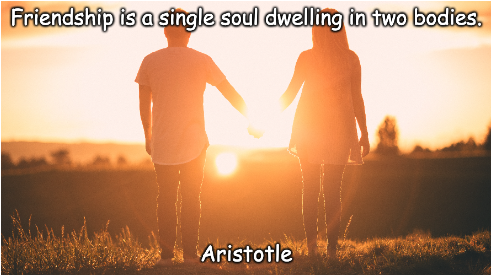
– 🤝 ‘True friendship is a deep connection’ between two people.
– 💛 Friends understand each other so well that it feels as if they share one inner life.
– 🧭 They often have shared values, trust, loyalty, and mutual care.
– 👥 It is not meant ‘literally’:
two people remain individuals, but are emotionally and morally strongly connected to each other.
🏛️ Origin:
The saying is ’traditionally attributed’ to Aristotle:
> “What is a friend? A single soul dwelling in two bodies.”
The source often cited is Diogenes Laërtius, a writer from the 3rd century AD, in his work “Lives and Opinions of Eminent Philosophers”, in the section on Aristotle.
There, according to tradition, Aristotle is asked what a friend is, to which he is said to have answered:
> “One soul dwelling in two bodies.” 👤 Author: Aristotle?
✅ The saying is often attributed to Aristotle.
⚠️ But with a caveat:
It does not appear ‘literally like that’ in Aristotle’s surviving major works, such as the “Nicomachean Ethics”. The formulation comes via later tradition, especially with Diogenes Laërtius, who lived centuries after Aristotle.
What does clearly fit Aristotle, however, is the idea that a friend is a kind of “other self”. In his ethics, he describes true friendship as a relationship in which people wish each other well for the sake of the other person.
📚 Philosophical background:
For Aristotle, friendship — Greek: ‘philia’ — is very important. He distinguishes, among other things:
– ⚖️ ‘Friendship of utility’: you are friends because you benefit from each other.
– 😊 ‘Friendship of pleasure’: you enjoy each other’s company. – 🌟 ‘Friendship based on virtue’: the highest form, based on mutual respect, goodness, and character.
The saying fits especially that last form: ’true friendship between people who truly know and appreciate each other’.
One swallow does not make a summer.
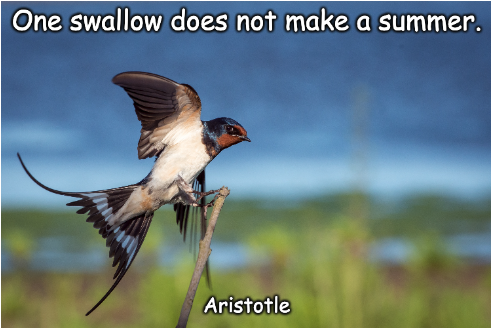
> ‘One favorable sign or one positive event is not proof that everything is permanently good or that a trend has truly begun.’
In other words:
do not jump to conclusions too quickly based on a single example.
Example:
– If a company makes a profit for one month, that does not mean it is financially healthy.
– If it is warm for one day in March, it is not really summer yet.
🏛️ Origin:
The expression dates back to ‘classical antiquity’, particularly to the idea that a ‘swallow’ is a sign of warmer weather. But one swallow returning early does not mean that the warm season has truly begun.
The original thought was often rather:
> *One swallow does not make a spring.”
✍️ Author: Aristotle?
Yes, the best-known and oldest literary source is indeed Aristotle — often misspelled as ‘Aistoteles’.
In his “Nicomachean Ethics”, Book I, Aristotle uses a similar formulation:
> “For just as one swallow or one beautiful day does not make a spring, so one day or a short time does not make a person happy and prosperous.”
📌 Important nuance:
Aristotle is probably ‘not the originator’ of the saying. He presumably uses it as a proverb or metaphor already known at the time. Therefore, you can say:
– Oldest known source: Aristotle
– ‘Probable author: unknown / folk wisdom from ancient Greece’.
– Became known via:
Aristotle and later Latin and European proverb collections
📚 Related version
The same expression exists in English:
> “One swallow does not make a summer.”
And in Latin, one encounters forms such as:
> “Una hirundo non facit ver”
> “One swallow does not make a spring.”
Happiness belongs to the self-sufficient.
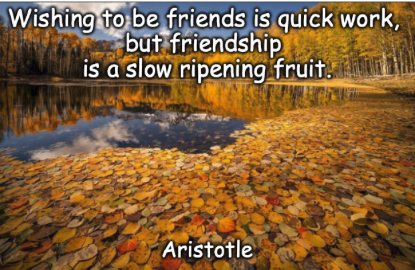
Wishing to be friends is quick work, but friendship is a slow ripening fruit.
There is only one way to avoid criticism…do nothing, say nothing and be nothing.
True friendship is love for the other, for the sake of the other.
The only thing you achieve with lying is not being believed when you tell the truth.
Attributed to Aristotle: Traditionally, this wisdom is attributed to the great Greek philosopher Aristotle (384–322 BC). It fits well within his virtue ethics, in which honesty and truthfulness are important virtues. Source: Diogenes Laërtius: The saying cannot be found in the preserved direct writings of Aristotle himself. We know the statement primarily through Diogenes Laërtius (3rd century AD) and his monumental work “Lives and Teachings of Famous Philosophers”. Uncertainty: Diogenes Laërtius was a biographer who wrote centuries ‘after’ the facts. He collected anecdotes, sayings, and summaries. It is therefore very likely that this quote is a ‘paraphrase’, a summary, or even a piece of folk wisdom attributed to Aristotle, rather than his literal words. Conclusion: Although it is doubtful whether Aristotle uttered this exact sentence, the saying remains a powerful and valuable summary of ancient philosophical thoughts on the value of truth and the destructive nature of falsehood.
Doing a good deed is easy; developing the habit of doing it all the time is not.
You need a bit of luck to be happy.
Friendship is one soul in two bodies.
There are three types of friendship in life:
Love each other for a reason – Friends for a season – Friends for life. ❤️
A friend to all is a friend to none.
Man is a social animal, he is not made to live alone.

If you know what is right, there is almost nothing else you can do.