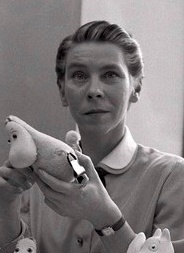
Tove Marika Jansson:
(Helsinki, 9 August 1914 – ibid., 27 June 2001).
Swedish-speaking Finnish author, painter and illustrator of children’s books and comic strips, among other things, and author of the series of books and comic strips about the Moomins. A large part of her work has been translated into Dutch since the 1970s by Cora Polet (pseudonym of C.W. Appel, 1930-2016). In 2007, the Belgian publisher Clavis relaunched the series in a new translation by Maaike Lahaise.
Along with Astrid Lindgren and Lennart Hellsing, Jansson is considered one of the so-called “giants” of Swedish-language children’s literature, who focused on the world and imagination of children.
One evening in August, you have an errand outdoors, and all of a sudden, it’s pitch-black. It is still summer, but the summer is no longer alive.
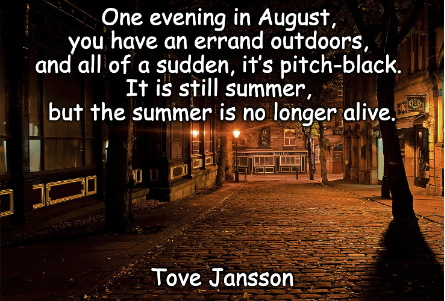
The line means that ‘late summer can end emotionally before it ends on the calendar’.
– It is ‘still August’, technically still summer.
– But suddenly the evenings are dark again.
– The warmth and freedom of high summer feel gone.
– “The summer is no longer alive” suggests a mood of ‘loss, melancholy, and seasonal transition’ — the moment you realise autumn is approaching.
It captures that very Nordic/Baltic feeling of a summer that is brief, intense, and then abruptly begins to fade.
📚 Origin & Author:
– Author: Tove Jansson
– Work: The Summer Book
– Original title: Sommarboken
– Language: Swedish
– Published: 1972
– English translator: Thomas Teal
The commonly quoted English version is:
> “One evening in August you have an errand outdoors, and all of a sudden it’s pitch-black. It is still summer, but the summer is no longer alive.”
🌿 Context:
“The Summer Book” is a quiet, poetic novel about a young girl and her grandmother spending summer on a small island in the Gulf of Finland. The book is full of observations about nature, aging, childhood, and the passing of time.
This quote is not really a “saying” or proverb; it is a ‘literary quotation’ from Jansson, often shared because it so perfectly describes the emotional end of summer.
August is the border between summer and autumn. It is the most beautiful month I know.
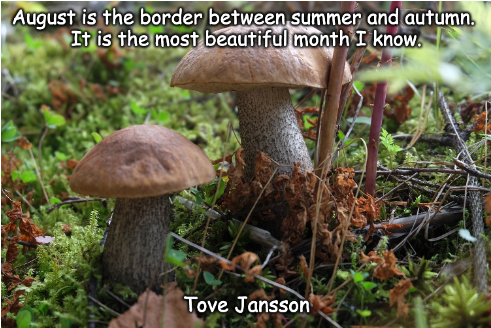
The quote is a meditation on liminality — the idea that in-between, transitional states are more beautiful and emotionally charged than the stable states on either side of them. August isn’t quite summer anymore, but not yet autumn either; twilight isn’t day or night; the shore is neither sea nor land. Jansson extends the thought by saying a border is a kind of longing — that unspoken moment when two things have fallen for each other but haven’t yet said so — and that a border is really about being on the way, since it’s the journey itself that matters most. It’s a bittersweet idea: something is ending, something else hasn’t quite begun, and that unresolved, not-yet-spoken quality is where she finds the beauty.
Origin:
The line comes from her novel “Moominvalley in November” (Sent i november, 1970) — the final, most melancholic Moomin book, written in the aftermath of her mother’s death. Notably, the Moomin family itself never appears in this book; instead a group of lonely, displaced characters gather at their empty house, which suits the book’s themes of absence and waiting.
(Note: some quote sites mistakenly attribute the line to “Moominland Midwinter” instead — “Moominvalley in November” is the correct and more reliably cited source.)
Author:
Tove Jansson (1914–2001), the Finnish-Swedish author and artist best known for creating the Moomin books, as well as adult novels like “The Summer Book” and “Fair Play”.
