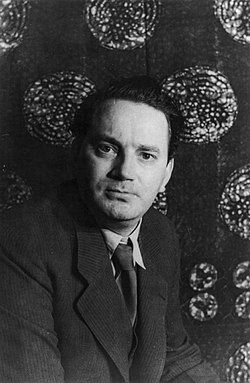
Thomas Clayton Wolfe:
(Asheville, North Carolina, 3 October 1900 – Baltimore, 15 September 1938).
American writer.
Wolfe studied at the University of North Carolina at Chapel Hill and later at Harvard University. From 1924 to 1929, he also taught American literature there, but gave that up to focus entirely on writing. Wolfe travelled to Europe on several occasions, including Berlin and Paris, and became acquainted with prominent writers such as Hemingway and Scott Fitzgerald.
All things on earth point home in old October; sailors to sea, travellers to walls and fences, hunters to field and hollow and the long voice of the hounds, the lover to the love he has forsaken.
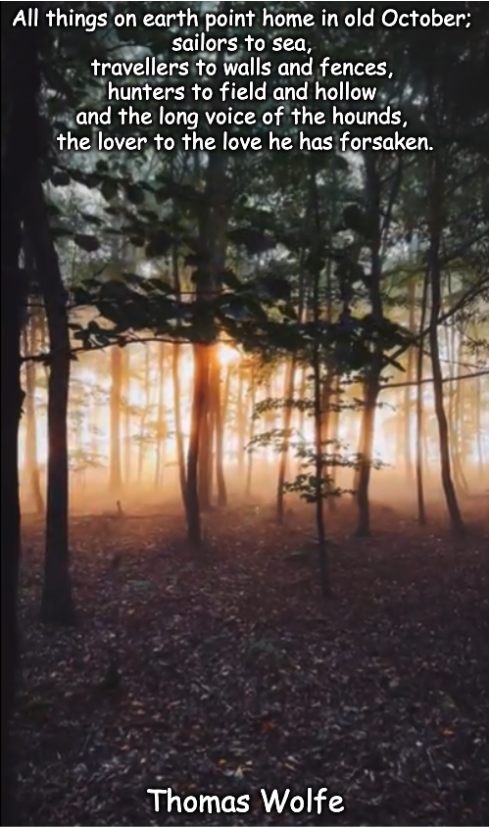
The sentence captures a ‘universal human instinct toward return and belonging’, using October — a transitional, elegiac month — as the emotional backdrop.
Key ideas:
– 🌊 “Sailors to sea”:
— professional identity as a kind of “home”
– 🚶 “Travellers to walls and fences”:
— the pull of settled domestic life after wandering
– 🐕 “Hunters to field and hollow”:
— nostalgia for ritual, nature, and tradition
– 💔 “The lover to the love he has forsaken”:
— even broken or abandoned relationships exert a magnetic, haunting pull
🍁 Central Theme:
Wolfe suggests that ‘autumn stirs a deep, almost involuntary longing’ in all people — not just for literal home, but for whatever represents ‘origin, identity, and emotional truth’. October becomes a symbol of:
– 🕰️ Time passing
– 🏡 The ache of nostalgia
– 🔄 The cyclical pull toward what we’ve left behind, even painfully
💭 Why It Resonates:
Wolfe’s prose is known for its ‘incantatory rhythm’ and ‘list-like structure’, building emotional momentum through repetition (“to… to… to…”). This mirrors the ‘instinctive, almost fated’ nature of homesickness he’s describing — as though all beings, human or otherwise, are drawn by invisible threads back to where they belong.
✍️ Author:
Thomas Wolfe (1900–1938),
American novelist known for his sprawling, lyrical, and emotionally intense prose style, most famous for works like “Look Homeward, Angel” and “Of Time and the River”.
📚 Origin:
– This passage is widely attributed to Wolfe’s meditative writing on the ‘season of October’, a recurring and deeply personal theme in his work.
– It is most commonly associated with “Of Time and the River” (1935), though it also circulates as a standalone piece sometimes simply titled “October.”
– ⚠️ Note:
Because Wolfe’s manuscripts were extensively edited (notably by Maxwell Perkins) and fragments were later compiled posthumously, the ‘exact book/chapter source is sometimes disputed’ among scholars and fans — but the authorship is consistently credited to Wolfe.
Come up into the hills. O, my young love, return! O lost, and by the wind grieved, ghost, come back again. As first, I knew you in the timeless valley where we shall feel ourselves anew, bedded on magic in the month of June.
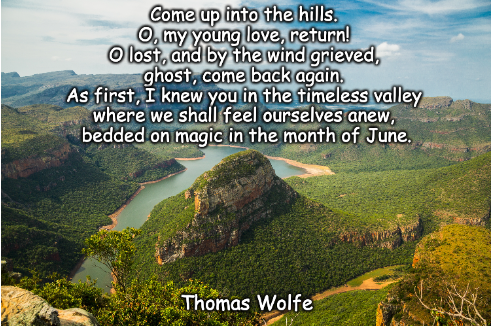
This is ‘not an idiom’ in the usual sense. It is a ‘literary quotation’ written in a poetic, emotional style.
The passage expresses:
– longing for a lost love
– grief for someone or something gone
– nostalgia for youth
– a desire to return to an innocent, beautiful past
The speaker calls out to a “ghost”:
> “O lost, and by the wind grieved, ghost, come back again.”
Here, the “ghost” may mean:
– a dead or absent lover,
– a memory,
– lost youth,
– or the speaker’s former self.
The “hills,” “timeless valley,” and “month of June” suggest a magical, ideal place where love and youth might be recovered.
In simple terms, the passage means:
> “Come back to me, lost love or lost past. Return to the beautiful place where we were once young, happy, and alive.”
Origin 📚:
The best-known line from the passage:
> “O lost, and by the wind grieved, ghost, come back again.”
comes from Thomas Wolfe’s novel:
> “Look Homeward, Angel: A Story of the Buried Life”
It was published in 1929.
The quoted wording belongs to Wolfe’s lyrical, poetic prose style. It appears in the opening/prologue of the novel and is one of his most famous lines.
Author ✍️: Thomas Wolfe.
– Full name: Thomas Clayton Wolfe
– Nationality: American
– Born: 1900
– Died: 1938
– Best known for: “Look Homeward, Angel”, “Of Time and the River”, and “You Can’t Go Home Again”.
