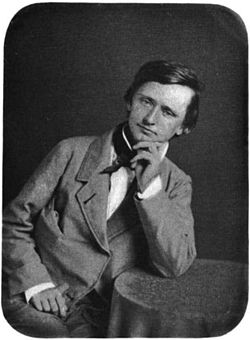
Thomas Buchanan Read:
(March 12, 1822 – May 11, 1872).
American poet and painter.
His portraits include many famous individuals including Robert Browning, Joseph Harrison Jr., William Henry Harrison, Abraham Lincoln, Henry Wadsworth Longfellow, and Alfred Tennyson.
May has come in, young May the beautiful, weaving the sweetest chaplet of the year. Along the eastern corridors, she walks. What time the clover rocks the earliest bee. Her feet a flush with sunrise, and her veil floating in breezy odors o’er her hair.
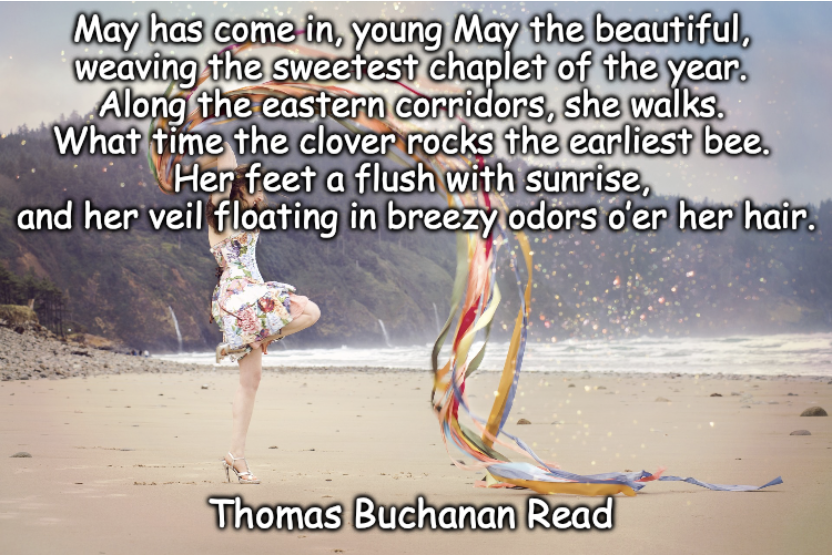
The poem personifies ‘May as a beautiful young woman’ — a goddess-like figure of spring — and its imagery works on several levels:
– “Weaving the sweetest chaplet of the year” — A ‘chaplet’ is a wreath or garland worn on the head. May is depicted as weaving the finest floral crown of all twelve months, suggesting she is the most glorious of the year’s seasons.
– “She walks the eastern pathways / along the eastern corridors” — May arrives from the east, the direction of the sunrise, reinforcing her association with dawning, new beginnings, and light.
– “Where the clover rocks the earliest bee” — A charming, precise natural detail: the clover blossom sways under the weight of the first bee of spring, signifying nature stirring back to life.
– “Her feet blush with the sunrise” — May’s footsteps are tinged with the rosy pink of dawn; she literally ‘is’ the morning light walking across the land.
– “Her veil floats in airy odors” — Her veil is made of fragrant spring breezes, blossoms and perfumed air — she is inseparable from the scents of the season.
Author: Thomas Buchanan Read (March 12, 1822 – May 11, 1872) An American poet and portrait painter born in Chester County, Pennsylvania. He wrote several collections of poetry, and is perhaps best remembered today for his rousing Civil War poem “Sheridan’s Ride.” He was also a talented visual artist — among the portraits he painted were Abraham Lincoln, Henry Wadsworth Longfellow, Alfred Tennyson, Elizabeth Barrett Browning, Robert Browning, and William Henry Harrison.
The Poem:
The passage you quoted is confirmed as Read’s. The lines — “May has come in, young May the beautiful, weaving the sweetest chaplet of the year. Along the eastern corridors, she walks. What time the clover rocks the earliest bee. Her feet a flush with sunrise, and her veil floating in breezy odors o’er her hair” — are attributed to Thomas Buchanan Read. The version you have is very close to this, with minor wording variations typical of 19th-century reprinting (“May is come” vs. “May has come in”, “eastern pathways” vs. “eastern corridors”, etc.) — common differences found when poems were copied into anthologies and gift books by hand.
Overall, the poem captures the ‘Romantic tradition of personifying nature*” treating May not as a mere month but as a living, luminous, almost divine presence ushering in warmth, beauty, and renewal. Read’s style here is lyrical and painterly — which makes sense for someone who was also a visual artist.
