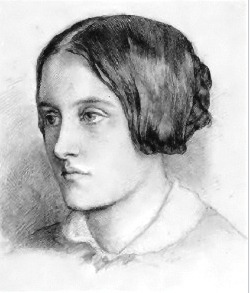
Christina Georgina Rossetti:
(London, 5 December 1830 – there 27 December 1894).
English poet and prose writer.
Much of her work is religious in nature and deals with renunciation of earthly love. Many of her poems also show a preoccupation with death. She posed as a model for a number of paintings by her brother Dante Gabriel Rossetti and other Pre-Raphaelites, although she was not a member of this movement.
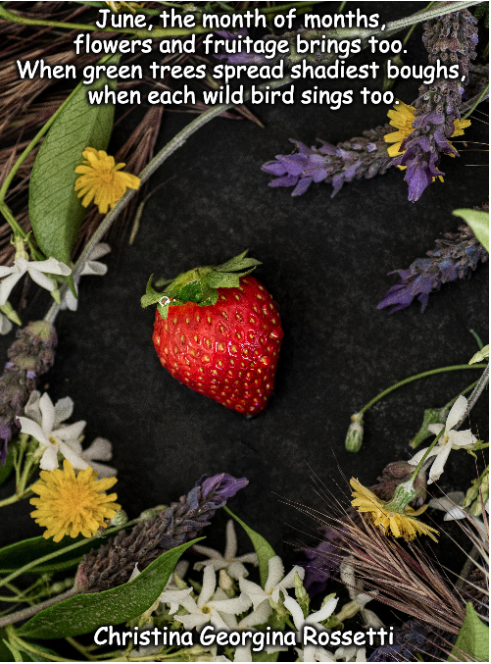
June, the month of months, flowers and fruitage brings too. When green trees spread shadiest boughs, when each wild bird sings too.
The quote primarily expresses that “June” is seen as:
– the ‘most beautiful and richest month’ of the year
– a time of ‘blossom and fertility’
– a month of ‘abundance, shade, birdsong, and summer joy’.
Core of the meaning:
– “the month of months”
– June is elevated above the other months
– “flowers and fruit”
– not only bloom, but also ripening and fullness
– “shady branches”
– image of summer, rest, and shelter
– “every wild bird sings”
– symbol of liveliness and natural joy
👉 In short: it is a ‘poetic hymn to June’ as a month of full natural splendor.
📖 Origin:
The lines are placed within the context of Christina Rossetti’s work on the months of the year.
– In this regard, a connection has primarily been made with her cycle of months and with the dramatic poem “The Months: A Pageant” in which the months appear as characters.
Context:
In that work, “June” is presented as:
– young
– flowery
– cheerful
– associated with roses, summer, and abundance
This aligns well with the content of this quote.
✍️ Author: Christina Georgina Rossetti (1830–1894).
– English poet
– associated with the ‘Pre-Raphaelite movement’
– known for:
– romantic poetry
– devotional poems
– nature and seasonal symbolism
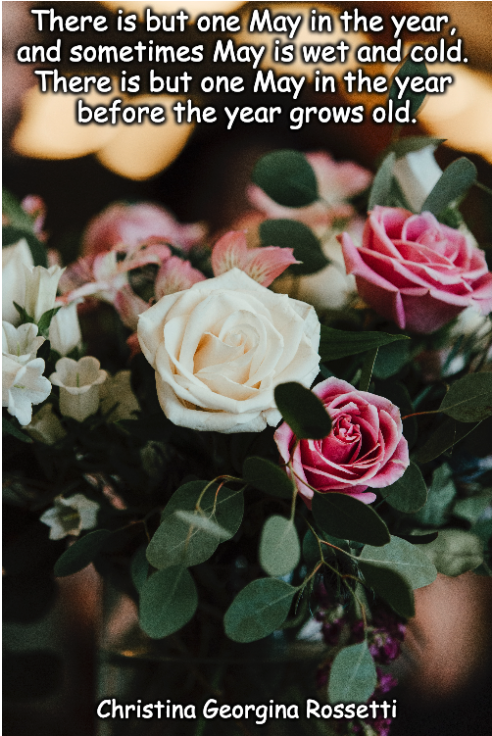
There is but one May in the year, and sometimes May is wet and cold. There is but one May in the year before the year grows old.
– There is only one May in the year: every year has exactly one month of May.
– May is sometimes wet and cold: the months of April-May can be cool and rainy; weather can be unpredictable.
– The line “There is only one May…” emphasizes the transitional period from spring to summer and the hope that arises from that change, even if May is difficult or cold.
– In a broader sense, it concerns the unique but sometimes difficult transition from season to season and the combination of adversity with blossoming (flowers).
Origin:
– It is an English poem from the Victorian era and is often attributed to Christina Georgina Rossetti in a literary context.
– The exact publication date and first appearance are the subject of debate; the attribution to Rossetti is not undisputed.
– The connection to Rossetti arises because the text is attributed to her in many sources, but its authenticity is disputed. The poem is now in the public domain. Author:
– Christina Georgina Rossetti (1830–1894) is often mentioned as a possible author.
– The attribution to Rossetti is not definitive; some sources doubt or confirm her as the author, and there is no unambiguous primary source confirming the attribution.
– Rossetti was a respected English poet (known for, among others, “Goblin Market”, “Remember”, and her contributions to “Christmas carols”), but the authorship of this specific poem remains a subject of debate.
Yet though it be the chilliest May with least of sun and most of showers, its wind and dew, its night and day, bring up the flowers.

The rules express that ‘something beautiful can arise even under unfavorable circumstances’. Literal meaning:
– May is not always mild and sunny.
– Sometimes it is ‘cold, wet and gloomy’.
– Yet “wind, dew, night and day” cause the flowers to rise. Figurative meaning:
– ‘Growth requires not only sunshine’, but also rain, cold and time.
– ‘Adversity does not preclude flourishing’.
– Difficult circumstances can actually be part of a process of ‘maturation, development and hope’.
👉 Concise: ‘even a bleak May produces flowers’.
📚 Origin: Exact source: The lines come from a ‘short, untitled poem’ in:
– “Sing-Song: A Nursery Rhyme Book”
– year: 1872
– poem no.: 17
– opening line: “There is only one May in the year”
Full English text:
> There is only one May in the year,
> And sometimes May is wet and cold;
> There is only one May in the year
> Before the year grows old.
> Yet though it be the chilliest May,
> With least of sun and most of showers,
> Its wind and dew, its night and day,
> Bring up the flowers.
✍️ Author: Christina Georgina Rossetti (1830–1894)
– English poet from the Victorian era
– known for her ‘lyrical, religious and nature-sensitive poetry’
– author of, among others, “Sing-Song”, a collection of children’s songs, rhymes and seasonal poems.
I cannot tell you what it was, but this I know, it did but pass. It passed away with sunny May, like all sweet things it passed away, and left me old, and cold, and gray.

I cannot tell you how it was, but this I know, it came to pass upon a bright and sunny day when May was young. Ah, pleasant May!
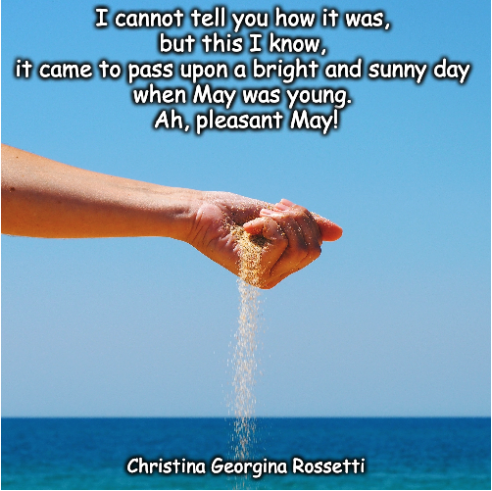
“I cannot tell you how it was;
But this I know: it came to pass
Upon a bright and sunny day
When May was young; ah, pleasant May!”
Important nuance: This is therefore ‘not an old folk saying’, but a ‘poetic line’. It comes from a poem by Christina Rossetti. The line is often ‘quoted in isolation’. In such cases, the ‘first line is sometimes also used as a title’, because many 19th-century poems were referred to without a fixed title. 👩🏫 Author: Christina Georgina Rossetti (1830–1894). English poet of the Victorian era. Known for, among others: “Goblin Market”, “Remember”, “A Birthday”.
On the wind in February, snowflakes float still, half inclined to turn to rain, nipping, dripping, chill.
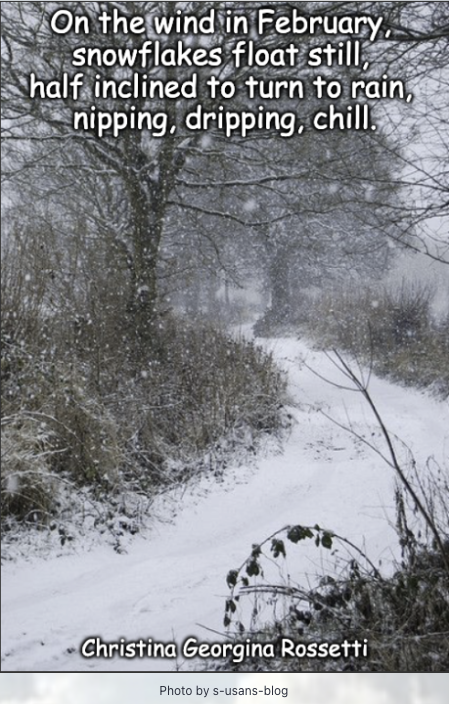
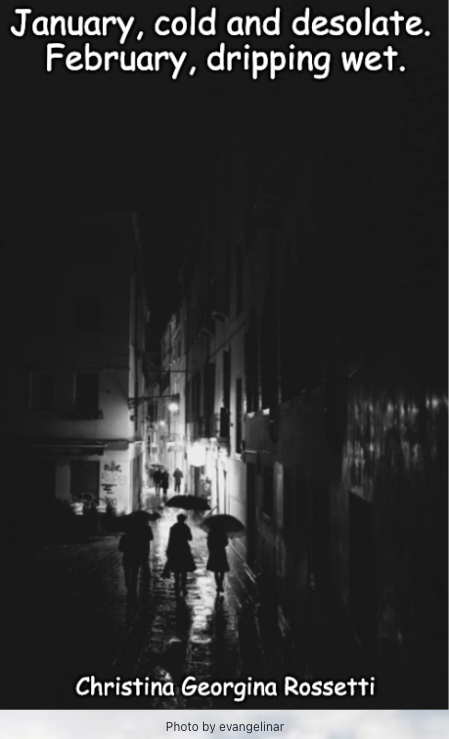
January, cold and desolate. February, dripping wet.