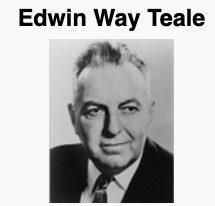
Edwin Way Teale:
(June 2, 1899 – October 18, 1980).
American naturalist, photographer and writer. Teale’s works serve as primary source material documenting environmental conditions across North America from 1930–1980. He is perhaps best known for his series The American Seasons, four books documenting over 75,000 miles (121,000 km) of automobile travel across North America following the changing seasons.
The world’s favorite season is the spring. All things seem possible in May.

1. “The world’s favorite season is spring” — Teale presents spring as universally beloved. After the chill and closedness of winter, nature opens up again: blossom, light, growth. That sense of rebirth touches something deep within people.
2. “Everything seems possible in May” — May is the height of spring: full of promise, not yet finished blooming. The word ‘seems’ is significant — it is not about certainty, but about the ‘feeling’ of endless possibilities that nature evokes in its most beautiful month. It is an invitation to hope and optimism. The quote fits perfectly with Teale’s broader philosophy: he described spring as something you can never fully grasp — you touch it here and there, you know it only in parts and fragments — and it is precisely that which makes it so enchanting. Author: The quote is by Edwin Way Teale and dates from 1951. It appeared in his book “North With the Spring”. Edwin Way Teale was an American naturalist, photographer, and Pulitzer Prize-winning writer. He lived from 1899 to 1980 and dedicated his life to describing American nature and the seasons. “North With the Spring” was the first part of a famous four-part series about the American seasons, in which he traveled 17,000 miles across North America with his wife to follow spring from Georgia to Canada.
How sad would be November if we had no knowledge of the spring!
For humans, autumn is a time to harvest and gather. For nature, it is a time to sow and scatter.
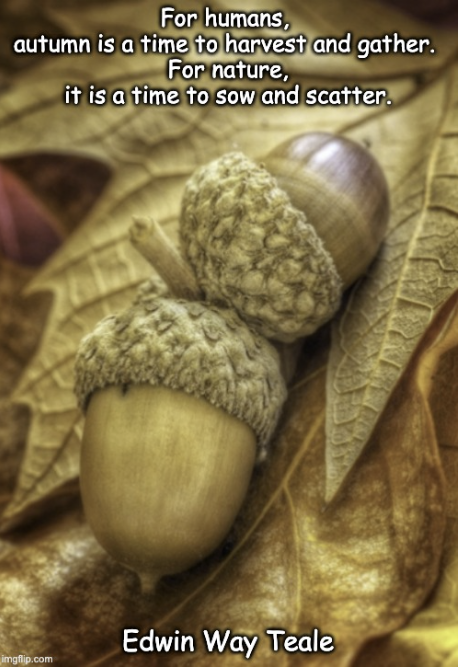
This quote contrasts two perspectives on the same season:
– 🌾 Human view:
Autumn = ‘conclusion’ — we harvest crops, gather resources, celebrate the fruits of a year’s labor (harvest festivals, storing food for winter).
– 🌰 Nature’s view:
Autumn = ‘beginning’ — trees drop seeds, nuts, and fruit; wind and animals disperse them; what appears to be an “ending” is actually nature’s mechanism for ‘future growth and renewal’.
Core insight:
The same moment in time is simultaneously an ‘ending’ (human frame) and a ‘beginning’ (ecological frame) — a meditation on cyclical versus linear thinking, and on how human perception differs from natural processes.
🌐 Origin:
📍 Source provided: spiritueleteksten.nl(https://spiritueleteksten.nl)
— a Dutch website compiling quotes/aphorisms about autumn.
📂 Type of sourc:
Quote-aggregation site (comparable to Goodreads/BrainyQuote).
⚠️ Reliability concern:
Such sites typically ‘copy from other quote sites’ rather than citing primary/original publications |
🔗 Missing info:
No page number, book title, or publication year is typically provided on these platforms.
🌍 Translation factor:
Possible the quote was translated into Dutch and back, or sourced from an English quote site originally.
Conclusion on origin:
The quote circulates widely online in quote-collection contexts, but its ’textual origin (original publication) remains unverified’ through this type of source.
🧑🌾 Author:
👤 Attributed to:
Edwin Way Teale (1899–1980), American naturalist
📚 Known works:
Autumn Across America (1956), part of his seasonal tetralogy |
✅ Stylistic fit:
Thematically and tonally consistent with Teale’s lyrical nature writing.
❌ Direct verification:
Not confirmed in a primary/searchable edition of his texts.
🔄 Risk:
Common pattern online:
Evocative nature quotes get attributed to well-known naturalists (Teale, Thoreau, Emerson) without sourcing.
