Herman Gorter:
(Wormerveer, 26 November 1864 – Sint-Joost-ten-Node, 15 September 1927).
Dutch poet and council communist. He was also a co-founder of the Social Democratic Party, which later became the CPN. He is best known for his epic-length poem Mei (1889). The opening line of this poem, ‘A new spring and a new sound’, has become a common saying.

First night of May and the soft-silvered moon frightens her semicircle in the blue.
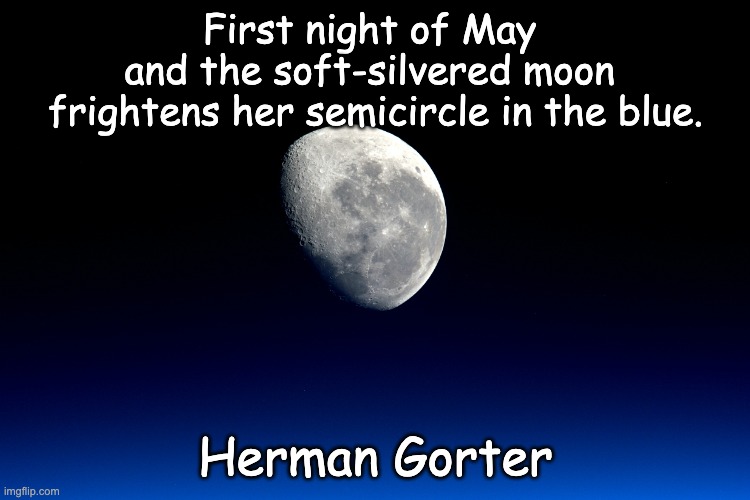
– The month of May is presented in the poem as a person, as the daughter of the moon and the sun.
– Born of the mother moon and the sun, May arrives on a beach in the first song. Her dead sister April is carried away that night.
– The poem is steeped in moon imagery and night scenes in May, exactly the atmosphere of the quote.
– The annual relay recitation of the entire poem takes place on Ascension Day in Zutphen — perhaps not a coincidence that I live in Zutphen! However, it is fair to say that we have not found the ‘exact’ lines of verse in the available texts — the phrasing may be slightly paraphrased or taken from a modernized edition.
And a bird overhead sang follow, and a bird to the right sang here. And the arch of the leaves was hollow, and the meaning of May was clear.
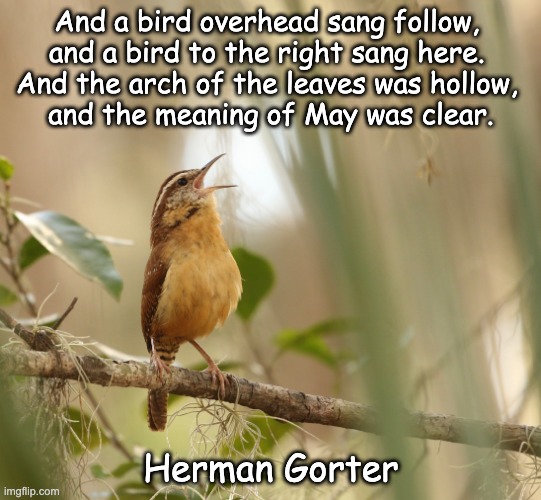
“the meaning of May was clear” refers to May as a symbol of: 🌱 ‘new life’, ❤️ ‘love and desire’, ☀️ ‘growth, blossoming, and joy of life’. 📚 Origin: The excerpt comes from “Mei”, a long lyrical poem by Herman Gorter. The work was published in 1889. “Mei” is an important work of Dutch literature and belongs to the ‘Tachtigers’ movement. Characteristics of the work are: strong ‘experience of nature’, much ‘musicality and sound’, intense ‘expression of emotion’. 👤 Author: Herman Gorter (1864–1927). Dutch poet and writer. One of the best-known representatives of the ‘Tachtigers’. Known for his: evocative style, musical language, emphasis on personal and sensory poetry.
What potent blood hath modest May.

“What potent blood has modest May” is an exclamation of wonder at the paradox of the month of May: outwardly soft and modest, yet driven from within by an unstoppable life force. “Blood” stands for vitality, juiciness, and earthly life itself — the driving force behind everything that bursts forth in spring. The tension between “modest” and “powerful” is deliberate: it is precisely the vulnerable that carries the most life within it. At the same time, there is a tragic undertone — such a powerful being is also ephemeral, for summer will irrevocably displace May.
Origin: The imagery harks back to the American poet Ralph Waldo Emerson, who wrote in his poem “May-Day” (1875): “What potent blood hath modest May” — literally the same metaphor. The Tachtigers were strongly influenced by English and American Romanticism, and Emerson was widely known in the Netherlands at that time. It is therefore quite possible that Herman Gorter adopted this image, consciously or unconsciously, and formulated it in Dutch. The two sentences are so related in content and style that the Dutch version can be considered a free translation by Emerson. Felix Timmermans is sometimes mentioned as a possible author because his work — particularly “Pallieter” (1916) — breathes the same atmosphere of sensual joie de vivre and natural power, but the sentence is not by him.
Author: The Dutch phrasing “Wat een krachtig bloed heeft de bescheiden mei” is by Herman Gorter (1864–1927), from his epic poem “Mei” (1889). Gorter worked on it in secret for over two years; it consists of 4,381 lines and is considered the pinnacle of Tachtigers poetry. The sentence appears in the third book, when May wanders through an impoverished city — far from free nature, but still radiating inner strength. Incidentally, the most famous line of the poem is the opening line: “A new spring and a new sound.”
