Julius Henry “Groucho” Marx:
(October 2, 1890 – August 19, 1977).
American comedian, actor, writer, and singer who performed in films and vaudeville on television, radio, and the stage. He was a master of quick wit and is considered one of America’s greatest comedians.

My favorite poem is the one that starts, ‘Thirty days hath September,’ because it actually tells you something.
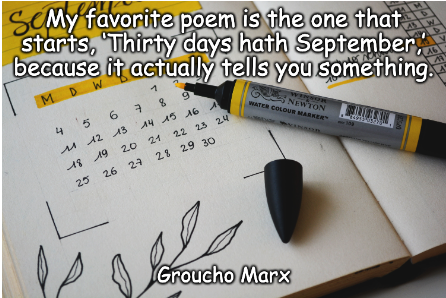
It’s a bit of anti-poetry humor. Groucho is mocking the pretension often associated with poetry — flowery language, abstract emotion, ambiguous meaning — by praising the ‘least’ poetic “poem” imaginable: a ‘children’s mnemonic rhyme’ used to memorize the number of days in each month:
> Thirty days hath September,
> April, June, and November;
> All the rest have thirty-one,
> Excepting February alone,
> Which has but twenty-eight days clear,
> And twenty-nine in each leap year.
The joke’s engine is the word “means” or “tells you something” — Groucho is pointing out that unlike “real” poetry (which he implies is often vague, self-important, or empty), this humble little rhyme is ‘actually useful’. It has one plain, literal, practical purpose, and it delivers on it every time. It’s Groucho’s classic move:
deflating something considered “high-minded” by comparing it unfavorably to something plain and functional.
Author:
This line is widely attributed to Groucho Marx (1890–1977), the American comedian famous for his quick, dry, self-deprecating wit as part of the Marx Brothers. It’s one of his many one-liners poking fun at pompous or “high” culture — poetry, in this case.
That said, as with many famous quips, there’s no rock-solid documented original source (a specific interview, book, or performance) tying it definitively to him — it circulates the way most Groucho lines do, passed down through quote collections and comedy anthologies. It’s consistent with his style, though, so the attribution is generally accepted.
Origin:
The mnemonic rhyme long predates Groucho by centuries. An early English reference appears in a 1577 text by William Harrison, though that version begins “Thirty days hath November” rather than September. It’s a traditional verse mnemonic for remembering the number of days in each month of the Julian and Gregorian calendars, and it arose as an oral tradition existing in many variants across Europe. The wording has shifted over the centuries — different published versions from the 1500s through the 1800s use “hath” or “has,” and end with slightly different final lines about leap year — but the core structure has stayed essentially the same for 450+ years.
