Alexander Smith:
(1829/30–1867).
Scottish poet and essayist, associated with the Spasmodic School of poets known for their intense imagery and metrical variation. He published poetry collections like “City Poems,” a Northumbrian epic poem “Edwin of Deira,” and prose works such as “Dreamthorp” and “A Summer in Skye.” He died young at 37 and was also known for editing editions of Burns’ works.
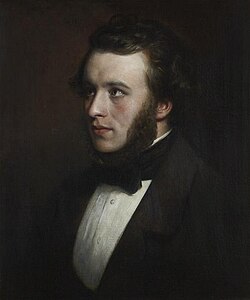
In the entire circle of the year, there are no days so delightful as those of a fine October.

The sentence expresses Alexander Smith’s admiration for the ‘calm, clear, and reflective days of October’.
– “The entire circle of the year” means the complete annual cycle of seasons.
– “A fine October” means an October with pleasant, crisp, settled weather—not merely an “acceptable” October.
– Smith finds these autumn days especially delightful because they combine natural beauty with a gentle sense of change, maturity, and the approach of winter.
The mood is therefore both ‘joyful and quietly solemn’:
‘autumn is beautiful partly because it is temporary.’
✍️ Author and origin:
The quotation is by Alexander Smith (1830–1867), a Scottish poet and essayist.
It comes from his essay “An Essay on an Old Subject,” collected in:
> “Dreamthorp: A Book of Essays Written in the Country* (1863).”
📖 Fuller version:
The commonly quoted sentence is usually shortened. The fuller passage reads:
> “In the entire circle of the year there are no days so delightful as those of a fine October, when the trees are bare to the mild heavens, and the red leaves bestrew the road, and you can feel the breath of winter, morning and evening,—no days so calm, so tenderly solemn, and with such a reverent meekness in the air.”
Punctuation may vary slightly among editions, but the attribution to Alexander Smith and “Dreamthorp” is well established.
In the entire circle of the year, there are no days so delightful as those of a fine October.
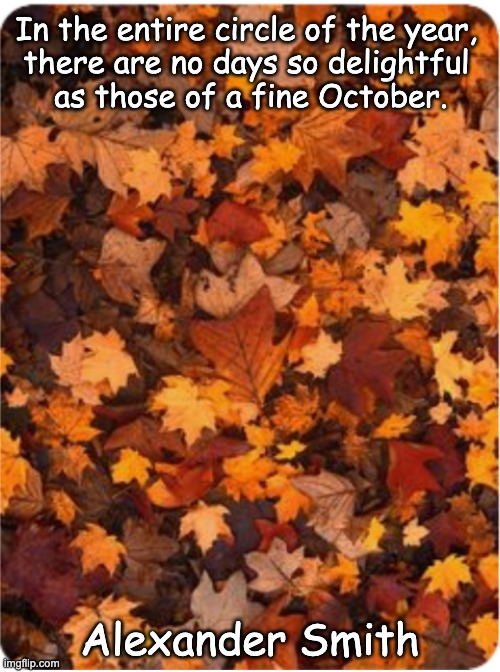
The full sentence reads as follows:
> “In the whole cycle of the year there are no days so delightful as those of a fine October: when the trees stand bare against the soft sky, red leaves carpet the road, and you feel the breath of winter in the morning and evening air; no days so calm, so tenderly solemn, and with such a reverent stillness in the air.”
Smith praises October as the most beautiful time of year, and the surprise lies in “what” exactly he is praising. It is not the warm, radiant days of summer; it is the quiet, melancholic days of late autumn. The trees are nearly bare, leaves lie on the road, and one can already sense the approach of winter in the morning and evening air. He describes these days as “calm” and “tenderly solemn,” with a “reverent stillness” in the air—as if nature itself were in a hushed, almost devout mood.
The sentence also conveys a quintessentially Victorian idea: beauty is at its most profound when it is nearing its end. October is beautiful, partly because it represents the final mild interlude before the cold sets in. That bittersweet quality is why this passage is quoted so frequently every autumn.
Origin:
Several of his best-known essays were collected in “Dreamthorp” (1863), a book of contemplative, tranquil prose about rural life, books, and the seasons. I suspect the excerpt comes from that work, but none of the sources I consulted specify the particular essay, so I cannot confirm this with certainty. Author:
Alexander Smith (1830–1867).
A Scottish poet and essayist associated with the so-called ‘Spasmodic’ school of poetry. He died young, at the age of 36.
Sweet April’s tears, Dead on the hem of May.
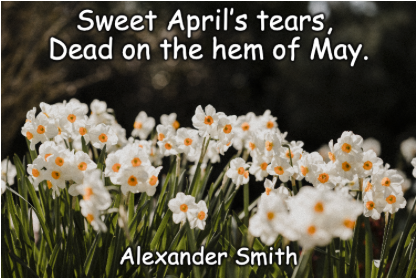
“April tears” refers to: spring rain; melancholy; temporary sadness. “the edge of May” refers to: the transition to full spring; bloom, warmth, and renewal. “dead on the edge of May” means: gone as soon as May arrives; overcome by the new spring. Core meaning: Sadness is short-lived; April gloom gives way to May and bloom; What still mourns in April is over by May. 📚 Origin: Important nuance: The quote appears in ‘collections of sayings by Alexander Smith’. The ‘precise primary source’ — that is, from which ‘poem, essay, or book’ it exactly comes — is ‘not easy to ascertain’. Therefore, a cautious source citation is best. ✍️ Author: Usually attributed to Alexander Smith (1830–1867), a Scottish poet.
