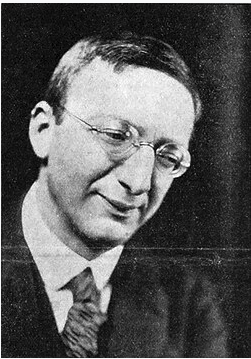
Bruno Alfred Döblin:
(German: [10 August 1878 – 26 June 1957).
German novelist, essayist, and doctor, best known for his novel ‘Berlin Alexanderplatz (1929)’. A prolific writer whose œuvre spans more than half a century and a wide variety of literary movements and styles, Döblin is one of the most important figures of German literary modernism. His complete works comprise over a dozen novels ranging in genre from historical novels to science fiction to novels about the modern metropolis; several dramas, radio plays, and screenplays; a true crime story; a travel account; two book-length philosophical treatises; scores of essays on politics, religion, art, and society; and numerous letters—his complete works, republished by Deutscher “Taschenbuch Verlag” and “Fischer Verlag”, span more than thirty volumes. His first published novel, “Die drei Sprünge des Wang-lung” (The Three Leaps of Wang Lun), appeared in 1915 and his final novel, “Hamlet oder Die lange Nacht nimmt ein Ende” (Tales of a Long Night) was published in 1956, one year before his death.
The world, however, is set up in such a way that the stupidest proverbs are right.

This sentence is one of the many proverbial, colloquial insertions with which Döblin shapes the narrative tone of “Berlin Alexanderplatz” (1929). The novel is known for its collage-like narrative style, which assembles Berlin slang, biblical quotations, advertising slogans, weather reports, and, indeed, proverbs—often with an ironic or resigned undertone.
The statement itself has a slightly self-ironic, folksy core: It suggests that even the seemingly most banal, “stupid” proverbs repeatedly prove true in life—that simple folk wisdom is often more accurate than one might think, even if one intellectually scoffs at it. The following follows directly:
– “When a person thinks, ‘Now it’s all right,’ it’s far from all right” – one shouldn’t let their guard down too soon.
– “Man proposes, God disposes” – a classic proverb about the limitations of human planning.
– “The pitcher goes to the well once too often” – also an old proverb, suggesting that risky behavior will eventually go wrong.
Döblin deliberately strings together several clichéd pieces of wisdom here to show that, however banal they may sound, they often prove true in the end – a commentary on Biberkopf’s fate, who, despite good intentions, repeatedly falls into misfortune because life (or rather, fate, “God”) directs him differently than he had planned.
