Plato:
(Athens, c. 427 BC – there, 347 BC).
Greek philosopher and writer. Plato was a pupil of Socrates and teacher of Aristotle. He became one of the influential thinkers in Western philosophy and was the founder of the Athenian Akademeia, the first institution of higher learning in the West. He wrote dialogues on various topics and with his Theory of Ideas became the patriarch of metaphysical realism, in which visible reality consists of imperfect reflections of universals existing in an upper world. It remains to be seen to what extent Plato’s own views are known, as he nowhere speaks on his own behalf, often raises questions without answering them and is not always consistent.

No one is more hated than he who speaks the truth.
Those who are too smart to engage in politics are punished by being governed by those who are dumber.

The man who makes everything that leads to happiness depends upon himself, and not upon other men, has adopted the very best plan for living happily. This is the man of moderation, the man of manly character and of wisdom.
Don’t force your children into your ways, for they were created for a time different from your own.
The beginning is the most important part of the work.

The idiom expresses the idea that how something starts determines, to a large degree, how everything that follows will turn out. A flawed or careless beginning tends to compound into lasting problems, while a well-laid beginning tends to set a trajectory that’s easier to build on correctly. It’s often invoked today as a general maxim about foundations — in education, projects, habits, relationships, or any long undertaking — arguing that first steps deserve disproportionate care precisely because they’re hardest to correct once things are underway.
Origin:
The idea originates in Plato’s “Republic”, “Book II”, around “Stephanus page 377a–b”. There, Socrates is discussing with Adeimantus how the guardians of the ideal city should be educated. He argues that the beginning is the most important part of any work, especially in the case of something young and impressionable, since that is the time when character is being formed and impressions are most readily absorbed. This is used to justify why the myths and stories told to children must be carefully supervised and censored — a bad influence introduced early, he warns, is very hard to undo later.
Worth noting: the underlying Greek word is ‘archē’ (ἀρχή), which means both “beginning” and “first principle” — so the original carries a double resonance (not just “start of a task” but “foundational principle”), which likely helped the line travel beyond its original context about childhood education into a general-purpose proverb about foundations.
There’s also a related, though distinct, Socratic remark elsewhere about how a small unnoticed error at the very start of a geometrical construction will remain consistent throughout everything built on it — suggesting this was a recurring concern for Plato, not a one-off line.
Author:
Plato (via the character of Socrates as his mouthpiece), writing in the “Republic”, one of his two book-length dialogues. The famous English phrasing — “the beginning is the most important part of the work” — comes from Benjamin Jowett’s “19th-century translation, which is largely why this particular wording became the widely quoted version.
The price good men pay for indifference to public affairs is to be ruled by evil men.

Never discourage anyone who continually makes progress, no matter how slow.
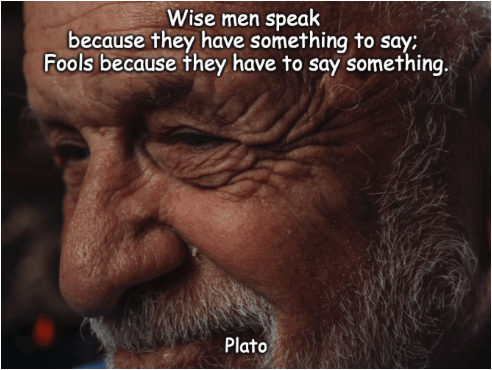
Wise men speak because they have something to say.
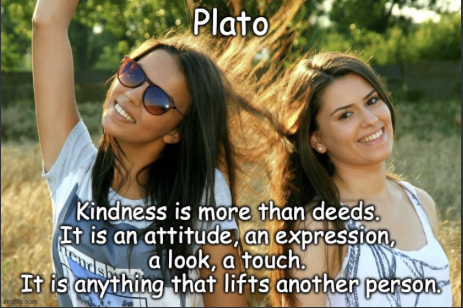
Kindness is more than deeds. It is an attitude, an expression, a look, a touch. It is anything that lifts another person.
Wisdom begins in wonder.