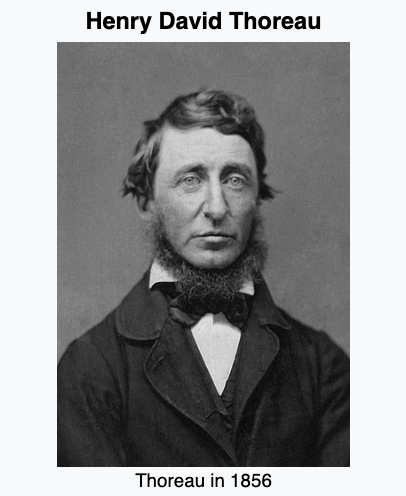
Henry David Thoreau:
Born as David Henry Thoreau.
(Concord (Massachusetts), 12 July 1817 – there, 6 May 1862). American essayist, teacher, social philosopher, naturalist and poet.
The question is not what you look at, but what you see.

Experience is in the fingers and head. The heart is inexperienced. –

If one advances confidently in the direction of his dream, and endeavors to live the life with he has imagined, he will meet with a succes unexpected in common hours.

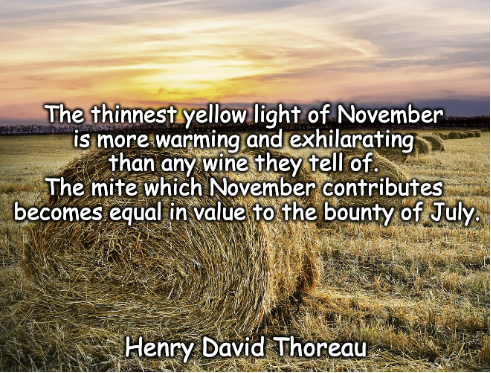
The thinnest yellow light of November is more warming and exhilarating than any wine they tell of. The mite which November contributes becomes equal in value to the bounty of July.
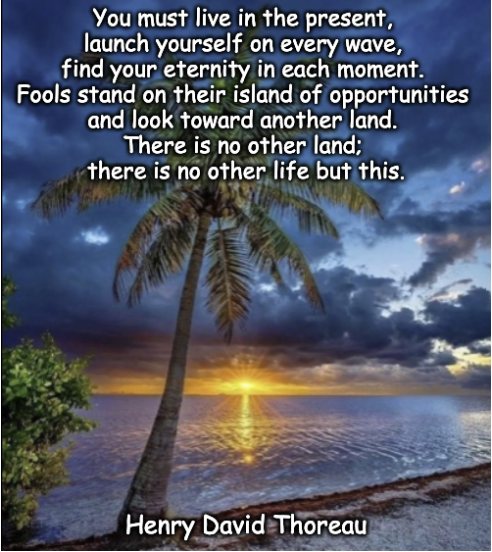
You must live in the present, launch yourself on every wave, find your eternity in each moment. Fools stand on their island of opportunities and look toward another land. There is no other land; there is no other life but this.
October is the month of painted leaves. Their rich glow now flashes round the world. As fruits and leaves and the day itself acquire a bright tint just before they fall, so the year nears its setting. October is its sunset sky; November the later twilight.

We can never have enough of nature.

– Humans can’t get their fill of nature, because it renews us in a way civilized life can’t. Time in it is a need, not a luxury.
– Nature’s value lies partly in its excess and wildness: it is bigger, stranger and more powerful than anything we control. That overflow humbles us and keeps us from believing the human world is all there is.
– Thoreau often saw modern life as narrowing and mechanical. For him, the wild is a corrective that restores vitality, perspective and a sense of proportion.
Origin:
The sentiment sits at the heart of Transcendentalism, the American philosophical movement of Emerson and Thoreau, which held that spiritual truth and self-renewal are found through direct experience of nature. It also connects to Thoreau’s famous line elsewhere, “in Wildness is the preservation of the World” (from his essay “Walking”). The “Walden” passage is often quoted today in conservation, environmental writing and outdoor-wellness discussions.
Context in the text:
Thoreau writes it after describing a day spent watching a bog, the sights of the wild, and the way he feels revived by it. The surrounding passage goes roughly like this: we need the tonic of wildness, and we must be refreshed by the sight of inexhaustible vigor and “vast and Titanic features” (the sea-coast with its wrecks, the wilderness with its living and decaying trees, the thunder cloud, the long rains and floods). He adds that we need to witness our own limits transgressed, and to see some life pasturing freely where we never wander.
Author: Henry David Thoreau.
The line comes from “Walden” (1854), in the chapter “Spring,” near the end of the book.
Happily we bask in this warm September sun, which illuminates all creatures.
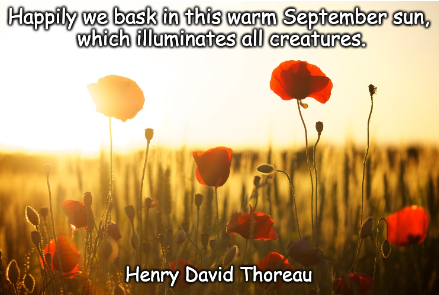
– We are joyfully enjoying the warmth of the September sun.
– The sun shines not only on humans but on ‘all living beings’.
– Nature offers a shared, universal blessing.
– There is quiet happiness in simply being alive and present in the natural world.
🍂 Deeper Interpretation:
Thoreau often saw nature as morally and spiritually meaningful. In this line:
– “Happily we bask”
suggests simple contentment.
– “Warm September sun”
evokes late summer or early autumn peace.
– “Illuminates all creatures”
suggests that nature is generous, impartial, and shared by every form of life.
So the saying expresses ‘gratitude, harmony with nature, and reverence for the common life of all creatures’.
Origin / Source:
– The line is generally traced to ‘Thoreau’s personal journals’, later published posthumously as “The Journal of Henry David Thoreau”.
– It is also circulated in collections of Thoreau’s nature writing, especially autumn-themed selections.
– It is ‘not usually cited as coming from Walden’, though many people assume so because it sounds very Thoreauvian.
A cautious citation would be:
> Henry David Thoreau, “Journal”, September entry, 1850s.
Some quote collections cite it more specifically to a “September 1851 journal entry”, though exact dating can vary by edition.
👤 Author: Henry David Thoreau
– American writer, naturalist, philosopher, and Transcendentalist
– Lived 1817–1862
All perception of truth is the detection of an analogy.
In August, the large masses of berries, which, when in flower, had attracted many wild bees, gradually assumed their bright velvety crimson hue, and by their weight, again bent down and broke their tender limbs.
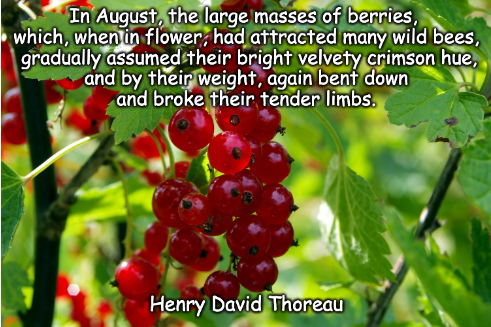
Thoreau is describing ‘sumac’ — specifically ‘smooth sumac’, ‘Rhus glabra’ — growing near his cabin at Walden Pond.
🌿 Literal meaning:
– In spring or early summer, the plant’s flowers attracted many wild bees.
– By August, those flowers had become heavy clusters of red, velvety berries.
– The berries became so heavy that they bent and even broke the young, delicate branches.
🌱 Deeper meaning:
Thoreau is observing the ‘abundance and energy of nature’:
– Nature grows with such force that it can become almost excessive.
– Beauty and fruitfulness can be heavy burdens.
– The passage reflects the cycle of life: flowering, pollination, fruiting, weight, decay, and renewal.
The word “again” refers to an earlier part of the same paragraph, where Thoreau says the young sumac branches sometimes broke simply from their own rapid growth and weight.
🧑🏫 Origin and Context:
– Author: Henry David Thoreau
– Work: “Walden; or, Life in the Woods”
– Published: 1854
– Chapter: “Spring”
– Subject: Sumac growing near Thoreau’s cabin at Walden Pond, Massachusetts
This is not really a “saying” or proverb; it is a ‘descriptive literary passage’ from Thoreau’s nature writing.
🌺 In Plain Modern English:
By August, the clusters of berries that had once been flowers visited by bees turned a rich crimson red. They became so heavy that they bent down and broke the young branches holding them.
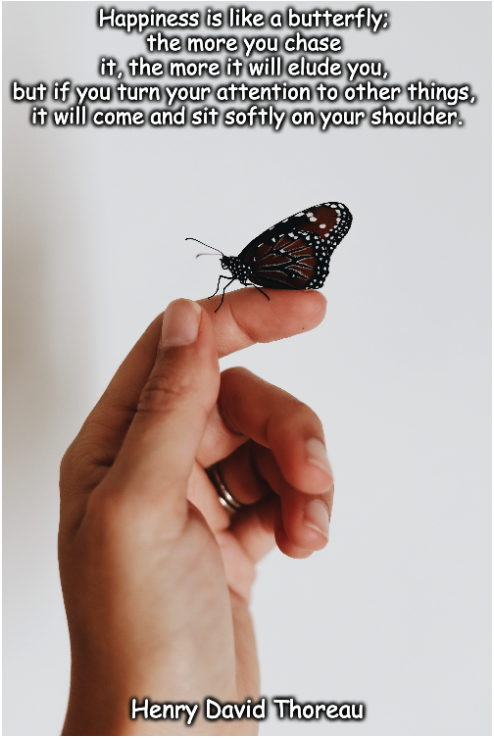
Happiness is like a butterfly; the more you chase it, the more it will elude you, but if you turn your attention to other things, it will come and sit softly on your shoulder.
What’s the use of a fine house if you haven’t got a tolerable planet to put it on?

There are two seasons when the leaves are in their glory—their green and perfect youth in June and this their ripe old age.
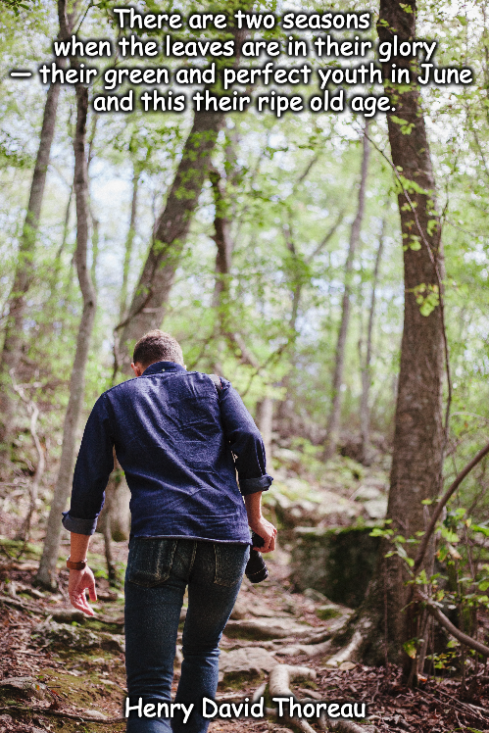
The saying means that leaves are particularly beautiful at ’two moments’:
– 🌱 ‘In June’: when they are young, fresh, green, and perfect.
– 🍂 ‘In autumn’: when they are old, ripe, and colorful.
The deeper meaning is that beauty belongs not only to ‘youth, freshness, and growth’, but also to ‘maturity, old age, and change’.
Loosely translated:
> ‘Leaves are beautiful in their young green state, but also in their ripe old age when they take on autumn colors.’
As wisdom for life, you can understand it like this:
– Youth has its own beauty.
– Old age also has its own glory.
– Decay or change does not necessarily mean loss.
– Autumn is not the end of beauty, but another form of it. 📚 Origin:
The quote comes from the English essay:
– “Autumnal Tints”.
This essay was published in 1862 in the magazine “The Atlantic Monthly”, shortly after Thoreau’s death.
It was later included in the collection:
– “Excursions” from 1863.
The original English phrasing reads:
> “There are two seasons when the leaves are in their glory: their green and perfect youth in June, and their ripe old age.”
👤 Author: Henry David Thoreau.
– Full name: Henry David Thoreau
– Lived: 1817–1862
– Nationality: American
– Profession: writer, philosopher, naturalist, and essayist
– Known for: “Walden” and “Civil Disobedience”.
Thoreau was known for his keen observations of nature. In this quote, he uses the leaves as an image for the beauty of both “youth” and “old age”.
Not ’till June can the grass be said to be waving in the fields. When the frogs dream, and the grass waves, and the buttercups toss their heads, and the heat disposes to bathe in the ponds and streams, then is summer begun.
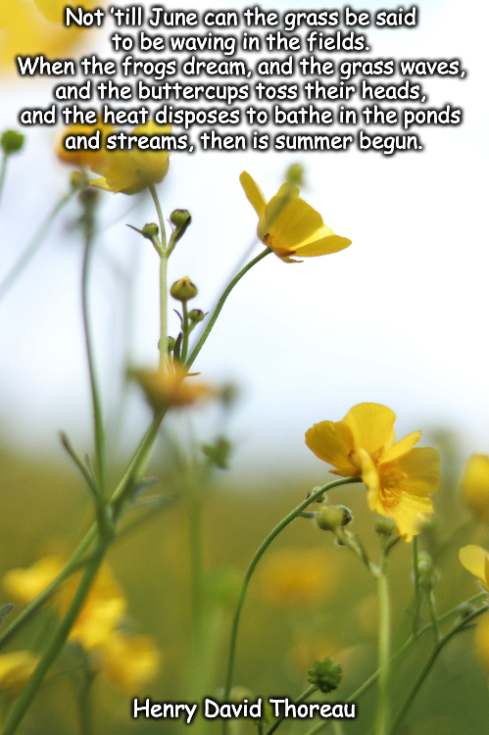
– For Thoreau, summer does not begin merely according to the calendar.
– Summer only begins when nature truly feels summery:
– the grass is tall enough to sway;
– frogs are active;
– buttercups bloom and move in the wind;
– the warmth invites you to bathe in ponds and streams.
In other words: ’the real summer begins when you can see, hear, and feel it in nature’.
🐸 About “when the frogs dream”:
The expression “when the frogs dream” is poetic and not meant literally as a fixed saying. Thoreau uses ‘personification’ here: he gives animals and plants almost human characteristics. It evokes a dreamy, warm June atmosphere. Origin 📜 : The common English version reads:
> “Not till June can the grass be said to wave in the fields. When the frogs dream, and the grass waves, and the buttercups toss their heads, and the heat disposes to bathe in ponds and streams, then is summer begun.” Source: Journal / diary notes, usually cited under June 1; later included in collections such as Summer: From the Journal of Henry D. Thoreau.
This is June, the month of grass and leaves. Already the aspens are trembling again, and a new summer is offered me.

DIt drukt vooral het volgende uit:
– 🌱 ‘Juni als maand van volle groei’
Gras en bladeren staan voor overvloed, frisheid en levenskracht.
– 🍃 “De espen trillen”
Espen (ratelpopulieren/aspen trees) hebben bladeren die snel beven in de wind. Dat beeld roept beweging, lichtheid en zomerse levendigheid op.
– ☀️ “Een nieuwe zomer wordt mij aangeboden”
Dat is poëtisch bedoeld: de natuur geeft als het ware opnieuw een kans op vreugde, verwondering en een nieuw begin.
De uitspraak betekent zoiets als:
– ‘de zomer dient zich opnieuw aan’
– ‘de natuur herleeft’
– ‘de mens krijgt opnieuw een seizoen van schoonheid en mogelijkheden aangereikt’
🖋️ Auteur:
De uitspraak is ‘vrij algemeen bekend’ als een citaat van Henry David Thoreau (1817–1862), de Amerikaanse schrijver, denker en natuurwaarnemer van onder meer:
– ‘Walden’
– zijn ‘dagboeken / journals.’
📚 Oorsprong:
De oorspronkelijke Engelse tekst luidt vrijwel zeker:
> “This is June, the month of grass and leaves. Already the aspens are trembling again, and a new summer is offered me.”
– Deze regel wordt meestal aan “Thoreau’s Journal” toegeschreven.
– De ‘exacte bronvermelding’ verschilt soms per uitgave en citatensite.
– Vaak wordt als herkomst genoemd: “Journal, 1 June 1857”
➜ maar daar zit soms wat onzekerheid in, omdat citaten online niet altijd nauwkeurig geannoteerd zijn.
Belangrijke nuance:
– De Nederlandse zin is dus ‘een vertaling’, niet de oorspronkelijke formulering.
– De ‘preciese Nederlandse vertaler’ is zonder extra bron moeilijk met zekerheid vast te stellen.
🌦️ Is dit echt een “weerspreuk”?
Eigenlijk ‘niet helemaal’.
Een echte weerspreuk is meestal iets als:
– “Avondrood, mooi weer aan boord”
– “Maart roert zijn staart”
Dit citaat is eerder:
– 🌿 een ‘natuurspreuk’
– ✍️ een ‘literair citaat’
– 🍃 een ‘poëtische seizoensobservatie’
Dus: ‘mooie juni-spreuk? ja
‘klassieke weerspreuk? nee, niet echt’
It is dry, hazy June weather. We are more of the earth, farther from heaven these days.
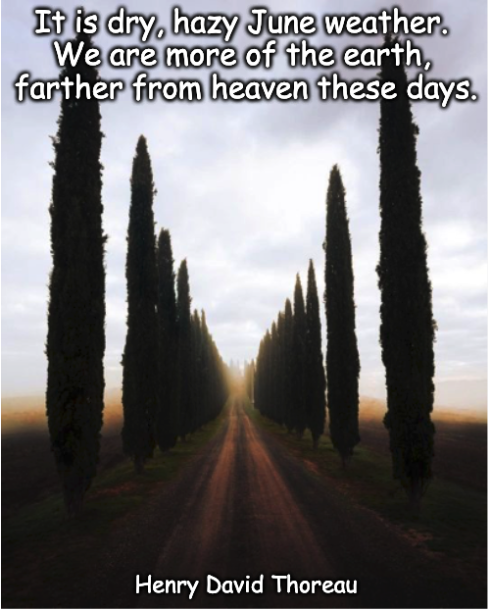
– Literally, the quote describes ‘dry, misty June weather’: an atmosphere in which the air is hazy and the sky seems less clear and close.
– Figuratively, Thoreau says that such days make a person more ‘earthly’:
– more focused on the ‘material and everyday’
– less on the ‘exalted, spiritual or spiritual’
– “More of the earth, farther from heaven” is therefore a poetic way of saying that on such days one feels ‘heavier,’ more worldly and less ‘exalted’.
> It is at the same time a ‘weather observation’ and a ‘philosophical reflection’.
📚 Origin:
– The origin is “Thoreau’s Journal”:
– so ‘not’ from an essay or book
– but from a ‘diary entry’
– According to the information it is in:
– “The Journal of Henry D. Thoreau”
– “Princeton University Press” edition
– from 1981.
– editors: John C. Broderick, Robert Sattelmeyer and Sandra Harbert Petrulionis
– The reference to page 180 is useful, although for a completely precise source the ‘part/volume’ or ‘date of the note’ is normally also desirable.
✍️ Author:
– The author is Henry David Thoreau (1817–1862).
– He was a:
– American writer
– nature observer
– philosopher
– essayist
– The sentence is very typical of his style:
– a concrete observation of nature 🌿
– which transitions into a broader thought about human existence 💭
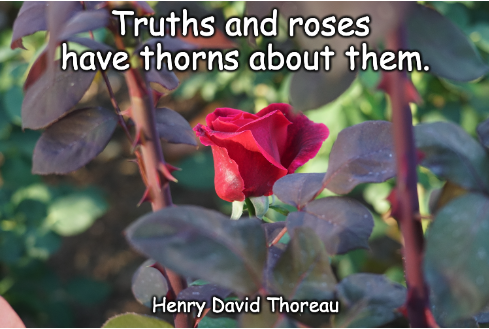
Truths and roses have thorns about them.
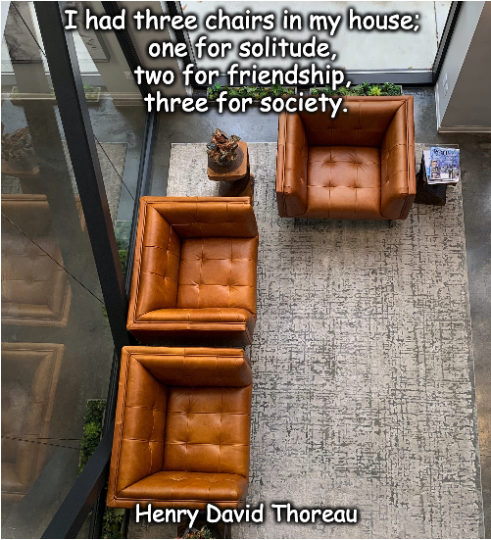
I had three chairs in my house; one for solitude, two for friendship, three for society.
Dreams are the touchstones of our character.

Say what you want to say, instead of what others want to hear.

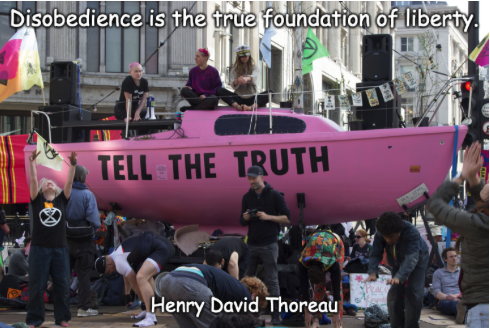
Disobedience is the true foundation of liberty.
It takes two to speak the truth, one to speak, and another to hear.
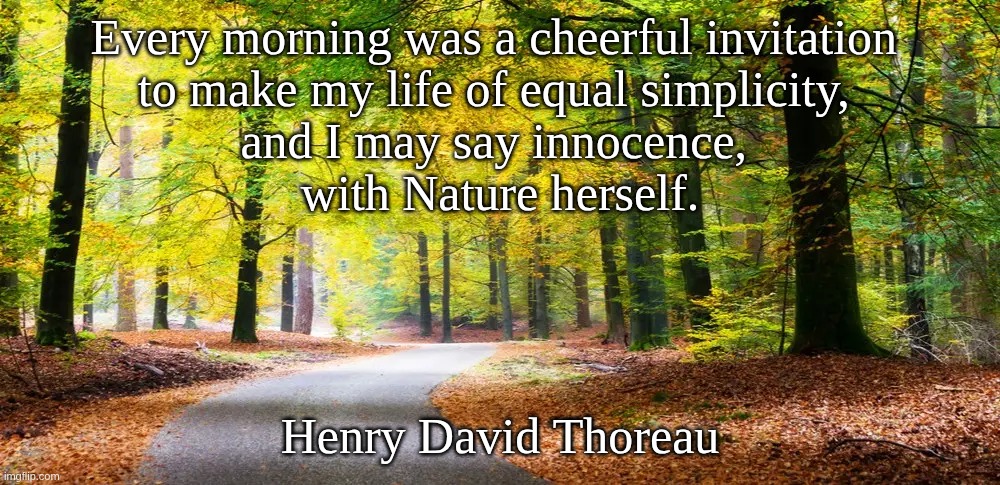
Every morning was a cheerful invitation to make my life of equal simplicity, and I may say innocence, with Nature herself.
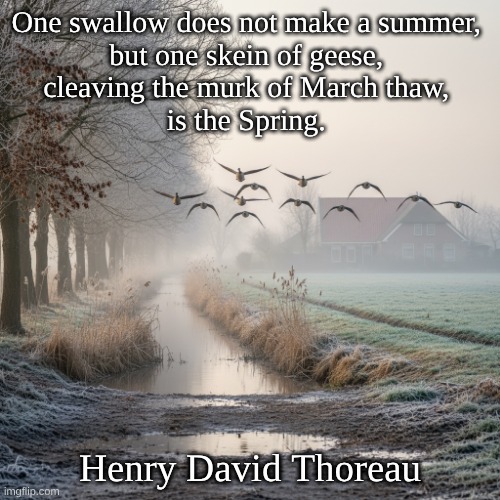
One swallow does not make a summer, but one skein of geese, cleaving the murk of March thaw, is the Spring.