Thomas Malory:
(circa 1405 – 14 March 1471).
Author or compiler of Le Morte d’Arthur, the best and most complete Middle English prose treatment of the story of King Arthur and his knights.
With this adaptation of mostly French romances, Malory was the first English writer to prove that prose could be as delicate a medium as poetry. He is said to have achieved with similar simplicity the same with prose as Geoffrey Chaucer did with poetry. According to poet and antiquarian John Leland, Thomas came from Wales, but others place him in Warwickshire.

Therefore all ye that be lovers call unto your remembrance the month of May.

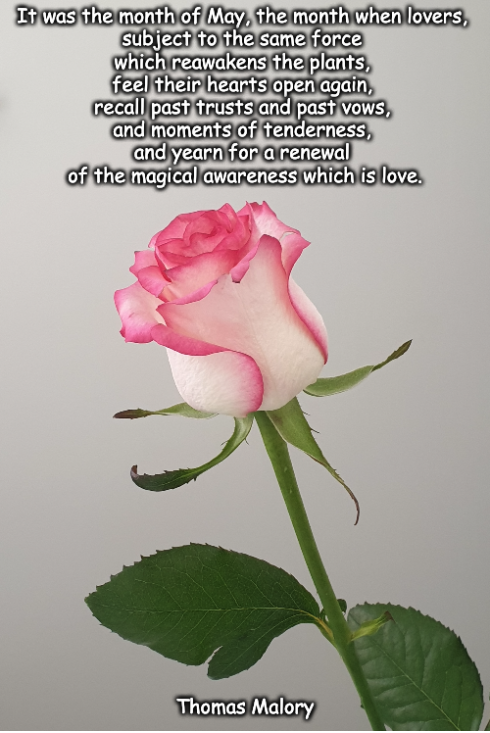
It was the month of May, the month when lovers, subject to the same force which reawakens the plants, feel their hearts open again, recall past trusts and past vows, and moments of tenderness, and yearn for a renewal of the magical awareness which is love.
The month of May has come, when every lusty heart beginneth to blossom, and to bring forth fruit.
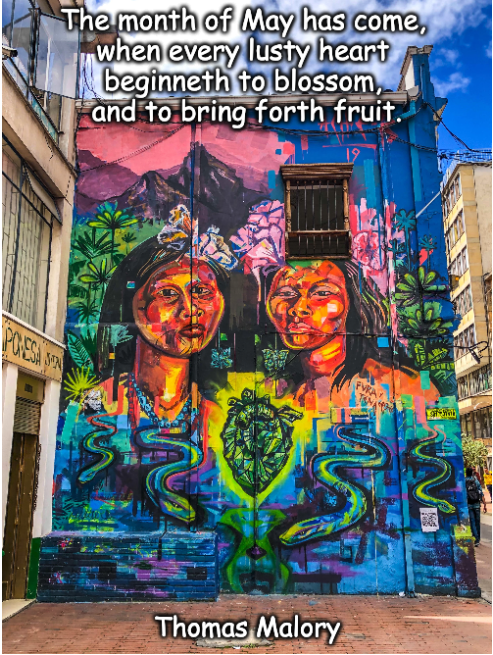
more active, more sensitive to love and desire. 🏰 Origin: The phrasing comes from the ‘Arthurian romance tradition’ and specifically from: Sir Thomas Malory: “Le Morte d’Arthur,” written in the 15th century, printed by William Caxton in 1485. The passage appears in the section where May is presented as the month in which love, chivalry, and desire come to life anew. ✍️ Probable source text: A well-known version in Middle English reads approximately: “For it was in the month of May, when every lusty heart begins to blossom, and to bring forth fruit…” Sometimes a comparison follows with herbs and trees that bloom in May, and with lovers whose hearts also “blossom” at that time. In modern English
That means approximately: “For it was in the month of May, when every lively/loving heart begins to blossom and bring forth fruit.” 👤 Author: Thomas Malory. Sir Thomas Malory is considered the author of the original passage. The thought and phrasing fit very clearly with “Le Morte d’Arthur”. 🌸 Literary background: This idea is, incidentally, broader than just Malory. In medieval literature, “May” is often the month of: love, renewal, youth, desire, and courtly romance. This motif can also be found in the works of other medieval authors. Malory therefore uses a ‘familiar literary spring motif’, but his phrasing has become famous.
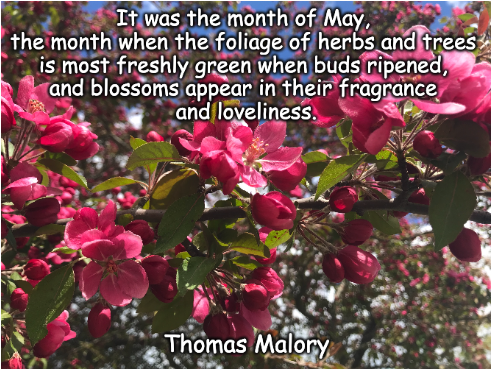
It was the month of May, the month when the foliage of herbs and trees is most freshly green when buds ripened, and blossoms appear in their fragrance and loveliness.