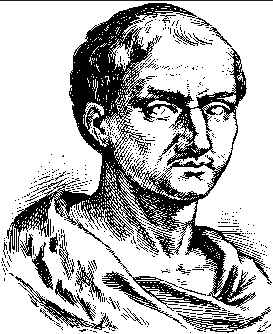
Anicius Manlius Torquatus Severinus Boethius:
(Rome, c. 480 – Pavia, 524).
A Christian, late Roman philosopher, music theorist, writer and politician who lived in Italy in the late 5th and early 6th centuries AD. He is generally regarded as an important link between ancient pagan philosophy and the Christian Middle Ages. Boethius was executed in 524 on the orders of his former friend King Theodoric the Great, who suspected him of conspiring with the Byzantine Empire.
Boëthius – wikikids.org.
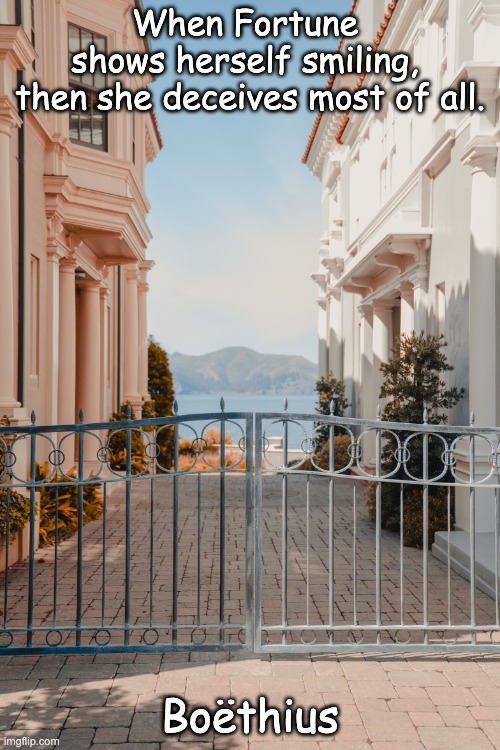
When Fortune shows herself smiling, then she deceives most of all.
Image Michael Marcagi. Meaning 📖 🧠: The essence is that people who experience ‘prosperity’, ‘happiness’, ‘wealth’, or ‘social success’ are often more easily seduced by the ‘appearance of happiness’, and consequently have a poorer view of what is truly valuable, stable, or true. Core idea: Prosperity can be misleading 🎭. Success creates the illusion of security or truth. Adversity, on the other hand, can provide insight 📚. Philosophically speaking: The thought is not simply: “rich people are stupid” — but rather: external prosperity is ‘unreliable’; it can make us believe that we are truly happy, while that happiness remains dependent on circumstances and is therefore fragile. A more precise formulation of the thought would be: ‘He who is favored by fortune is easily misled by the appearance of happiness.’ 🏛️ Origin: The origin most likely lies with Boëthius in: “De consolatione philosophiae”, written around 523–524, during his imprisonment, while awaiting his execution. Relevant thought regarding Boëthius: The passage to which this is substantively based reads roughly in English: “Good fortune is ever lying when she seems to favour by an appearance of happiness… The one deceives; the other edifies.” Boëthius contrasts: ‘good fortune / prosperity’: deceives, gives an appearance of happiness; ‘adversity’: teaches, purifies, reveals what is truly of value. ✍️ Author: Likely author of the rationale: Anicius Manlius Severinus Boëthius (c. 480–524) Work: “De consolatione philosophiae”.
Door Pieter
Mensenmens, zoon, echtgenoot, vader, opa.
Spiritueel, echter niet religieus.
Ik hou van golf, wandelen, lezen en de natuur in veel opzichten.
Onderzoeker, nieuwsgierig, geen fan van de mainstream media (MSM).