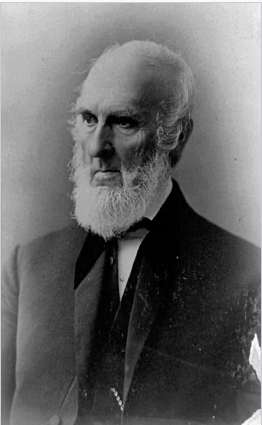
John Greenleaf Whittier:
(Haverhill, Massachusetts, 17 December 1807 – 7 September 1892 Hampton Falls, New Hampshire).
American Quaker, reformer and poet who belonged to the group of the Fireside Poets. Whittier was a pioneer in regional literature and a passionate campaigner for humanitarian causes, especially the abolition of slavery. His first poems were published in 1826 by his friend William Lloyd Garrison. From 1828 to 1832, Whittier edited and wrote stories, sketches and poems. His first two published books, Legends of New England (1831) and the poem Moll Pitcher (1832), deal with everyday life in the county.
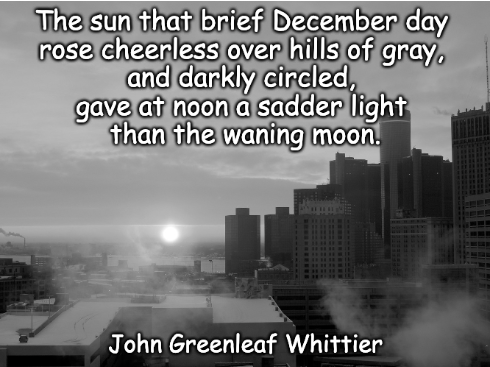
The sun that brief December day rose cheerless over hills of gray, and darkly circled, gave at noon a sadder light than the waning moon.
Oh for boyhood’s time of June, crowding years in one brief moon when all things I heard or saw, me, their master, waited for.
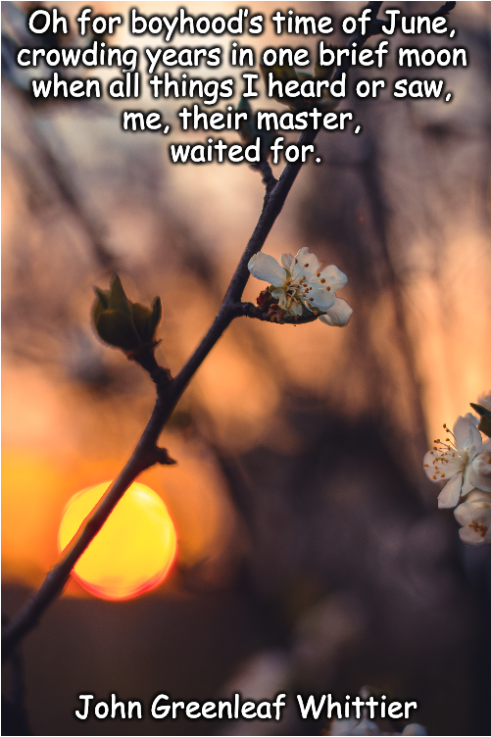
This is ‘not really an idiom’; it is a ‘literary quotation’ from a poem.
The speaker is nostalgically remembering childhood, especially the joyful days of summer.
Line-by-line sense:
– “Oh for boyhood’s time of June”
→ The speaker longs for the bright, happy days of childhood, symbolized by “June”, a month of warmth, growth, and freedom.
– “Crowding years in one brief moon”
→ A single short month of childhood felt full of experiences, as if many years of joy and discovery were packed into it.
– “When all things I heard or saw”
→ Everything in the world seemed exciting and full of wonder.
– “Me, their master, waited for”
→ As a child, the speaker felt that the whole world was waiting for him to explore it, enjoy it, and imagine himself in control of it.
🌿 Overall Meaning:
The quote expresses ‘nostalgia for childhood’, when life felt magical, free, rich, and full of possibility. It remembers a time when the natural world seemed to belong to the child’s imagination.
✍️ Author: John Greenleaf Whittier
– American poet and abolitionist
– Lived 1807–1892
📖 Origin:
– The lines come from Whittier’s poem “The Barefoot Boy”.
– The poem celebrates the freedom, innocence, imagination, and joy of childhood.
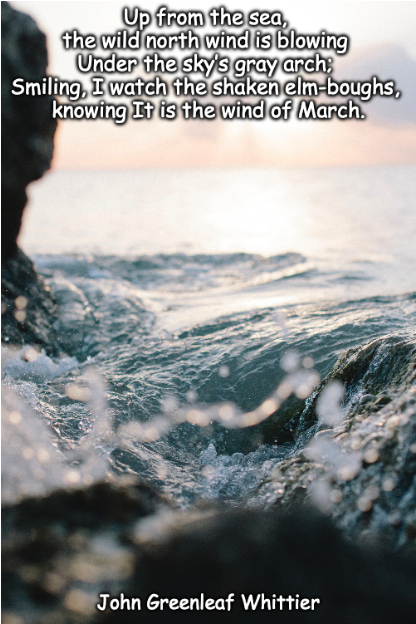
Up from the sea, the wild north wind is blowing Under the sky’s gray arch; Smiling, I watch the shaken elm-boughs, knowing It is the wind of March.