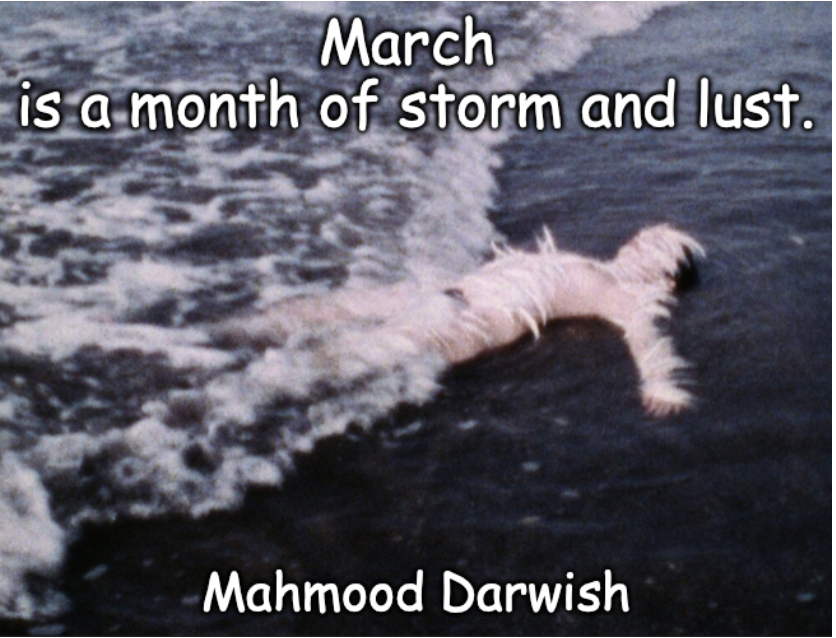
Mahmood Darwish

March is a month of storm and lust.

Photo by Ana Mendieta, Ocean Bird (Washup), 1974. Silueta Series.Meaning 🌪️❤️: The saying “March is a month of storm and lust” refers to the characteristic qualities of the month of March, both meteorologically and figuratively: Storm (weather): March is known as a transition month between winter and spring. The weather can be very changeable, with strong winds, rain showers and sometimes even wintry showers (“March showers”). It is a month in which the weather can go in all directions, hence the “storm”. Lust (figuratively): “Lust” here does not so much refer to sexual lust, but more to a general vitality, drive or zest for life. Natural lust: Nature awakens in March. Plants start to grow, trees bud and animals become more active. There is a clear urge for life and reproduction in nature. Human lust: March can also be a time for people when energy and the desire for new things increase after the dark winter months. It can also refer to a certain restlessness or unrest that comes with the changing of the seasons. Taken together, the saying suggests that March is an unpredictable, energetic, and sometimes wild month, both in the weather and in the natural and human urge for life and activity. Origin and Author 📜: Conclusion on Authorship: While Mahmood Darwish undoubtedly wrote beautiful poetry that blends natural elements and deep emotions, it is more likely that “March is a month of storm and lust” is a traditional English saying reflecting observations of the weather and nature in March, rather than a direct utterance by Mahmood Darwish. Folk wisdom: It is most likely an expression of folk wisdom based on centuries of observation of nature and the weather in March. Many older sayings about months and seasons arose in this way. Think of sayings like “March stirs its tail” or “April does what it wants.” Oral tradition: Before such sayings were written down, they were passed down orally from generation to generation, making it difficult to trace a specific source. Variations: It is possible that several variations on this theme existed over time, and that this became the most common or catchy formulation. Conclusion: Although it is a recognizable and catchy saying, there is no known author or exact date of origin. It is part of the treasure trove of Dutch proverbs and sayings that reflect observations of life and nature.

Door Pieter

Mensenmens, zoon, echtgenoot, vader, opa. Spiritueel, echter niet religieus. Ik hou van golf, wandelen, lezen en de natuur in veel opzichten. Onderzoeker, nieuwsgierig, geen fan van de mainstream media (MSM).

Geef een reactie

Je e-mailadres wordt niet gepubliceerd. Vereiste velden zijn gemarkeerd met *