Félicité Robert de Lamennais:
(La Mennais) (Saint-Malo, 19 June 1782 – Paris, 27 February 1854).
French Catholic priest, philosopher and political writer.
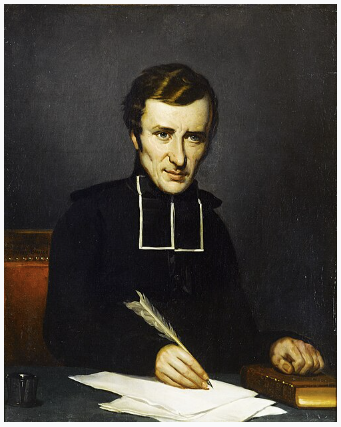
Felicité de La Mennais (1827); portrait L. D. Lancôme. wikipedia.org.
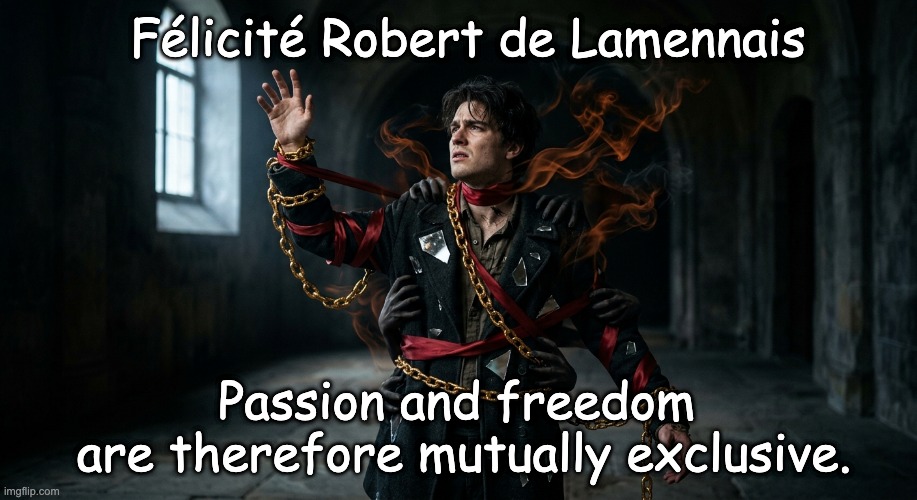
Passion and freedom are therefore mutually exclusive.
Image: Peter van Geest AI. Meaning 📖 🧠:The saying “Passions and freedom are mutually exclusive” means that a person who is controlled by his ‘passions, drives, or desires’ is ‘not truly free’. Core idea: “Freedom” here does not mean doing whatever you feel like doing. Rather, “freedom” means being able to control oneself. Whoever is a slave to anger, jealousy, desire, ambition, addiction, or other passions does not act autonomously but is inwardly compelled. Philosophical implication:The statement fits into a classical moral and philosophical tradition in which the following holds:true freedom = inner independence,unfreedom = being dominated by passions. In other words: He who does not control his passions is controlled by them. 📚 Origin:The statement stems from the work: “De la religion”, published in 1841. The original French formulation reads: « Les passions et la liberté s’excluent l’une l’autre. » Context: The sentence expresses a moral-philosophical thought that is strongly present in religious and ethical reflections from the 19th century: man is only free when he is not subjected to his lower inclinations; freedom therefore requires ‘self-control’ and ‘moral order’. 👤 Author:Félicité Robert de Lamennais (1782–1854). Lamennais was a: French thinker, writer, priest, and religious philosopher. He wrote about: religion, morality, society, freedom, and the spiritual destiny of man. In this case, the attribution is ‘clear and correct’.
Door Pieter
Mensenmens, zoon, echtgenoot, vader, opa.
Spiritueel, echter niet religieus.
Ik hou van golf, wandelen, lezen en de natuur in veel opzichten.
Onderzoeker, nieuwsgierig, geen fan van de mainstream media (MSM).