Whenever a treaty of peace is signed, God is present.

The saying reflects a core idea in Rebbe Nachman’s thought:
That peace (‘shalom’) is not merely a human political arrangement but carries a spiritual, sacred dimension. For Nachman, peace was one of the highest values, closely tied to truth and to the presence of the Divine (the Shechinah) in the world. He taught elsewhere that “the essence of peace is to merge two opposites” and that “where there is no peace, prayers are not heard.” In that context, saying God is “co-signed” onto a peace treaty means that genuine reconciliation between enemies is itself a sacred act — one in which the Divine presence becomes manifest. Peace-making mirrors God’s own unifying, reconciling nature, so a peace treaty carries not just legal but sacred weight.
Origin:
The saying circulates in English as:
“Whenever a treaty of peace is signed, God is present” (sometimes rendered as “A peace treaty is always co-signed by God”).
It’s often labeled a “Yiddish saying” because Nachman taught and spoke in Yiddish in daily life, but strictly speaking it isn’t an anonymous Yiddish folk proverb (unlike something like “Man plans, God laughs”). Rather, it comes from the corpus of Hasidic teachings attributed to him, recorded chiefly in Hebrew by his scribe and chief disciple, Reb Nathan of Breslov (Nathan Sternhartz), in works like “Likutei Moharan” and related collections of his sayings and stories.
– A caution:
I could not trace this specific line to an exact passage in “Likutei Moharan” or “Sichot HaRan” — it circulates widely on quote-aggregator sites with this attribution, but it may be a later paraphrase or loose translation of his teachings on peace rather than a verbatim quotation. Treat the precise wording/sourcing with some caution, even though the general attribution is fairly consistent across sources.
Author:
Rebbe Nachman of Breslov (1772–1810)
— Hasidic master, great-grandson of the Baal Shem Tov, and founder of the Breslov Hasidic movement, active in Ukraine.
Lies are common fare; truth is a feast.
– ‘Lies are ordinary, abundant, and easy to come by’ — like everyday food.
– ‘Truth is rare, valuable, and nourishing’ — like a special feast.
– It suggests a somewhat cynical view of human life: people often encounter falsehoods more often than honesty, so truth should be valued when it appears.
In simpler wording:
“Falsehood is common; truth is precious.”
Origin 🌍:
This saying is usually cited as a ‘Yiddish / Jewish proverb’, not as a modern authored quotation.
It belongs to the tradition of ‘Ashkenazi Jewish folk wisdom’, where proverbs often use food, holidays, and household images to express moral lessons.
Author ✍️:
There is ‘no known individual author’. Like most proverbs, it is considered ‘anonymous’ and traditional.
If you see it attributed simply to “Yiddish proverb,” that is probably the safest attribution.
Note on wording 📝:
The English phrase “common fare” means “ordinary everyday food,” while “feast” means a special, celebratory meal. So the proverb is using a food metaphor to contrast the everydayness of lies with the rarity of truth.
Everyone is kneaded out of the same dough but not baked in the same oven.

– People may be made from the ‘same basic “stuff” (common human nature, similar origins, same potential).
– But they ’turn out differently’ because of the ‘conditions’ they face and the ‘environment/process’ they go through (family, opportunities, experiences, discipline, etc.).
– In short:
‘same starting material
→ different outcomes’ due to different “ovens” (circumstances).
🌍 Origin / Author:
This line is ‘very likely a Yiddish / Jewish proverbial-style saying’—or at least a translation of that tradition—but:
– There’s ‘no single universally agreed-upon original’ wording or ‘named author’ attached to this exact sentence in most proverb databases.
– Similar Yiddish sayings and Jewish proverb variants are common, and English versions often circulate as:
– “Same dough… different oven”
– “Kneaded from the same dough… baked differently”
– “One dough… different baking”
📌 Why it’s hard to pin down an exact author:
Proverbs like this typically come from ‘folk speech’ neder rather than a documented literary source, and multiple versions spread across languages (Yiddish → English, Russian/Yiddish-influenced proverb collections, etc.).
📝 What I can say confidently:
– ✅ It’s proverb-like and aligns strongly with Yiddish/Jewish idiom tradition
– ❌ No widely documented single author
– ❌ Exact earliest citation depends on which English version you found, and that version may be a later retelling/translation
I ask not for a lighter burden, but for broader shoulders.
The proverb reframes how a person relates to hardship. Rather than asking for troubles to be removed or made easier, the speaker asks for the inner and physical capacity to bear them — for strength, not relief.
It’s a statement of resilience:
the goal isn’t an easier life, but a self equal to whatever life brings. This resonates with a recurring theme in Jewish thought — endurance through adversity, and the belief that difficulty is met by growing capable of carrying it, not by escaping it.
Origin:
This is a traditional ‘Yiddish/Jewish’ folk proverb, the kind of saying that develops through oral culture rather than a single written source. It’s closely related to (and possibly a free translation of) an older Yiddish line, “Got git di last laut di pleitses” — “God gives the burden according to the shoulders” — which carries a similar idea: that what a person is asked to endure is matched to what they’re able to endure.
Author: ‘No specific author.’
Every reliable source treats it as anonymous folk wisdom, credited generically as “Jewish Proverb” or “Yiddish Proverb” in quote collections rather than to a named poet, rabbi, or writer. If you’ve come across an attribution to a particular individual somewhere, it isn’t well supported — the honest answer is that it belongs to communal, oral tradition rather than to one author.
The worst wheel squeaks loudest.
The fool’s world is a paradise.

Too bad, the bride is so pretty!

The tavern can’t corrupt a good man, the synagogue can’t reform a bad one.

A word to the good is enough, but even a stick won’t help the bad.
A guest is like the rain: when he persists, he is a nuisance.
A brother turned enemy is an enemy for life.
The beautiful is not always good; the good is not always beautiful.
You don’t stumble because you are weak, but because you think yourself strong.
Even if a man sees his grave open, he must always hope.

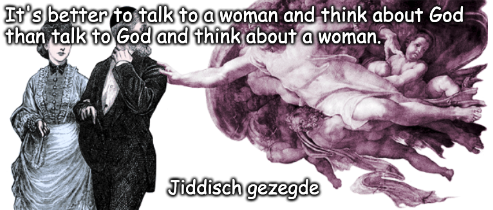
It’s better to talk to a woman and think about God than talk to God and think about a woman.
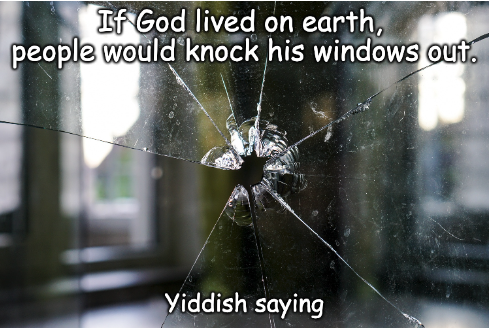
If God lived on earth, people would knock his windows out.
In the bed of a divorced man who has a divorced wife, there are always four people.

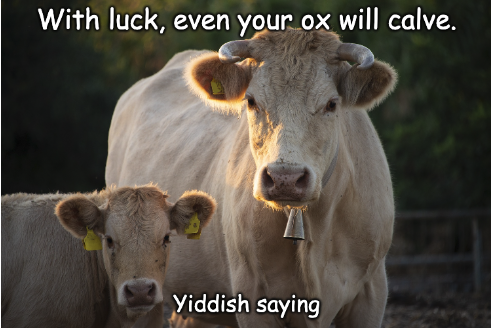
With luck, even your ox will calve.
With money in your pocket you are wise and you are beautiful and you can sing beautifully too.

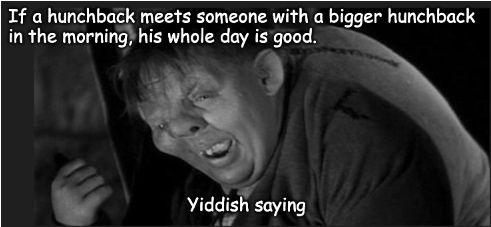
If a hunchback meets someone with a bigger hunchback in the morning, his whole day is good.
He who dances at all weddings, cries at all funerals.

If a girl can’t dance, she says the musicians can’t play.
Take staff, but do it yourself.
Man was created on the last day, even the mosquito is older.
There’s no bad liquor for a drunkard, no bad money for a dealer, and no ugly woman for a lecher.
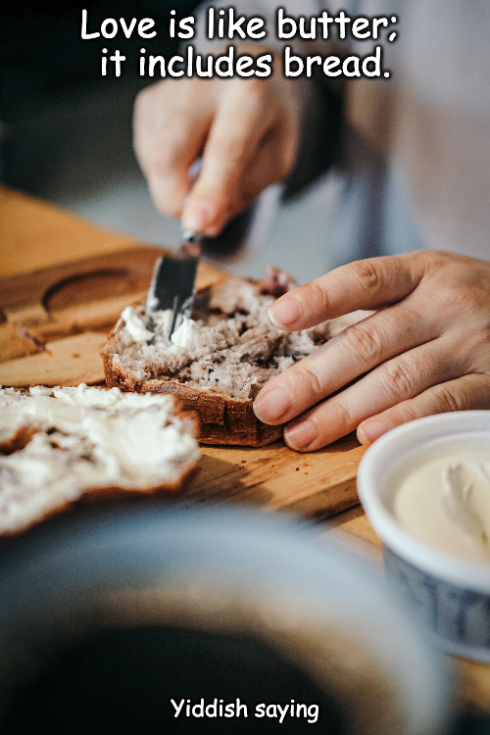
Love is like butter; it includes bread.
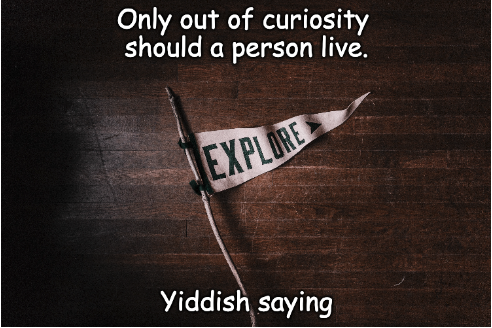
Only out of curiosity should a person live.
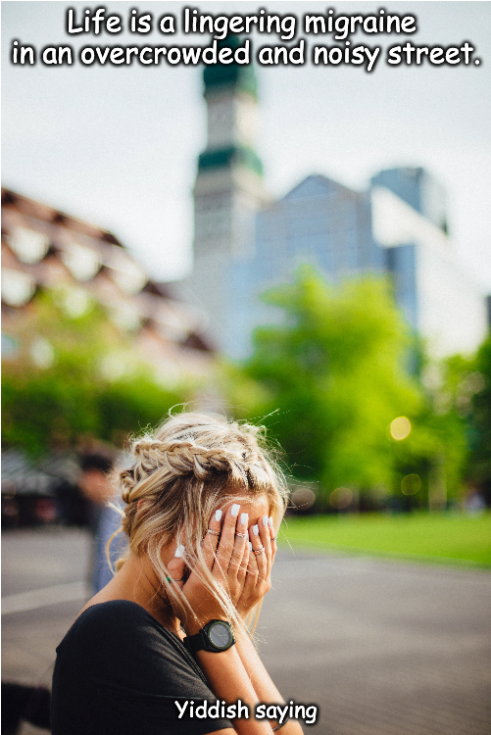
Life is a lingering migraine in an overcrowded and noisy street.
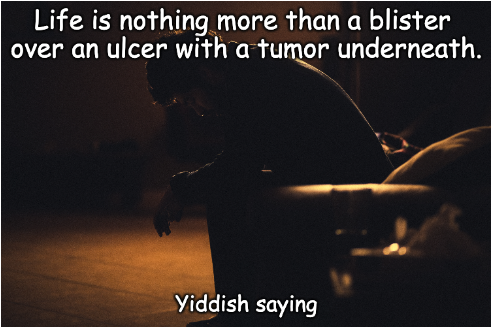
Life is nothing more than a blister over an ulcer with a tumor underneath.
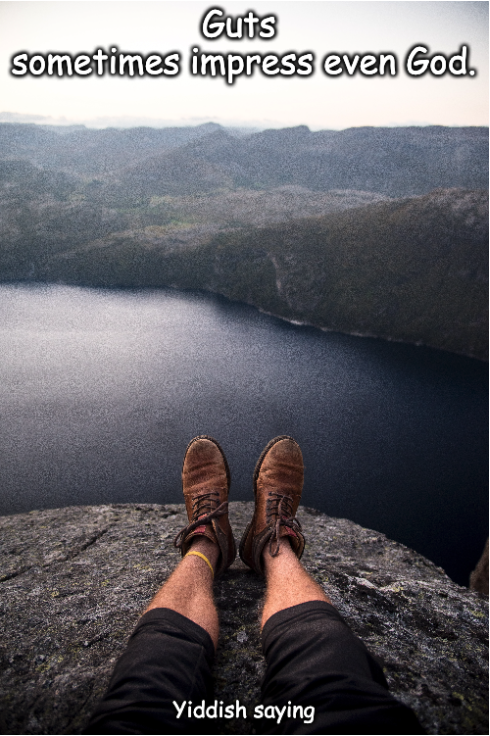
Guts sometimes impress even God.
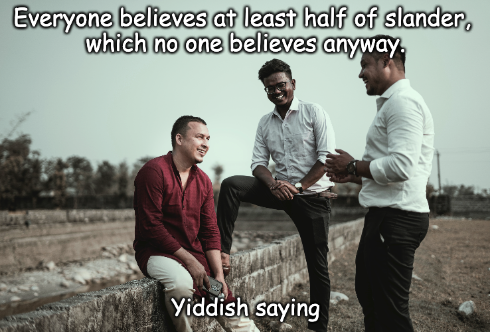
Everyone believes at least half of slander, which no one believes anyway.
If you want your dreams to come true, don’t sleep.
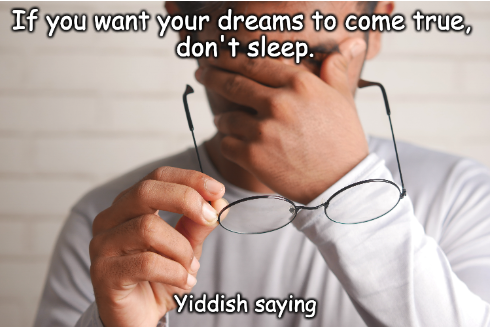
– ‘Ambitions require action’ — you cannot achieve goals by merely wishing or fantasizing.
– “Dreams” here means hopes, plans, or life goals.
– “Don’t sleep” means don’t be passive, lazy, or idle; wake up and work toward what you want.
In simple terms:
> ‘Success comes from effort, not just imagination.’
🌍 Origin:
This saying is often described as a ‘Yiddish proverb’ or ‘Yiddish folk saying’, but its exact original source is unclear.
– It belongs to the tradition of ‘Jewish/Yiddish practical wisdom’, which often uses humor and irony to make a moral point.
– The wording commonly appears in English as:
– “If you want your dreams to come true, don’t sleep.”
– or
“If you want your dreams to come true, wake up.”
✍️ Author:
There is ‘no known individual author’.
Because Yiddish proverbs were usually passed down orally, many do not have a documented first author.
🗣️ Possible Yiddish Form:
A literal Yiddish rendering would be:
> ‘Oyb du vilst az dayne khaloymes zoln mekuyem vern, shlof nisht.’
Meaning:
> “If you want your dreams to be fulfilled, don’t sleep.”
⚠️ Note: This is a literal Yiddish version; the exact traditional wording may vary.
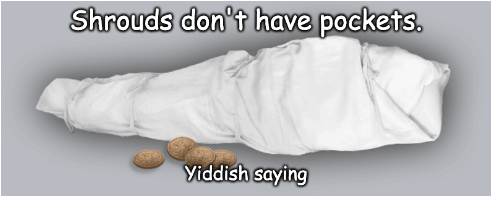
Shrouds don’t have pockets.
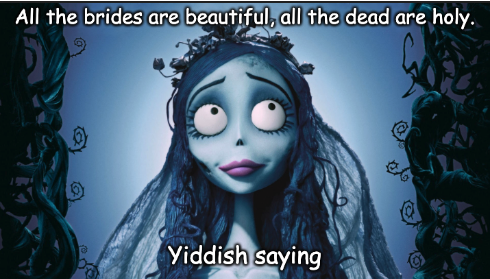
All the brides are beautiful, all the dead are holy.
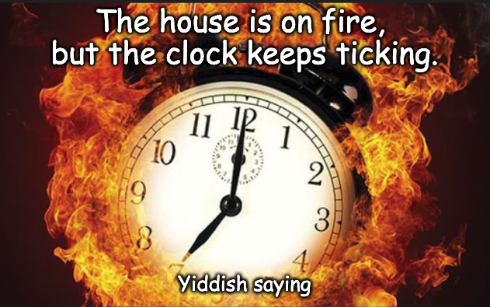
The house is on fire, but the clock keeps ticking.
If you are bitter at heart, sugar in the mouth will not help you.
You can’t dance at two weddings.

He who is clever hears one word and understands two.

Anyone who thinks that an argument is valid because it is printed is an idiot.
Attractiveness is better than beauty.

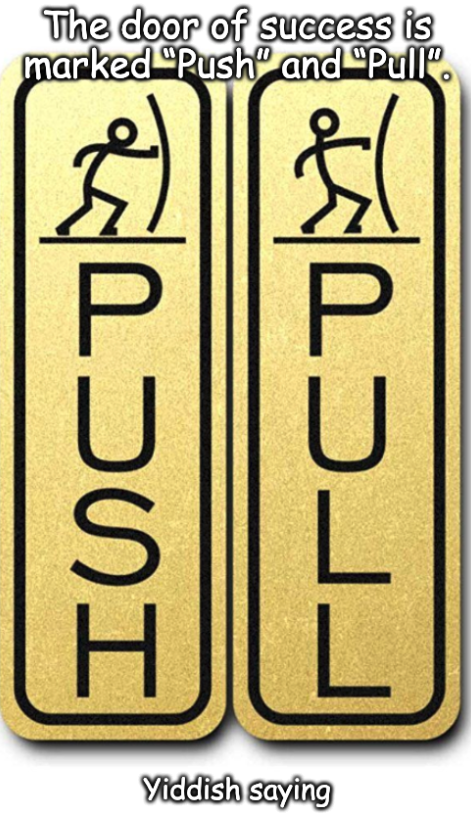
The door of success is marked “Push” and “Pull”.
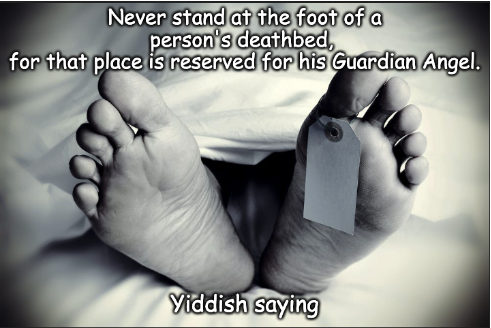
Never stand at the foot of a person’s deathbed, for that place is reserved for his Guardian Angel.
Never ask questions about fairy tales.

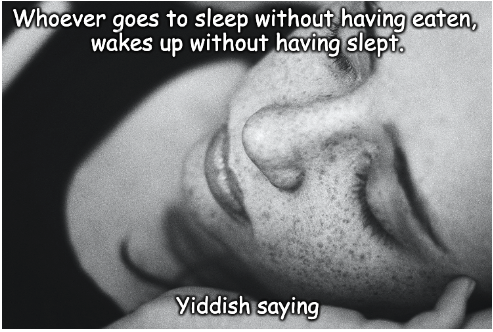
Whoever goes to sleep without having eaten, wakes up without having slept.
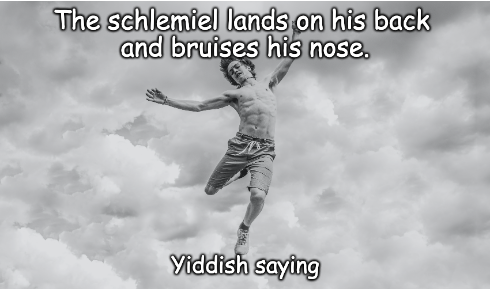
The schlemiel lands on his back and bruises his nose.
One should always view himself as half innocent and half guilty.

A rich man goes hungry only on doctors orders.

One would give one’s last shirt to become a millionaire.

Ask for advice, but use common sense.
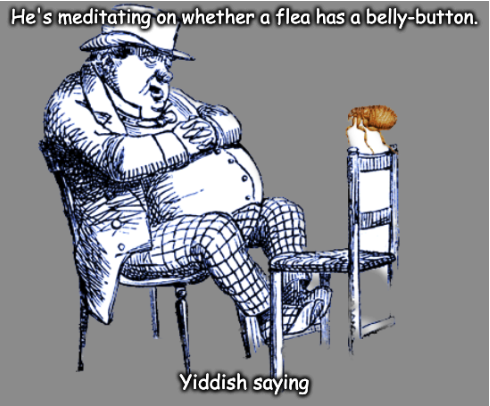
He’s meditating on whether a flea has a belly-button.
New worries make old worries forget.
Worries go down better with soup than without.

It’s a bit of comfort-food wisdom:
Worry doesn’t disappear just because you’re eating soup, but it feels more bearable when you’re warm, fed, and cared for. It captures a very Jewish/Yiddish blend of stoicism and self-care — you can’t always fix a problem, but you can make yourself more able to bear it.
Origin:
“Authorship is unknown”, though the saying is commonly credited as a ‘Yiddish proverb’. The earliest documented print appearance seems to be its inclusion in the 1949 book “Yiddish Proverbs” by Hanan J. Ayalti. It then shows up repeatedly through the mid-20th century — for instance in a 1964 issue of “Jewish Affairs,” the journal of the South African Jewish Board of Deputies, and a 1972 Milwaukee Sentinel article on soup that called it “the Yiddish proverb”.
Like most folk proverbs, it wasn’t coined by a single identifiable person — it circulated orally in Yiddish-speaking communities before being collected in print, which is why you’ll see it attributed generically as “Yiddish Proverb” or “Jewish Proverb” rather than to a named author.
If all men were sages, mankind would soon be extinct.
– If everyone were purely intellectual, overly prudent, ascetic, or devoted only to study and wisdom, people might avoid the messy, risky, irrational parts of life — especially ‘marriage, sex, and child‑rearing’.
– Humanity continues not only because of wisdom, but also because of ‘instinct, passion, ordinary foolishness, and practical life’.
– It is a humorous, slightly cynical proverb:
too much “wisdom” might make people think better of reproducing.
In short:
the world needs more than sages; it also needs ordinary human desire and folly.
Yiddish / Jewish Origin ✡️:
The saying is usually treated as a ‘Yiddish or Jewish proverb’, not as a quotation from a known author.
A plausible Yiddish form would be something like:
> ווען אַלע מענטשן וואָלטן געווען חכמים, וואָלט די וועלט אויסגעשטאָרבן.
> Ven ale mentshn voltn geven khakhomim, volt di velt oysgeshtorbn.
> “If all people were sages, the world would die out.”
Here ‘khakhomim’ comes from Hebrew ‘ḥakhamim / חכמים’, meaning “wise men” or “sages.”
Author ✍️:
– ‘No individual author is known.’
– It belongs to the category of ‘anonymous folk wisdom / proverb’.
– English versions may vary:
“men,” “people,” “sages,” “wise men,” “mankind,” “the world,” etc.
Possible Rabbinic Echo 📚
The idea resembles a theme found in Jewish rabbinic literature:
the tension between ’total devotion to Torah study’ and the obligation to marry and have children.
A famous example is Ben Azzai, a Talmudic sage who praised the commandment to “be fruitful and multiply” but did not marry himself, saying his soul was attached to Torah and that the world could be sustained by others. That story appears in the Talmud, Yevamot 63b.
So the proverb may echo that older Jewish idea, but the exact sentence itself is best described as:
> ‘an anonymous Yiddish/Jewish proverb, not a traceable quotation by a named author..
The truth is the safest lie.
A young woman for an old man; a hard nut for a crumbly tooth.
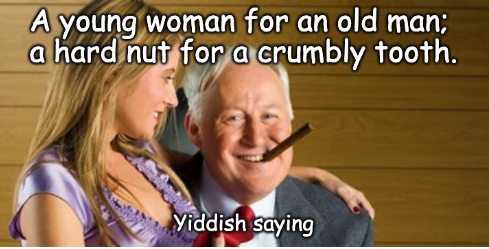
– An old man marrying or pursuing a much younger woman is ‘an ill-suited match’.
– The “young woman” is compared to a ‘hard nut’ — desirable, but difficult to “manage” or enjoy.
– The “old man” is compared to a ‘crumbly/weak tooth’ — not capable of dealing with the challenge.
– It implies a mix of ‘humor, warning, and sexual/social realism’:
desire may exceed ability.
In plain English:
> ‘Some things may be tempting, but they are no longer suitable for you.’
🗣️ A likely Yiddish-style version would be approximately:
> ‘A yunge froy far an altn man iz vi a harte noz far a morshn tson.’
> ‘A young woman/wife for an old man is like a hard nut for a rotten/weak tooth.’
Wording varies in translation:
– “young woman” / “young wife”
– “old man” / “old husband”
– “crumbly tooth” / “bad tooth” / “rotten tooth” / “weak tooth”
📜 Origin:
– The saying comes from ‘Yiddish-speaking Ashkenazi Jewish folk tradition’.
– It belongs to the world of ‘oral proverbs’, especially the humorous, sharp, practical wisdom common in Yiddish culture.
– Similar proverbs exist in other European folk traditions, so it may reflect a broader old-world proverb pattern, but it is commonly identified as ‘Yiddish’.
✍️ Author: ‘No known individual author’.
It should be credited as:
> ‘Anonymous Yiddish proverb’
or
> ‘Traditional Yiddish saying’
⚠️ Tone / Nuance:
– humorous,
– earthy,
– somewhat cynical,
– and reflects older attitudes about age, marriage, and sexuality.
Today it may sound old-fashioned or sexist, but its main point is about ‘mismatch between desire and capacity’.
Run away from fire and you get water.
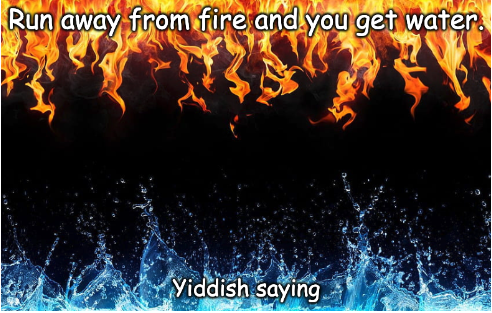
– ‘You escape one danger or problem, only to land in another.’
– ‘Avoiding one extreme may throw you into the opposite extreme.’
– It can imply that a hurried or fearful escape may not actually solve anything.
In context, “fire” represents one threat, while “water” is not necessarily safety — it may mean ‘drowning, being overwhelmed, or a different kind of trouble’.
Similar English idioms:
– “Out of the frying pan and into the fire.”
– “From bad to worse.”
– “Escaping one trap only to fall into another.”
The difference is that the Yiddish-style version uses ‘opposites — fire and water’ — to stress irony: you flee burning, but end up drowning.
🗣️ Is it Yiddish?
Yes, it is very likely a translation or paraphrase of a Yiddish proverb. A possible Yiddish form would be something like:
> “פֿון פֿײַער אַנטלויפֿן און אין וואַסער אַרײַנפֿאַלן”
> “Fun fayer antloyfn un in vaser araynfaln”
> “To run away from fire and fall into water.”
Exact wording varies, as with many folk sayings.
📜 Origin:
– The saying belongs to the tradition of ‘Yiddish / Ashkenazi Jewish folk proverbs’.
– It is probably ‘oral and anonymous’, not a line invented by a known writer.
– Similar “escape one danger, meet another” proverbs exist in many languages, so the idea is not uniquely Yiddish, though this ‘fire/water formulation’ has a Yiddish flavor.
✍️ Author: There is ‘no known individual author’.
It should be cited as:
> ‘Yiddish proverb’
> or
> ‘Anonymous Yiddish folk saying’
The author may have been ‘quoting or adapting’ the proverb rather than creating it.
A loss that can be made up for with money is only a small loss.
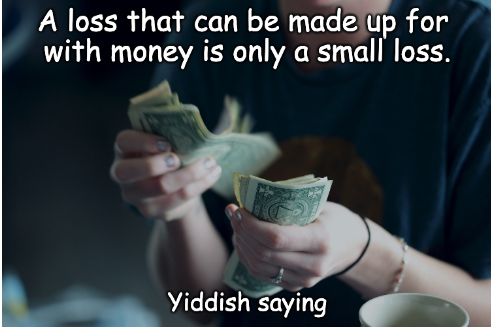
– If money can repair, replace, or compensate for something, then the loss is not among life’s worst losses.
– The truly serious losses are things money cannot restore, such as:
– health
– life
– love
– trust
– time
– family
– peace of mind
In short:
> ‘If money can fix it, it is not the worst kind of problem.’
Origin 🌍:
This saying is usually described as a ‘Yiddish / Jewish proverb’.
It belongs to the tradition of ‘Ashkenazi Jewish folk wisdom’, where practical sayings about life, money, suffering, and perspective were passed down orally.
A common related version is:
> “If a problem can be solved with money, it is not a problem; it is an expense.”
The exact original wording may vary, because proverbs often exist in several forms.
Author ✍️: There is ‘no known individual author’.
It should be attributed as:
> ‘Traditional Yiddish proverb’
> or
> ‘Anonymous Jewish proverb’
His nose curls with pride, because the king’s donkey has urinated right outside his door.

– Someone is ‘absurdly proud of a meaningless connection to power or status’.
– They feel honored merely because something associated with an important person came near them — even if that “honor” is actually dirty, ridiculous, or insulting.
– It mocks ‘snobbery, servility, name-dropping, and basking in reflected glory’.
In plain English:
> “He is so status-obsessed that even being dirtied by the king’s donkey feels like a privilege.”
Comparable ideas:
– “He thinks he’s important because he once stood near someone important.”
– “He is proud of receiving crumbs from the powerful.”
– “Basking in reflected glory.”
🐴 Why the donkey and urine?
The joke is in the contrast:
– The king = highest authority, prestige, power.
– The donkey = a lowly animal, not the king himself.
– Urinating outside the door = not an honor at all; it is a nuisance or insult.
So the saying ridicules a person who turns even a degrading or trivial contact with greatness into a source of pride.
🌍 Origin:
This is generally treated as an ‘old Yiddish / Eastern European Jewish folk saying or proverb’.
A possible Yiddish-style version would be something like:
> ‘Er krimpt di noz fun shtolts, vayl dem meylekhs eysl hot gepisht bay im far der tir.’
> “He wrinkles/curls his nose with pride because the king’s donkey pissed by his door.”
The exact wording may vary in translation. Yiddish proverbs often appear in several forms, especially when translated into English.
✍️ Author: There is ‘no known individual author’.
It is best described as:
– ‘Anonymous’
– ‘Traditional’
– ‘Yiddish folk proverb / saying’
If it appears in a book, the named person is usually the ‘collector, translator, or editor’, not the original author.
Anyone who believes that everything is for sale is willing to sell himself.

This saying is a ‘moral critique of extreme materialism’.
It suggests that:
– If you reduce ‘all things’—including human values, relationships, honor, and principles—to items with a ‘price tag’, then you logically must also accept that ‘your own integrity and dignity’ can be bought and sold.
– The person who believes “everything has a price” inevitably becomes willing to trade away their self-respect, reputation, or moral code for money or advantage.
– It warns that ‘cynical greed is self-destructive’:
The more you see the world as a marketplace, the more you become a ‘commodity yourself’—selling your soul, piece by piece.
In short:
‘The belief that all is for sale dehumanizes the believer, because it makes them willing to sell their own worth.’
📜 Origin:
– This saying is a ’traditional Yiddish proverb’ (a folk saying from Ashkenazi Jewish communities in Eastern/Central Europe).
– It was ‘passed down orally’ over generations, likely originating in the ’18th–19th centuries’ within Jewish communities that valued ‘ethical warnings against greed’ (echoing teachings from the ‘Pirkei Avot’ / Ethics of the Fathers).
– The proverb was later ‘collected and published’ in anthologies of Yiddish wisdom, such as ‘The Joys of Yiddish’ by Leo Rosten (1968) or earlier proverb collections from the late 19th/early 20th century.
– It is not a literary quote from a single book or philosopher—it belongs to ‘folk tradition’, which is why it has no single documented first appearance.
👤 Author:
– ‘Anonymous’ (as is typical for traditional proverbs).
– The saying is attributed to ‘Yiddish-speaking Jewish culture’, not to any specific individual.
– It is often ‘misattributed online’ to modern thinkers (e.g., Ayn Rand, Milton Friedman) but those claims have ‘no historical evidence’.
– The true “author” is the ‘collective wisdom of a community’—a hallmark of folk proverbs.
A deaf man heard how a mute told that a blind man has seen how a cripple walked.
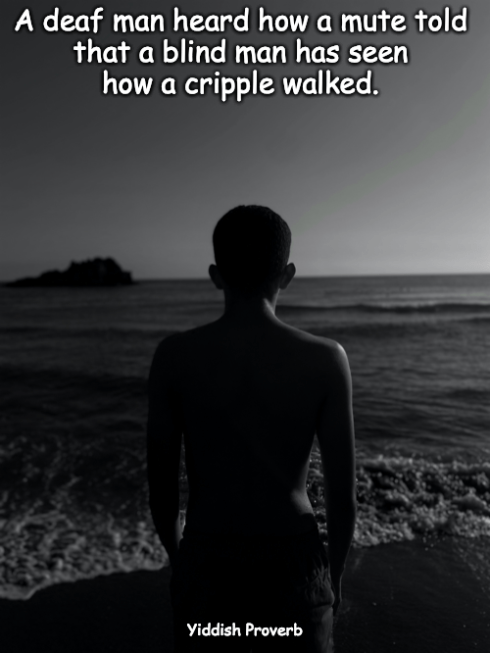
– ‘The story is completely unbelievable’ — every link in the chain is impossible.
– ‘It mocks gossip, rumors, and hearsay’: “Someone heard from someone who said someone saw…”
– It is used when a claim has ‘no credible source or evidence’.
In short:
“That report is so unreliable that it might as well have come from impossible witnesses.”
Why it is funny / paradoxical 😄:
Each part cancels itself out:
– A ‘deaf man’ cannot hear.
– A ‘mute man’ cannot tell/say it.
– A ‘blind man’ cannot see.
– A ‘cripple/lame man’ walking may be impossible or miraculous, depending on the wording.
So the whole sentence is a chain of absurd impossibilities.
Origin 🌍:
It is often quoted as a ‘Yiddish or Jewish proverb’, usually in forms like:
> “A deaf man heard a mute man say that a blind man saw a lame man run.”
However, it is probably not exclusively Yiddish. Similar versions exist in several European and Middle Eastern folk traditions. It belongs to a broad family of ‘folkloric nonsense proverbs’ or ‘anti-hearsay sayings’.
So the safest description is:
> ‘A traditional proverb, often attributed to Yiddish/Jewish folklore, with many international variants.’
Author ✍️: There is ‘no known individual author’.
It is a ‘folk proverb’, meaning it was passed down orally and appears in different versions. When quoted, it is usually attributed simply to:
– ‘Yiddish proverb’
– ‘Jewish proverb’
– ‘Traditional proverb’
– ‘Anonymous’
Comparable English sense 📌:
> “That’s just hearsay on top of hearsay.”
or
> “A friend of a friend of a friend said…”
with the added implication that the source is absurdly impossible.
