Life is nothing more than a blister over an ulcer with a tumor underneath.
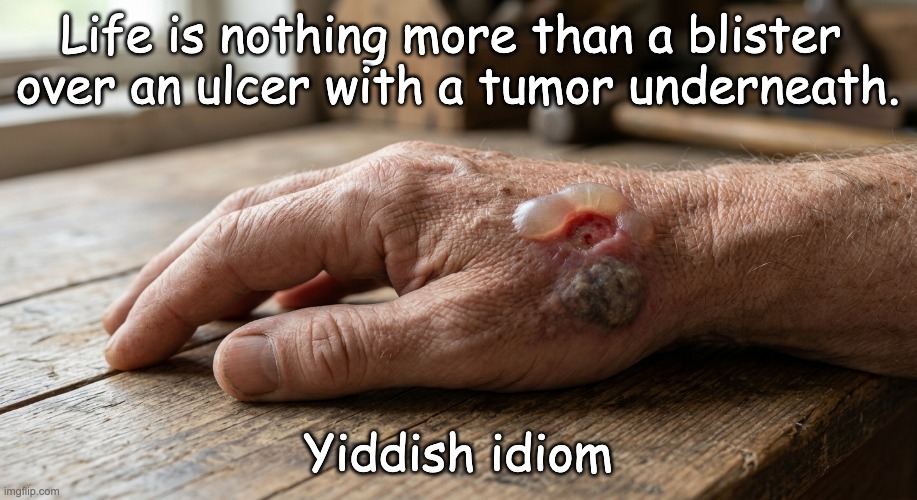
This quote is a deeply cynical, pessimistic, and visceral metaphor for human existence. It suggests that life is fundamentally defined by suffering and decay, with only a thin, superficial layer of apparent normality or “well-being” covering layers of deeper, progressive illness or tragedy.
– “Blister on an ulcer”:
The ‘blister’ represents the apparent, mundane ‘good’ parts of life or perhaps a temporary reprieve from pain. But a blister is fragile and easy to break. Below this lies the ‘ulcer’ – a deeper, persistent sore or source of pain that is hidden but still present.
– “With a tumor underneath”:
The “tumor” represents the ultimate, inevitable source of decay and destruction – death or some profound, unstoppable tragedy that lies beneath it all and is quietly growing.
Essentially, it states that the moments of happiness or relief (the blister) are merely illusions or temporary states that mask a core of suffering (the ulcer), which in itself is only a harbinger of inevitable, deeper destruction (the tumor).
🕵️♂️ Origin and author: No known author. The saying is mentioned as a ‘Yiddish saying’, but there is no really solid evidence for this.
Guts sometimes impress even God.
“Guts sometimes impress even God”
is a softened, modern paraphrase. More accurately, the saying means:
> ‘Extraordinary audacity or persistence can sometimes get results—even when directed toward God.’
Here ‘chutzpah’ means brazen nerve, boldness, or impudence. “Heaven” is a respectful euphemism for God.
The saying is not necessarily praising courage, and “impress” does not mean “win God’s admiration.” In context, it means that brazenness may ‘prevail, have an effect, or obtain a concession’.
📖 Biblical context:
The Talmud applies the saying to Balaam in Numbers 22. God initially tells Balaam not to accompany Balak’s messengers, but after Balaam persists, God permits him to go. The outcome is not presented as divine approval—God subsequently becomes angry with him.
Thus the sense is closer to:
> “Chutzpah can sometimes prevail even against Heaven.”
📜 Origin:
The line is a loose English rendering of a saying in the “Babylonian Talmud, Sanhedrin 105a”:
> חוצפא אפילו כלפי שמיא מהני
> Ḥutzpa afilu kelapei Shemaya mahanei.
Literally:
> “Impudence is effective even toward Heaven.”
It is introduced with:
> אמר רב נחמן — “Rav Naḥman said…”
The speaker is conventionally identified as Rav Naḥman bar Yaakov, a third-century Babylonian rabbi.
🗣️ Is it Yiddish?
Not originally. The Talmudic sentence is ‘Jewish Babylonian Aramaic’, with Hebrew/rabbinic vocabulary. However, ‘chutzpah’ passed into Yiddish and then English, so the saying is often described loosely as a “Yiddish proverb.”
There is no modern “author” of the exact English wording. It is best regarded as a free translation or adaptation of Rav Naḥman’s Talmudic dictum.
Even one hour in paradise is good.

The saying captures a kind of pragmatic, bittersweet optimism that runs through a lot of Yiddish wisdom literature:
‘a brief taste of something good is still worth having, even if it doesn’t last.’ It pushes back against the idea that joy or fulfillment only “counts” if it’s permanent or complete.
Even a fleeting moment of peace, happiness, or grace — an “hour in paradise” — has real value and shouldn’t be dismissed just because it will end. There’s also a quieter, more resigned undertone common to Yiddish proverbs generally:
‘life is short and mostly hard, so take the good when it comes, however briefly.’
Origin:
It comes out of the broader tradition of Yiddish proverbs (‘shprikhverter’) that developed among Ashkenazi Jewish communities in Eastern Europe, passed down orally for generations before being collected in print by folklorists and linguists in the 19th and 20th centuries (figures like Ignaz Bernstein and Nahum Stutchkoff compiled major published collections). Like most proverbs in this tradition, it has no single “author” — it’s a piece of collective folk wisdom.
Note on usage:
The writer Joan Leegant used this proverb as the title of her debut short story collection, “An Hour in Paradise” (2003), citing it as “the Yiddish proverb ‘Even an hour in Paradise is worthwhile.'” That’s likely where you encountered the phrase, but Leegant didn’t coin it — she was drawing on the existing proverb.
You can’t dance at two weddings.

This is a wonderful Yiddish idiom that beautifully captures a universal human truth.
This proverb:
“You can’t dance at two weddings”
(Yiddish: ‘Me ken nisht tantsn bay tsvey khasenes’),
is a powerful metaphor for ’the impossibility of being in two places or doing two conflicting things at once’.
Its core meaning can be broken down into several related concepts:
– Impossible Choices:
It highlights that some situations force a choice. You cannot have everything, and sometimes you must pick one path over another.
– Divided Loyalties:
It can refer to the difficulty of trying to please two different groups or people who have conflicting interests.
– Overcommitment:
It serves as a warning against spreading yourself too thin, trying to participate in every event or opportunity, and ultimately failing to fully commit to any of them.
– The Nature of Time and Space:
At its most literal level, it’s a simple statement of fact: you physically cannot be present at two separate events occurring simultaneously.
In essence, it’s a piece of wisdom about ‘making conscious choices, prioritizing, and accepting the limitations of being human.’
🌍 Origin:
This idiom is deeply rooted in ‘Eastern European Jewish culture’ and was a common saying in ‘Yiddish-speaking communities’.
– Cultural Context:
In traditional Jewish life, a wedding (‘khasene’) was a major, multi-day community event. It was full of joy, music, and, of course, dancing. To be invited to a wedding was a great honor and a significant social obligation.
– The Dilemma:
Imagine the social and emotional conflict for someone invited to two weddings on the same day! They would have to choose which family to honor, which celebration to join. This real-life, relatable dilemma became the perfect metaphor for broader life choices.
– Yiddish Folklore:
The proverb is a product of the rich oral tradition of Yiddish folklore. It wasn’t coined by a single individual but rather emerged from the collective wisdom and experiences of the people. It’s a classic example of “the wisdom of the folk.”
✍️ Author:
There is ‘no known single author’ of this proverb.
– Oral Tradition:
Like many idioms, folk songs, and fairy tales, “You can’t dance at two weddings”
is a product of oral tradition. It was passed down through generations, refined and polished by countless speakers until it became a fixed part of the language.
– Anonymous Wisdom:
The beauty of such proverbs lies in their anonymity. They don’t belong to one person but to the entire community that created and uses them. They represent a shared understanding of life’s complexities.
While you might find it used by many Yiddish writers (like Sholem Aleichem or Isaac Bashevis Singer) to add color and authenticity to their characters’ speech, they were ‘quoting a pre-existing folk saying’, not inventing it.
A wise man hears one word and understands two.
It praises the person who can grasp implications quickly — someone sharp enough to catch what’s ‘implied’ or hinted at, not just what’s literally said. It’s the opposite of needing everything spelled out. English idioms it overlaps with:
“a word to the wise is enough,” or “reading between the lines.”
Origin and author:
Yiddish original:
“A kluger farshteyt fun eyn vort tsvey” — literally “A clever person understands two [things] from one word.”
Like most Yiddish proverbs, ‘it doesn’t have a single named author’ — ‘it’s an anonymous folk saying’ that circulated orally in Ashkenazi Jewish communities in Eastern Europe, likely for generations before anyone wrote it down. It’s recorded in Nahum Stutchkoff’s 1950 Yiddish thesaurus, Der Oytser fun der Yidisher Shprakh (“The Treasury of the Yiddish Language”), which is one of the standard scholarly repositories of Yiddish vocabulary and idiom, but Stutchkoff was compiling existing usage, not coining the line. It also turns up in other well-known 20th-century collections of Yiddish proverbs, such as Hanan Ayalti’s “Yiddish Proverbs”.
It’s often paired with, or confused for, a related but distinct saying:
“a kluger veyst vos er zogt; a nar zogt vos er veyst” — “a clever person knows what he says; a fool says what he knows” — which is about discretion rather than quick comprehension. Worth noting, since the two get bundled together in lists sometimes.

It reflects a cultural value in Ashkenazi Jewish tradition that inner grace, warmth, and personableness (Yiddish: ‘kheyn’ — חן) matter more, and last longer, than mere physical attractiveness (‘sheynkeyt’ — שיינקייט). A related saying makes the same point directly:
“Charm is the soul of beauty.”
Another puts it even more plainly:
“You don’t need to be pretty, just charming.”
Origin:
Like most Yiddish proverbs, this one doesn’t have a single identifiable author — it’s ‘folk wisdom’, passed down orally through generations of Ashkenazi Jewish communities in Eastern Europe, and later collected in various anthologies of Yiddish sayings. It shows up consistently in lists of Yiddish proverbs, alongside other well-known ones like:
“Beautiful is not what is beautiful, but what one likes” and “Better a steady dime than a rare dollar.”
A likely deeper root:
The sentiment closely echoes a much older source — the Hebrew Bible. Proverbs 31:30 (part of the famous “Eshet Chayil” / “Woman of Valor” poem) says, in the original Hebrew, roughly “sheker ha-chen ve-hevel ha-yofi”
— “charm is deceptive and beauty is fleeting” (translated in the King James Version as “Favour is deceitful, and beauty is vain”).
The Hebrew word used there, ‘chen’ (חן), is the same root as Yiddish ‘kheyn’. So while the punchy modern proverb “charm is better than beauty” is a folk formulation, its underlying values-contrast between ‘chen/kheyn’ and ‘yofi/sheyn’ almost certainly traces back to this biblical verse, which has been part of Jewish liturgy (sung in many homes every Friday night as part of ‘Eshet Chayil’) for millennia.
One should always view himself as half innocent and half guilty.

This is ‘not originally Yiddish’. It comes from ‘rabbinic Hebrew/Aramaic sources’, especially the “Talmud”.
The idea is ethical and spiritual:
– A person should imagine that their moral standing is ‘exactly balanced’:
– half ‘meritorious / innocent’
– half ‘guilty / liable’
– Therefore, ‘one good deed’ can tip the balance toward merit.
– Conversely, ‘one sin’ can tip the balance toward guilt.
In broader form, the teaching says that a person’s actions may affect not only themselves but even the ‘whole world’, so every deed matters.
🕍 Origin:
The source is the “Babylonian Talmud”, tractate ‘Kiddushin 40b’.
In Hebrew:
> לעולם יראה אדם עצמו כאילו חציו חייב וחציו זכאי
> ‘Le-olam yir’eh adam et atzmo ke-ilu chetzyo chayav ve-chetzyo zakai.’
Meaning:
> “A person should always see himself as though he is half guilty and half meritorious.”
The Talmud continues:
> ‘If he performs one mitzvah, fortunate is he, for he has tipped himself toward merit.’
> ‘If he commits one transgression, woe to him, for he has tipped himself toward guilt.’
👤 Author / Attribution:
The statement appears in the Talmud as a ‘baraita’, an early rabbinic teaching. It is not a Yiddish folk idiom and does not have a single folk author.
A related expansion is attributed there to:
> Rabbi Elazar son of Rabbi Shimon
> Hebrew: רבי אלעזר ברבי שמעון
He adds the idea that one deed can tip not only the individual but the ‘entire world’ toward merit or guilt.
📚 Later Famous Version:
The teaching is also quoted and developed by “Maimonides / Rambam” in:
> “Mishneh Torah, Laws of Repentance — Hilchot Teshuvah 3:4”.
Rambam writes that a person should see both themselves and the entire world as evenly balanced, so that one action may tip the scale.
A rich man goes hungry only on doctors orders.

This is a truly insightful and witty Yiddish idiom that highlights a deep truth about human nature and the limitations of wealth.
This proverb is a sharp commentary on the relationship between wealth, self-discipline, and mortality.
– The Power of Wealth:
It underscores that the wealthy have the means to satisfy any craving. Their material resources can eliminate physical hunger easily.
– The Limits of Money:
However, even the richest person cannot buy perfect health or immortality. When facing medical necessity—such as preparing for surgery, managing a severe illness (like diabetes or heart disease), or following a strict diagnostic protocol—their wealth is irrelevant. They must submit to the same physical constraints as everyone else.
– The Reluctance of Discipline:
It implies that a wealthy person, accustomed to indulging their desires, would rarely ‘choose’ to go hungry out of simple self-control. They only accept such deprivation when an authority figure (the doctor) dictates it as a matter of survival.
In short, it means:
‘No amount of money can exempt you from the fundamental laws of biology and health.’
🌍 Origin:
This idiom is definitely ‘Yiddish’ in origin. It is a classic example of Yiddish folklore and oral tradition, which often uses humor and irony to address serious life themes.
– Cultural Context:
Eastern European Jewish life was often marked by poverty and struggle. The figure of the ‘naugid’ (the wealthy man) was viewed with a mix of respect for their success and a grounded, sometimes cynical understanding of their humanity.
– Irony and Wit:
Yiddish humor is famous for its “laughter through tears” and sharp social commentary. This idiom perfectly captures that spirit, using a bit of schadenfreude (joy in another’s misfortune) to level the playing field between the rich and the poor, reminding everyone that in matters of health, we are all equal.
Like most proverbs from oral traditions, it was likely passed down through generations before being anthologized in collections of Yiddish folklore.
✍️ Author:
There is ‘no single known author’ for this idiom.
Folklore, by its nature, is the collective creation of a community. Proverbs like this are coined by an unknown individual, resonate with the culture, and are adopted and repeated until they become part of the common language.
It belongs to the vast treasury of anonymous Yiddish folk wisdom.
Ask for advice, but use common sense.

Balancing Wisdom and Action.
This proverb highlights the importance of seeking guidance while maintaining critical thinking. It suggests:
– Seek input:
Don’t hesitate to ask others for their perspectives and experiences. They might offer valuable insights you haven’t considered.
– Trust your judgment:
Ultimately, you are responsible for your decisions. Use your own knowledge, values, and intuition to evaluate the advice you receive.
– Avoid blind obedience:
Don’t automatically follow every suggestion. Evaluate advice critically and determine if it aligns with your specific situation and goals.
– Integrate advice with common sense:
Use common sense as a filter to sift through different viewpoints and select the most practical and beneficial course of action.
🕰️ Origin: A Yiddish Proverb.
This saying is widely recognized as a ‘Yiddish proverb’. Yiddish culture has a rich tradition of proverbs and idioms that offer practical wisdom and reflect the experiences of Jewish life in Eastern Europe.
Oral tradition:
Yiddish proverbs were primarily passed down orally through generations. They were used to impart life lessons, offer comfort, and provide guidance in various situations.
– Reflecting cultural values:
The proverb:
“Ask for advice, but use common sense” reflects the importance of community and shared wisdom in Yiddish culture, while also emphasizing individual responsibility and practical judgment.
– Universal relevance:
Although rooted in Yiddish culture, the proverb’s message resonates across cultures and time periods. It addresses the universal human need for guidance and the importance of critical thinking in decision-making.
🖋️ Author: The Wisdom of the People.
Like most proverbs, this saying does not have a single known author. It is a product of collective wisdom, evolved and refined through countless interactions and shared experiences within the Yiddish-speaking community.
– Anonymous origins:
Proverbs are often anonymous, reflecting the shared knowledge and values of a community rather than the individual creation of a single author.
– Enduring relevance:
The anonymity of proverbs contributes to their enduring relevance. They are not tied to a specific individual or time period, but rather represent timeless truths that continue to resonate with people across generations.
He’s meditating on whether a flea has a belly-button.

The idiom “He’s meditating on whether a flea has a belly-button” captures the essence of someone who is:
– ‘Overthinking insignificant details’: Spending an excessive amount of time and mental energy pondering trivial, irrelevant, or absurd questions.
– ‘Engaged in pointless speculation’: Focusing on matters that have no practical value or answer, often to the detriment of more important concerns.
– ‘A “hair-splitter” or “nitpicker” ‘: Demonstrating an obsessive attention to minute and often ridiculous points.
– ‘Procrastinating or avoiding the main issue’:
Using abstract and meaningless contemplation as a way to avoid dealing with a more pressing or difficult problem.
In short, it’s a humorous and slightly exasperated way to describe someone who is “lost in thought” about something utterly inconsequential.
🕰️ Origin:
A World of Yiddish Humour.
This idiom is almost certainly of ‘Yiddish origin’.
– ‘The Yiddish Flavor’:
It perfectly aligns with the characteristic Yiddish style of humor, which often employs:
– ‘Hyperbole’:
Exaggerating a situation to the point of absurdity (the idea of a flea having a belly-button is inherently ridiculous).
– ‘Specific Imagery’:
Using concrete and often humble objects (like a flea) to illustrate a point.
– ‘Self-Deprecating Wit’:
Gently poking fun at human foibles and eccentricities.
– ‘The Cultural Context’:
The phrase likely emerged from the vibrant intellectual and conversational culture of Eastern European Jewish communities (the ‘shtetl’). In a culture that highly valued learning, debate, and philosophical inquiry, this idiom might have been used to humorously critique someone who took their “deep thinking” just a ‘little’ too far, or who was engaging in debate for debate’s sake on a meaningless topic.
✍️ Author: ‘A Community Creation’
As with most traditional idioms and proverbs, there is ‘no single known author’.
– Folk Wisdom:
Idioms like this are the product of collective folk wisdom and oral tradition. They are created, refined, and passed down through generations within a community.
– A Shared Jest:
It’s likely that a clever individual first coined the phrase, and because it was so apt, humorous, and memorable, it was adopted and spread by others in the Yiddish-speaking world. The author is, in effect, the collective voice and humor of the people who used the language.
Whenever a treaty of peace is signed, God is present.

The saying reflects a core idea in Rebbe Nachman’s thought:
That peace (‘shalom’) is not merely a human political arrangement but carries a spiritual, sacred dimension. For Nachman, peace was one of the highest values, closely tied to truth and to the presence of the Divine (the Shechinah) in the world. He taught elsewhere that “the essence of peace is to merge two opposites” and that “where there is no peace, prayers are not heard.” In that context, saying God is “co-signed” onto a peace treaty means that genuine reconciliation between enemies is itself a sacred act — one in which the Divine presence becomes manifest. Peace-making mirrors God’s own unifying, reconciling nature, so a peace treaty carries not just legal but sacred weight.
Origin:
The saying circulates in English as:
“Whenever a treaty of peace is signed, God is present” (sometimes rendered as “A peace treaty is always co-signed by God”).
It’s often labeled a “Yiddish saying” because Nachman taught and spoke in Yiddish in daily life, but strictly speaking it isn’t an anonymous Yiddish folk proverb (unlike something like “Man plans, God laughs”). Rather, it comes from the corpus of Hasidic teachings attributed to him, recorded chiefly in Hebrew by his scribe and chief disciple, Reb Nathan of Breslov (Nathan Sternhartz), in works like “Likutei Moharan” and related collections of his sayings and stories.
– A caution:
I could not trace this specific line to an exact passage in “Likutei Moharan” or “Sichot HaRan” — it circulates widely on quote-aggregator sites with this attribution, but it may be a later paraphrase or loose translation of his teachings on peace rather than a verbatim quotation. Treat the precise wording/sourcing with some caution, even though the general attribution is fairly consistent across sources.
Author:
Rebbe Nachman of Breslov (1772–1810)
— Hasidic master, great-grandson of the Baal Shem Tov, and founder of the Breslov Hasidic movement, active in Ukraine.
Lies are common fare; truth is a feast.
– ‘Lies are ordinary, abundant, and easy to come by’ — like everyday food.
– ‘Truth is rare, valuable, and nourishing’ — like a special feast.
– It suggests a somewhat cynical view of human life: people often encounter falsehoods more often than honesty, so truth should be valued when it appears.
In simpler wording:
“Falsehood is common; truth is precious.”
Origin 🌍:
This saying is usually cited as a ‘Yiddish / Jewish proverb’, not as a modern authored quotation.
It belongs to the tradition of ‘Ashkenazi Jewish folk wisdom’, where proverbs often use food, holidays, and household images to express moral lessons.
Author ✍️:
There is ‘no known individual author’. Like most proverbs, it is considered ‘anonymous’ and traditional.
If you see it attributed simply to “Yiddish proverb,” that is probably the safest attribution.
Note on wording 📝:
The English phrase “common fare” means “ordinary everyday food,” while “feast” means a special, celebratory meal. So the proverb is using a food metaphor to contrast the everydayness of lies with the rarity of truth.
Everyone is kneaded out of the same dough but not baked in the same oven.

– People may be made from the ‘same basic “stuff” (common human nature, similar origins, same potential).
– But they ’turn out differently’ because of the ‘conditions’ they face and the ‘environment/process’ they go through (family, opportunities, experiences, discipline, etc.).
– In short:
‘same starting material
→ different outcomes’ due to different “ovens” (circumstances).
🌍 Origin / Author:
This line is ‘very likely a Yiddish / Jewish proverbial-style saying’—or at least a translation of that tradition—but:
– There’s ‘no single universally agreed-upon original’ wording or ‘named author’ attached to this exact sentence in most proverb databases.
– Similar Yiddish sayings and Jewish proverb variants are common, and English versions often circulate as:
– “Same dough… different oven”
– “Kneaded from the same dough… baked differently”
– “One dough… different baking”
📌 Why it’s hard to pin down an exact author:
Proverbs like this typically come from ‘folk speech’ neder rather than a documented literary source, and multiple versions spread across languages (Yiddish → English, Russian/Yiddish-influenced proverb collections, etc.).
📝 What I can say confidently:
– ✅ It’s proverb-like and aligns strongly with Yiddish/Jewish idiom tradition
– ❌ No widely documented single author
– ❌ Exact earliest citation depends on which English version you found, and that version may be a later retelling/translation
I ask not for a lighter burden, but for broader shoulders.
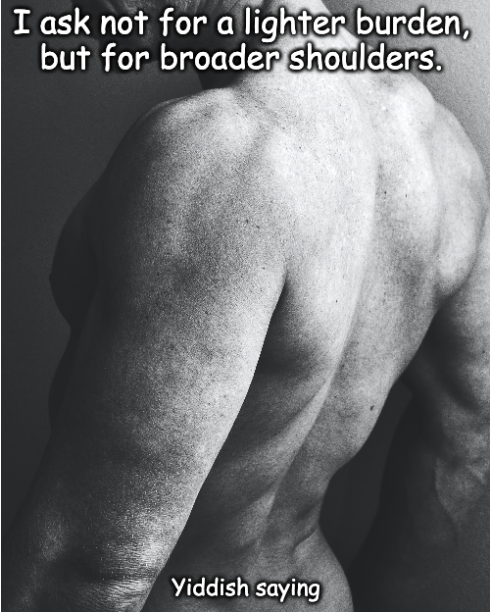
The proverb reframes how a person relates to hardship. Rather than asking for troubles to be removed or made easier, the speaker asks for the inner and physical capacity to bear them — for strength, not relief.
It’s a statement of resilience:
the goal isn’t an easier life, but a self equal to whatever life brings. This resonates with a recurring theme in Jewish thought — endurance through adversity, and the belief that difficulty is met by growing capable of carrying it, not by escaping it.
Origin:
This is a traditional ‘Yiddish/Jewish’ folk proverb, the kind of saying that develops through oral culture rather than a single written source. It’s closely related to (and possibly a free translation of) an older Yiddish line, “Got git di last laut di pleitses” — “God gives the burden according to the shoulders” — which carries a similar idea: that what a person is asked to endure is matched to what they’re able to endure.
Author: ‘No specific author.’
Every reliable source treats it as anonymous folk wisdom, credited generically as “Jewish Proverb” or “Yiddish Proverb” in quote collections rather than to a named poet, rabbi, or writer. If you’ve come across an attribution to a particular individual somewhere, it isn’t well supported — the honest answer is that it belongs to communal, oral tradition rather than to one author.
The worst wheel squeaks loudest.
The fool’s world is a paradise.

Too bad, the bride is so pretty!

The tavern can’t corrupt a good man, the synagogue can’t reform a bad one.

A word to the good is enough, but even a stick won’t help the bad.
A guest is like the rain: when he persists, he is a nuisance.
A brother turned enemy is an enemy for life.
The beautiful is not always good; the good is not always beautiful.
You don’t stumble because you are weak, but because you think yourself strong.
Even if a man sees his grave open, he must always hope.

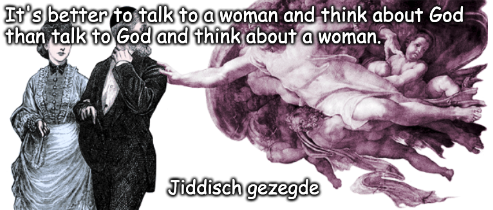
It’s better to talk to a woman and think about God than talk to God and think about a woman.
If God lived on earth, people would knock his windows out.
In the bed of a divorced man who has a divorced wife, there are always four people.

With luck, even your ox will calve.
With money in your pocket you are wise and you are beautiful and you can sing beautifully too.

If a hunchback meets someone with a bigger hunchback in the morning, his whole day is good.
He who dances at all weddings, cries at all funerals.
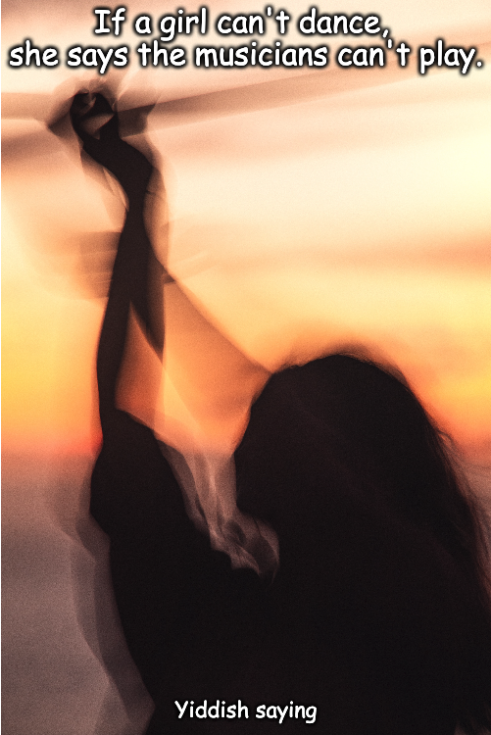
If a girl can’t dance, she says the musicians can’t play.
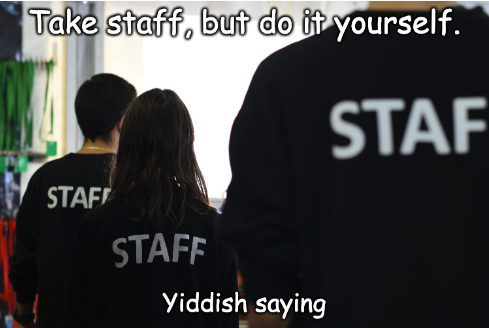
Take staff, but do it yourself.
Man was created on the last day, even the mosquito is older.

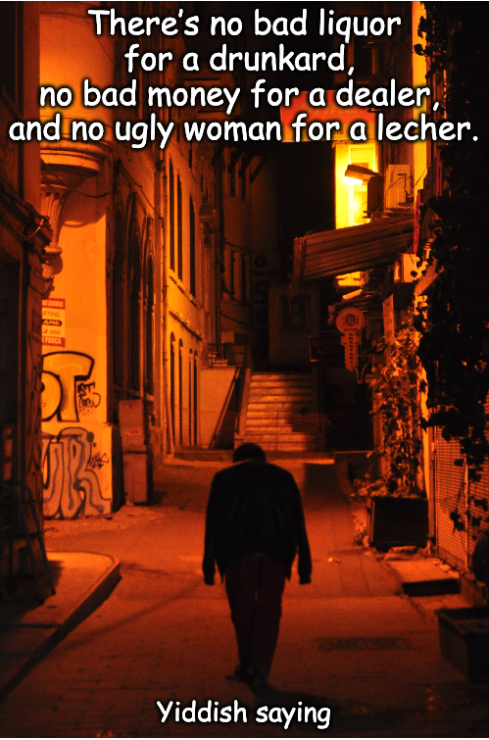
There’s no bad liquor for a drunkard, no bad money for a dealer, and no ugly woman for a lecher.
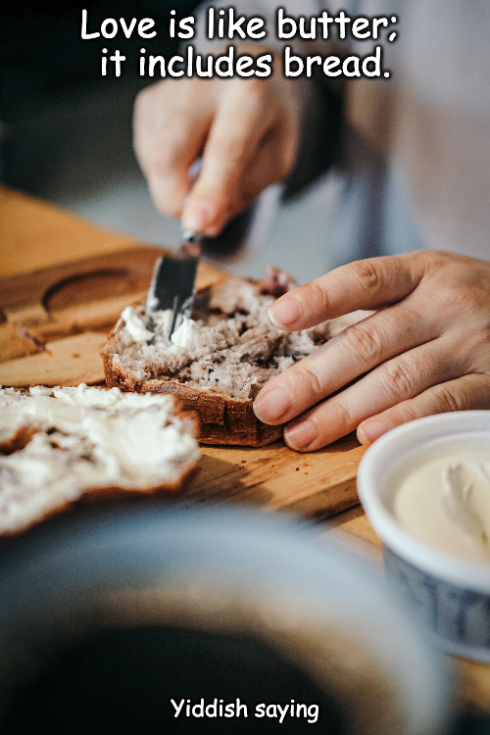
Love is like butter; it includes bread.
Only out of curiosity should a person live.

Life is a lingering migraine in an overcrowded and noisy street.
Guts sometimes impress even God.
Everyone believes at least half of slander, which no one believes anyway.
This paradoxical statement,
“Everyone believes at least half of slander, which no one believes anyway,” highlights a complex truth about human psychology and the power of gossip:
– Initial Skepticism:
We might claim not to believe gossip or slander, dismiss it as hearsay, or even actively try to ignore it.
– The Power of Doubt:
However, the very act of hearing something negative can plant a seed of doubt. Even if we don’t fully believe the slander, a small voice might whisper, “What if there’s a grain of truth to it?”
– The “At Least Half” Phenomenon:
This doubt can lead us to believe ‘some’ part of the story, even if we don’t buy the whole thing. The slander becomes more plausible, or at least less easily dismissed, simply because it’s been spoken.
– The Impact of Slander:
The saying emphasizes that slander can be damaging even if it’s not fully believed. It can damage reputations, sow discord, and create suspicion, all because we’re prone to believing at least a ‘portion’ of what we hear.
🗺️ Origin and Author:
It’s common for insightful sayings to be attributed to various sources, and this one is no exception. However, after careful research:
Author:
The author of this specific saying is ‘unknown’.
It’s a proverb that has been passed down and adapted over time.
Origin:
The saying is often described as a ‘Yiddish proverb’. Yiddish culture has a rich tradition of proverbs and folktales that offer witty and insightful observations about human nature. The phrasing and the paradoxical nature of the statement are characteristic of many Yiddish proverbs.
Here is an image illustrating the concept of slander and its impact:
💡 Final Thoughts:
This Yiddish proverb, “Everyone believes at least half of slander, which no one believes anyway,” remains a powerful reminder of the insidious nature of gossip and the importance of critical thinking. It encourages us to be mindful of the information we consume and to question the validity of slander, even when we’re tempted to believe a “half-truth.”
If you want your dreams to come true, don’t sleep.
– ‘Ambitions require action’ — you cannot achieve goals by merely wishing or fantasizing.
– “Dreams” here means hopes, plans, or life goals.
– “Don’t sleep” means don’t be passive, lazy, or idle; wake up and work toward what you want.
In simple terms:
> ‘Success comes from effort, not just imagination.’
🌍 Origin:
This saying is often described as a ‘Yiddish proverb’ or ‘Yiddish folk saying’, but its exact original source is unclear.
– It belongs to the tradition of ‘Jewish/Yiddish practical wisdom’, which often uses humor and irony to make a moral point.
– The wording commonly appears in English as:
– “If you want your dreams to come true, don’t sleep.”
– or
“If you want your dreams to come true, wake up.”
✍️ Author:
There is ‘no known individual author’.
Because Yiddish proverbs were usually passed down orally, many do not have a documented first author.
🗣️ Possible Yiddish Form:
A literal Yiddish rendering would be:
> ‘Oyb du vilst az dayne khaloymes zoln mekuyem vern, shlof nisht.’
Meaning:
> “If you want your dreams to be fulfilled, don’t sleep.”
⚠️ Note: This is a literal Yiddish version; the exact traditional wording may vary.
Shrouds don’t have pockets.
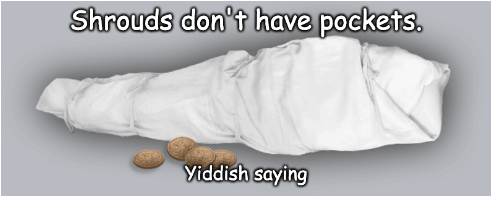
> ‘You cannot take money or possessions with you when you die.’
It is usually said as a warning against greed or excessive hoarding—and sometimes as encouragement to use one’s wealth generously or enjoy it while alive.
A modern equivalent is:
> “You never see a hearse pulling a moving van.”
✡️ It is widely identified as a ‘Yiddish/Jewish proverb’, often expressed along the lines of:
> ‘אין תּכריכים זײַנען נישטאָ קיין קעשענעס’
> ‘In takhrikhim zaynen nishto keyn keshene(s).’
> “There are no pockets in burial shrouds.”
This has particular resonance in Jewish burial practice:
the dead are traditionally dressed in simple, pocketless white shrouds—’tachrichim’—emphasizing humility and equality in death.
However, the proverb is ‘not exclusively Yiddish’. Variants such as “There are no pockets in a shroud” and “A coffin has no pockets” occur in Irish, French, Italian, Spanish and other proverbial traditions.
📜 Origin and author:
– ‘No individual author is known.’
It is best treated as a traditional folk proverb.
– The underlying idea is ancient. Compare:
– Job 1:21:
“Naked came I out of my mother’s womb, and naked shall I return.”
– Ecclesiastes 5:15:
A person departs “as naked as he came” and takes nothing from his labor.
– 1 Timothy 6:7:
“We brought nothing into this world, and it is certain we can carry nothing out.”
– The wording was popularized in English by Horace McCoy’s 1937 novel “No Pockets in a Shroud”, but McCoy did not originate the proverb.
Bottom line:
It is legitimate to call it a “Yiddish proverb”, especially in a Jewish context, but more accurately it is an ‘international traditional saying with no identifiable author’.
All the brides are beautiful, all the dead are holy.
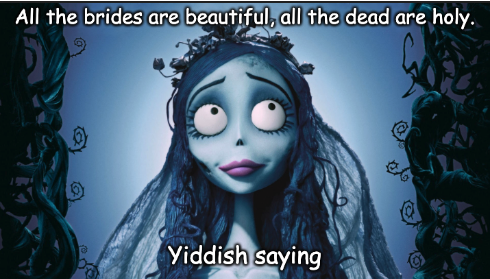
The saying is wry or ironic:
social convention requires that
– every bride be praised as beautiful, and
– every deceased person be remembered as virtuous.
In other words, judgments made at weddings and funerals are ceremonially generous and should not always be taken literally. The second half resembles the principle “Speak no ill of the dead” ‘de mortuis nil nisi bonum’).
📜 Yiddish form:
> ‘אַלע כּלות זײַנען שיין, און אַלע מתים זײַנען פֿרום’.
> ‘Ale kales zaynen sheyn, un ale meysim zaynen frum.’
Literally:
> “All brides are beautiful, and all the dead are pious.”
“Holy” is a somewhat free translation. ‘פֿרום (‘frum’)’ more precisely means ‘pious, devout, or religious’.
🕰️ Origin and author:
– It is generally regarded as a ’traditional Yiddish/Jewish proverb’.
– There is ‘no known individual author’.
– Although ‘kales’ (“brides”) and ‘meysim’ (“the dead”) derive from Hebrew, the sentence itself is Yiddish.
– Similar sentiments exist in many European and Jewish traditions, so it should not be treated as a quotation coined by a particular writer.
A more idiomatic English rendering would be:
> “Every bride is beautiful, and every dead man was a saint.”
If you are bitter at heart, sugar in the mouth will not help you.
“If you are bitter at heart, sugar in the mouth will not help you” means that outward sweetness—pleasant words, comforts, or treats—cannot cure deep unhappiness, resentment, or inner pain.
It can also suggest that ‘sweet speech cannot disguise a bitter or malicious disposition’. Genuine emotional or moral change must come from within.
Origin 📜:
This is a ’traditional Yiddish proverb’, associated with the oral folk culture of Ashkenazi Jewish communities, particularly in Eastern Europe. A possible Yiddish form is:
> אַז ס׳איז ביטער אויפֿן האַרצן, העלפֿט נישט קיין צוקער אין מויל.
> ‘Az s’iz bitter afn hartsn, helft nit keyn tsuker in moyl.’
Literally:
“If it is bitter in the heart, no sugar in the mouth helps.”
As with many oral proverbs, wording varies between collections and translations, and its precise date or place of origin is not known.
Author ✍️:
There is ‘no known individual author’. It is best credited simply as:
> ‘Traditional Yiddish proverb’
Strictly speaking, it is a ‘proverb’ rather than an idiom, because it expresses a complete piece of folk wisdom.
Anyone who thinks that an argument is valid because it is printed is an idiot.

The saying warns that ‘publication does not guarantee truth’. An assertion does not become sound merely because it appears in a book, newspaper, or other authoritative-looking source.
In modern terms, it criticizes:
– ‘Blind faith in the printed word’
– An ‘appeal to authority’
– Confusing publication or repetition with evidence
Here, “valid” is used informally to mean ‘correct or convincing’, rather than in the strict technical sense used in formal logic.
🗣️ Origin and author:
This is generally circulated as an ‘anonymous Yiddish proverb’, not as a reliably documented quotation by a particular author. Collections and quotation websites often label it simply “Yiddish proverb”, but no definitive original speaker, date, or early Yiddish source is commonly cited.
The English wording is probably a ‘modern translation or paraphrase’, so there may be no single canonical Yiddish text behind it. A possible reconstructed wording would be along the lines of:
> ‘Ver es meynt, az an argument iz rikhtik vayl es iz gedrukt, iz a nar.’
> “Whoever thinks an argument is right because it is printed is a fool.”
However, this should be treated as a ‘back-translation’, not as an authenticated historical original.
Never stand at the foot of a person’s deathbed, for that place is reserved for his Guardian Angel.
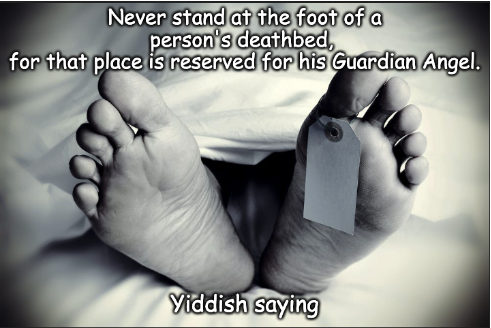
The saying warns people not to stand at the foot of a dying person’s bed because that is imagined as the place occupied by the supernatural being who has come for the soul.
It expresses:
– reverence for the moment of death;
– the belief that the dying person is accompanied by angels;
– the idea that one should not obstruct the soul’s departure.
It is primarily a ‘literal folk taboo’, though figuratively it can mean:
‘at death, step back and leave room for the sacred or unknowable.’
“Guardian Angel” or “Angel of Death”?
The more characteristically Jewish version would refer to the ‘Angel of Death’—Hebrew ‘Mal’akh ha-Mavet’, Yiddish ‘malekh-hamoves’—rather than to a personal “Guardian Angel.”
Thus an earlier or less softened form was probably along the lines of:
> ‘Do not stand at the feet of a dying person, because the Angel of Death stands there.’
“Guardian Angel” may be:
– a euphemistic translation;
– a Christianized adaptation;
– or an attempt to make the saying sound less frightening.
Jewish background:
Several strands of Jewish tradition associate a sickbed with a divine or angelic presence:
– Babylonian Talmud, Nedarim 40a:
says that the ‘Shekhinah’, the Divine Presence, rests above the sick person’s bed or head.
– Avodah Zarah 20b”:
depicts the Angel of Death standing over a dying person with a drawn sword.
– Later Jewish custom and folklore place the Angel of Death specifically near the dying person’s ‘feet’.
These sources do not give the exact English sentence. The proverb seems to combine such older religious images into a practical deathbed taboo.
– Author:
Unknown; it is anonymous folklore.
– Language/origin:
Commonly described as Jewish or Yiddish, but the exact English wording cannot confidently be traced to a traditional Yiddish original.
– Date:
The underlying beliefs are ancient and medieval; the polished English quotation is likely much more recent.
So the safest attribution is:
> ‘Traditional Jewish/Yiddish saying; author unknown.’
Never ask questions about fairy tales.

– ‘Don’t demand strict logic from a fairy tale, legend, joke, or folktale.’
– A story may have its own rules; asking “But how could that happen?” misses the point.
– It can also mean: ‘don’t overanalyze something whose purpose is wonder, moral teaching, humor, or imagination.’
In English, similar ideas would be:
– “Don’t spoil the story with too much logic.”
– “Suspend disbelief.”
– “It’s only a story.”
– “Don’t ask how the magic works.”
🗣️ Yiddish wording and nuance:
-‘Mayse / מעשׂה’
Means:
‘story, tale, anecdote, episode’.
It can refer to anything from a folktale to a Hasidic wonder-story.
– Kashes / קשיות**
From Hebrew/Aramaic, used in Jewish learning to mean ‘difficult questions, objections, logical challenges’.
So the Yiddish phrase literally says:
> “About a story, one does not ask difficult questions.”
There is a nice cultural irony here: Jewish/Yiddish culture is famous for questioning and argumentation, especially in Talmudic study — but the proverb says that ‘a tale is not a legal argument or philosophical proof’.
🧾 ✅ Origin:
It is best described as a ’traditional Yiddish proverb or folk saying’, not the work of a known individual author.
❌ Author:
There is ‘no single known author’.
Like many proverbs, it circulated orally in Yiddish-speaking Jewish communities.
It is especially associated with the world of:
– ‘Yiddish storytelling’
– ‘Jewish folktales’
– ‘Hasidic tales’
– ‘humorous anecdote and parable’
The schlemiel lands on his back and bruises his nose.

This saying is a perfect illustration of the concept of the ‘Schlemiel’ in Yiddish folklore.
– The Definition:
A ‘Schlemiel’ is a prototypically unlucky person, a “born loser” for whom simple things constantly go wrong. They are often clumsy, but their defining trait is their persistent, often comical, misfortune.
– The Proverb’s Meaning:
“The schlemiel lands on his back and bruises his nose” perfectly captures this essence. It describes an individual so incredibly unlucky that even when they fall backward (a situation where common sense dictates your back or head would be injured), they ‘still’ manage to somehow hurt their nose. It signifies a state of compounded, almost impossible, bad luck. It’s the ultimate “when it rains, it pours” scenario for the perpetually unfortunate.
Origin:
The concept of the Schlemiel originates in Eastern European Jewish (Yiddish) folklore and literature. The specific proverb itself is a classic piece of Yiddish folk wisdom, born from the oral tradition of the ‘shtetl’ (small Jewish towns). It doesn’t have a single, identifiable author but is rather a collective expression of a community’s worldview—one that used humor to cope with hardship.
✒️ The “Author” and the Schlemiel in Literature:
While this specific proverb is folk wisdom, the ‘archetype’ of the Schlemiel was famously popularized and explored by several major Yiddish authors.
– Scholem Aleichem:
Perhaps the most famous Yiddish writer (best known for the stories that inspired ‘Fiddler on the Roof’), he masterfully created characters who embodied the Schlemiel spirit. His character Menahem-Mendl is a classic example:
a quintessential dreamer and “luftmensch” (someone with his head in the clouds) whose elaborate business schemes consistently fail, often due to a mix of bad luck and impracticality.
– I.B. Singer:
The Nobel Prize-winning author also frequently populated his stories with Schlemiel-like characters, exploring the theological and philosophical implications of persistent misfortune and innocence.
One should always view himself as half innocent and half guilty.
A rich man goes hungry only on doctors orders.

One would give one’s last shirt to become a millionaire.

– People are sometimes willing to ‘sacrifice everything’ to become rich.
– The saying is ‘ironic’:
you even give away your last possession — your “last shirt” — in order to become a millionaire.
– It points to the ‘absurd or foolish side of greed’, love of money or social ambition.
In short:
> Some people desire wealth so much that they would even give up their last possessions for it.
Origin 🌍:
This is usually referred to as a ‘Yiddish saying’ or a saying from the ‘Jewish-Ashkenazi proverb tradition’.
– Yiddish was the language of many Jewish communities in Central and Eastern Europe.
– Such sayings were often passed on orally.
– They often contain ‘humor, irony and wisdom’, especially about poverty, money, trade and human weaknesses.
The expression “to give up one’s last shirt” also occurs in other European languages, including German and Dutch, as an example of:
> sacrificing everything one still possesses.
Author ✍️:
There is ‘no known individual author’.
These kinds of sayings usually belong to the ‘anonymous folk tradition’:
– no permanent writer;
– transmitted orally;
– later recorded in collections of Yiddish or Jewish proverbs.
Ask for advice, but use common sense.
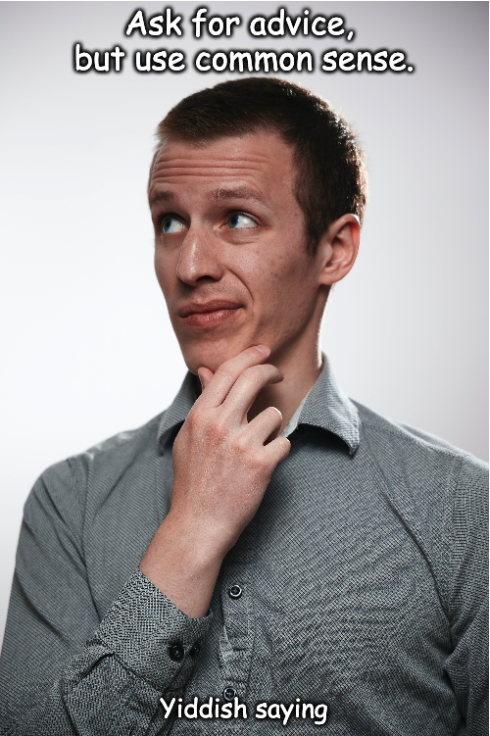
He’s meditating on whether a flea has a belly-button.

New troubles make you forget the old ones.

This Yiddish proverb means that ‘a fresh problem or anxiety often pushes earlier worries out of your mind’.
– A new crisis can make previous troubles seem smaller.
– Human attention has limited space: the most urgent pain usually takes over.
– It can be said humorously, bitterly, or philosophically.
Example:
If someone was worried about money, but then became ill, one might say:
> “Well, new troubles make old troubles forget.”
Meaning: the new, bigger concern has replaced the old one.
🌍 Origin:
– The saying comes from ‘Yiddish folk wisdom’, especially the proverb tradition of ‘Ashkenazi Jews in Eastern Europe’.
In Yiddish, it is commonly expressed as:
> ‘נײַע צרות מאַכן פֿאַרגעסן די אַלטע
> ‘Naye tsores makhn fargesn di alte’
> “New troubles make one forget the old ones.”
– It belongs to the broader world of ‘Yiddish proverbs about suffering, survival, irony, and resilience’.
– Like many Yiddish sayings, it reflects a practical, often darkly humorous view of life’s hardships.
✍️ Author: ‘No known individual author.’
It is a ’traditional Yiddish proverb’, passed down orally and later recorded in collections of Yiddish sayings.
🧠 Similar English Ideas:
– “One trouble drives out another.”
– “A new pain makes you forget the old one.”
– “The present crisis crowds out yesterday’s worry.”
But the Yiddish version has a particularly wry, resigned tone: life does not necessarily get easier — it simply gives you new things to worry about.
Worries go down better with soup than without.

It’s a bit of comfort-food wisdom:
Worry doesn’t disappear just because you’re eating soup, but it feels more bearable when you’re warm, fed, and cared for. It captures a very Jewish/Yiddish blend of stoicism and self-care — you can’t always fix a problem, but you can make yourself more able to bear it.
Origin:
“Authorship is unknown”, though the saying is commonly credited as a ‘Yiddish proverb’. The earliest documented print appearance seems to be its inclusion in the 1949 book “Yiddish Proverbs” by Hanan J. Ayalti. It then shows up repeatedly through the mid-20th century — for instance in a 1964 issue of “Jewish Affairs,” the journal of the South African Jewish Board of Deputies, and a 1972 Milwaukee Sentinel article on soup that called it “the Yiddish proverb”.
Like most folk proverbs, it wasn’t coined by a single identifiable person — it circulated orally in Yiddish-speaking communities before being collected in print, which is why you’ll see it attributed generically as “Yiddish Proverb” or “Jewish Proverb” rather than to a named author.
If all men were sages, mankind would soon be extinct.
– If everyone were purely intellectual, overly prudent, ascetic, or devoted only to study and wisdom, people might avoid the messy, risky, irrational parts of life — especially ‘marriage, sex, and child‑rearing’.
– Humanity continues not only because of wisdom, but also because of ‘instinct, passion, ordinary foolishness, and practical life’.
– It is a humorous, slightly cynical proverb:
too much “wisdom” might make people think better of reproducing.
In short:
the world needs more than sages; it also needs ordinary human desire and folly.
Yiddish / Jewish Origin ✡️:
The saying is usually treated as a ‘Yiddish or Jewish proverb’, not as a quotation from a known author.
A plausible Yiddish form would be something like:
> ווען אַלע מענטשן וואָלטן געווען חכמים, וואָלט די וועלט אויסגעשטאָרבן.
> Ven ale mentshn voltn geven khakhomim, volt di velt oysgeshtorbn.
> “If all people were sages, the world would die out.”
Here ‘khakhomim’ comes from Hebrew ‘ḥakhamim / חכמים’, meaning “wise men” or “sages.”
Author ✍️:
– ‘No individual author is known.’
– It belongs to the category of ‘anonymous folk wisdom / proverb’.
– English versions may vary:
“men,” “people,” “sages,” “wise men,” “mankind,” “the world,” etc.
Possible Rabbinic Echo 📚
The idea resembles a theme found in Jewish rabbinic literature:
the tension between ’total devotion to Torah study’ and the obligation to marry and have children.
A famous example is Ben Azzai, a Talmudic sage who praised the commandment to “be fruitful and multiply” but did not marry himself, saying his soul was attached to Torah and that the world could be sustained by others. That story appears in the Talmud, Yevamot 63b.
So the proverb may echo that older Jewish idea, but the exact sentence itself is best described as:
> ‘an anonymous Yiddish/Jewish proverb, not a traceable quotation by a named author..
The truth is the safest lie.
A young woman for an old man; a hard nut for a crumbly tooth.
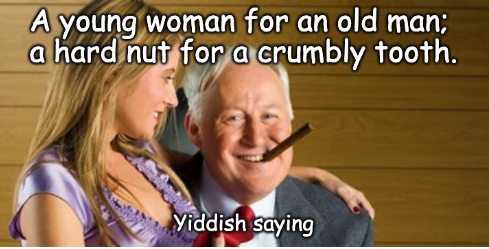
– An old man marrying or pursuing a much younger woman is ‘an ill-suited match’.
– The “young woman” is compared to a ‘hard nut’ — desirable, but difficult to “manage” or enjoy.
– The “old man” is compared to a ‘crumbly/weak tooth’ — not capable of dealing with the challenge.
– It implies a mix of ‘humor, warning, and sexual/social realism’:
desire may exceed ability.
In plain English:
> ‘Some things may be tempting, but they are no longer suitable for you.’
🗣️ A likely Yiddish-style version would be approximately:
> ‘A yunge froy far an altn man iz vi a harte noz far a morshn tson.’
> ‘A young woman/wife for an old man is like a hard nut for a rotten/weak tooth.’
Wording varies in translation:
– “young woman” / “young wife”
– “old man” / “old husband”
– “crumbly tooth” / “bad tooth” / “rotten tooth” / “weak tooth”
📜 Origin:
– The saying comes from ‘Yiddish-speaking Ashkenazi Jewish folk tradition’.
– It belongs to the world of ‘oral proverbs’, especially the humorous, sharp, practical wisdom common in Yiddish culture.
– Similar proverbs exist in other European folk traditions, so it may reflect a broader old-world proverb pattern, but it is commonly identified as ‘Yiddish’.
✍️ Author: ‘No known individual author’.
It should be credited as:
> ‘Anonymous Yiddish proverb’
or
> ‘Traditional Yiddish saying’
⚠️ Tone / Nuance:
– humorous,
– earthy,
– somewhat cynical,
– and reflects older attitudes about age, marriage, and sexuality.
Today it may sound old-fashioned or sexist, but its main point is about ‘mismatch between desire and capacity’.
Run away from fire and you get water.
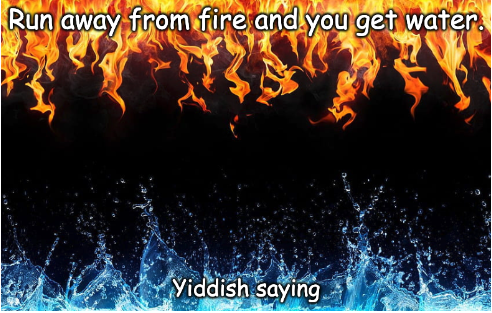
– ‘You escape one danger or problem, only to land in another.’
– ‘Avoiding one extreme may throw you into the opposite extreme.’
– It can imply that a hurried or fearful escape may not actually solve anything.
In context, “fire” represents one threat, while “water” is not necessarily safety — it may mean ‘drowning, being overwhelmed, or a different kind of trouble’.
Similar English idioms:
– “Out of the frying pan and into the fire.”
– “From bad to worse.”
– “Escaping one trap only to fall into another.”
The difference is that the Yiddish-style version uses ‘opposites — fire and water’ — to stress irony: you flee burning, but end up drowning.
🗣️ Is it Yiddish?
Yes, it is very likely a translation or paraphrase of a Yiddish proverb. A possible Yiddish form would be something like:
> “פֿון פֿײַער אַנטלויפֿן און אין וואַסער אַרײַנפֿאַלן”
> “Fun fayer antloyfn un in vaser araynfaln”
> “To run away from fire and fall into water.”
Exact wording varies, as with many folk sayings.
📜 Origin:
– The saying belongs to the tradition of ‘Yiddish / Ashkenazi Jewish folk proverbs’.
– It is probably ‘oral and anonymous’, not a line invented by a known writer.
– Similar “escape one danger, meet another” proverbs exist in many languages, so the idea is not uniquely Yiddish, though this ‘fire/water formulation’ has a Yiddish flavor.
✍️ Author: There is ‘no known individual author’.
It should be cited as:
> ‘Yiddish proverb’
> or
> ‘Anonymous Yiddish folk saying’
The author may have been ‘quoting or adapting’ the proverb rather than creating it.
A loss that can be made up for with money is only a small loss.
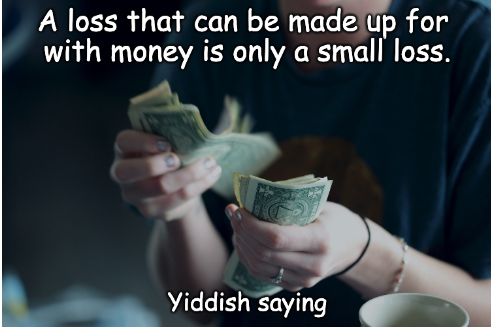
– If money can repair, replace, or compensate for something, then the loss is not among life’s worst losses.
– The truly serious losses are things money cannot restore, such as:
– health
– life
– love
– trust
– time
– family
– peace of mind
In short:
> ‘If money can fix it, it is not the worst kind of problem.’
Origin 🌍:
This saying is usually described as a ‘Yiddish / Jewish proverb’.
It belongs to the tradition of ‘Ashkenazi Jewish folk wisdom’, where practical sayings about life, money, suffering, and perspective were passed down orally.
A common related version is:
> “If a problem can be solved with money, it is not a problem; it is an expense.”
The exact original wording may vary, because proverbs often exist in several forms.
Author ✍️: There is ‘no known individual author’.
It should be attributed as:
> ‘Traditional Yiddish proverb’
> or
> ‘Anonymous Jewish proverb’
His nose curls with pride, because the king’s donkey has urinated right outside his door.

– Someone is ‘absurdly proud of a meaningless connection to power or status’.
– They feel honored merely because something associated with an important person came near them — even if that “honor” is actually dirty, ridiculous, or insulting.
– It mocks ‘snobbery, servility, name-dropping, and basking in reflected glory’.
In plain English:
> “He is so status-obsessed that even being dirtied by the king’s donkey feels like a privilege.”
Comparable ideas:
– “He thinks he’s important because he once stood near someone important.”
– “He is proud of receiving crumbs from the powerful.”
– “Basking in reflected glory.”
🐴 Why the donkey and urine?
The joke is in the contrast:
– The king = highest authority, prestige, power.
– The donkey = a lowly animal, not the king himself.
– Urinating outside the door = not an honor at all; it is a nuisance or insult.
So the saying ridicules a person who turns even a degrading or trivial contact with greatness into a source of pride.
🌍 Origin:
This is generally treated as an ‘old Yiddish / Eastern European Jewish folk saying or proverb’.
A possible Yiddish-style version would be something like:
> ‘Er krimpt di noz fun shtolts, vayl dem meylekhs eysl hot gepisht bay im far der tir.’
> “He wrinkles/curls his nose with pride because the king’s donkey pissed by his door.”
The exact wording may vary in translation. Yiddish proverbs often appear in several forms, especially when translated into English.
✍️ Author: There is ‘no known individual author’.
It is best described as:
– ‘Anonymous’
– ‘Traditional’
– ‘Yiddish folk proverb / saying’
If it appears in a book, the named person is usually the ‘collector, translator, or editor’, not the original author.
Anyone who believes that everything is for sale is willing to sell himself.

This saying is a ‘moral critique of extreme materialism’.
It suggests that:
– If you reduce ‘all things’—including human values, relationships, honor, and principles—to items with a ‘price tag’, then you logically must also accept that ‘your own integrity and dignity’ can be bought and sold.
– The person who believes “everything has a price” inevitably becomes willing to trade away their self-respect, reputation, or moral code for money or advantage.
– It warns that ‘cynical greed is self-destructive’:
The more you see the world as a marketplace, the more you become a ‘commodity yourself’—selling your soul, piece by piece.
In short:
‘The belief that all is for sale dehumanizes the believer, because it makes them willing to sell their own worth.’
📜 Origin:
– This saying is a ’traditional Yiddish proverb’ (a folk saying from Ashkenazi Jewish communities in Eastern/Central Europe).
– It was ‘passed down orally’ over generations, likely originating in the ’18th–19th centuries’ within Jewish communities that valued ‘ethical warnings against greed’ (echoing teachings from the ‘Pirkei Avot’ / Ethics of the Fathers).
– The proverb was later ‘collected and published’ in anthologies of Yiddish wisdom, such as ‘The Joys of Yiddish’ by Leo Rosten (1968) or earlier proverb collections from the late 19th/early 20th century.
– It is not a literary quote from a single book or philosopher—it belongs to ‘folk tradition’, which is why it has no single documented first appearance.
👤 Author:
– ‘Anonymous’ (as is typical for traditional proverbs).
– The saying is attributed to ‘Yiddish-speaking Jewish culture’, not to any specific individual.
– It is often ‘misattributed online’ to modern thinkers (e.g., Ayn Rand, Milton Friedman) but those claims have ‘no historical evidence’.
– The true “author” is the ‘collective wisdom of a community’—a hallmark of folk proverbs.
A deaf man heard how a mute told that a blind man has seen how a cripple walked.
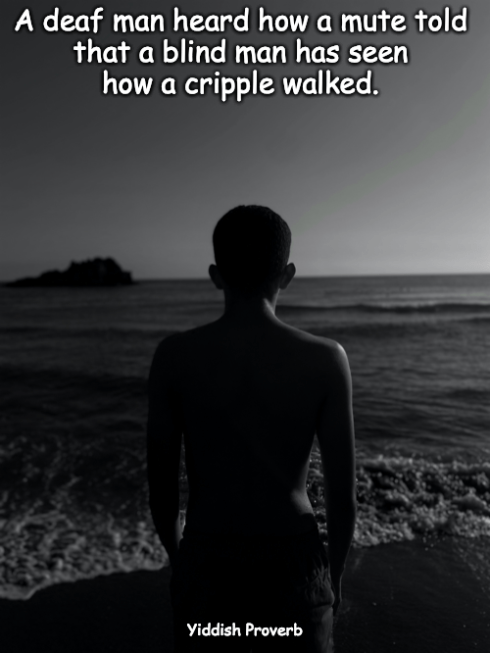
– ‘The story is completely unbelievable’ — every link in the chain is impossible.
– ‘It mocks gossip, rumors, and hearsay’: “Someone heard from someone who said someone saw…”
– It is used when a claim has ‘no credible source or evidence’.
In short:
“That report is so unreliable that it might as well have come from impossible witnesses.”
Why it is funny / paradoxical 😄:
Each part cancels itself out:
– A ‘deaf man’ cannot hear.
– A ‘mute man’ cannot tell/say it.
– A ‘blind man’ cannot see.
– A ‘cripple/lame man’ walking may be impossible or miraculous, depending on the wording.
So the whole sentence is a chain of absurd impossibilities.
Origin 🌍:
It is often quoted as a ‘Yiddish or Jewish proverb’, usually in forms like:
> “A deaf man heard a mute man say that a blind man saw a lame man run.”
However, it is probably not exclusively Yiddish. Similar versions exist in several European and Middle Eastern folk traditions. It belongs to a broad family of ‘folkloric nonsense proverbs’ or ‘anti-hearsay sayings’.
So the safest description is:
> ‘A traditional proverb, often attributed to Yiddish/Jewish folklore, with many international variants.’
Author ✍️: There is ‘no known individual author’.
It is a ‘folk proverb’, meaning it was passed down orally and appears in different versions. When quoted, it is usually attributed simply to:
– ‘Yiddish proverb’
– ‘Jewish proverb’
– ‘Traditional proverb’
– ‘Anonymous’
Comparable English sense 📌:
> “That’s just hearsay on top of hearsay.”
or
> “A friend of a friend of a friend said…”
with the added implication that the source is absurdly impossible.
