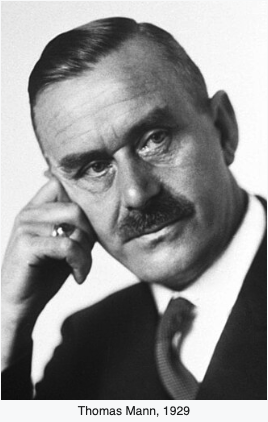
Paul Thomas Mann:
(Lübeck, June 6, 1875 – Zurich, August 12, 1955)
Considered one of the greatest German writers of the twentieth century. His best-known works include the novels Buddenbrooks and The Magic Mountain and the novella Death in Venice. His work was strongly influenced by that of Goethe, Nietzsche and Schopenhauer. In 1929 he received the Nobel Prize for Literature. He fled the German Nazi regime to Switzerland in 1936, partly because his wife, Katia Mann, had Jewish parents. From 1939 to 1952 he lived in the United States, where he became an important exponent of the struggle against fascism, and then again in Switzerland until his death.
Face to face with fanaticism itself, a freedom that no longer believes in itself out of sheer goodness and humane skepticism is lost.
Freedom exists, and also the will exists; but the freedom of the will does not exist, for a will that aims at its own freedom aims at the unknown.
> “Freedom exists, and the will also exists; but the freedom of the will does not exist…”
This distinguishes between three things:
1. Freedom exists 🕊️
There is such a thing as freedom in a practical or political sense:
you can be free to act, to speak, to move, to carry out choices.
2. The will exists 💭
People have desires, motives, inclinations, decisions: in short, a will.
3. But ‘free will’ does not exist ⚖️
According to this idea, your will itself is not free. You can do what you want, but you do not choose what you want completely freely. Your will is shaped by character, disposition, circumstances, motives, past, nature, and so on.
That aligns closely with Schopenhauer’s famous statement:
> “Man can do what he wants; but he cannot want what he wants.” “Man can do what he wants, but he cannot want what he wants.”
🔍 “A will that strives for its own freedom…”
The second part:
> “…for a will that strives for its own freedom strives for the unknown.”
means approximately:
– A will is always directed towards something: a goal, object, desire.
– But if the will wants “its own freedom,” it tries to detach itself from all motives and causes.
– Then nothing concrete remains for which it can strive.
– A completely “free” will would be a will without foundation, without motive, without direction — and that is almost a contradiction.
In other words: a will that wants to be absolutely free actually wants something indeterminate or incomprehensible.
📚 Origin and author: ✅ Thomas Mann?
The formulation is indeed often associated with Thomas Mann. In German, it circulates roughly as:
> “Freedom exists, and the will exists too; but freedom of will does not…”
📖 Schopenhauer as a source:
The idea itself, however, comes from Arthur Schopenhauer’s philosophy, especially from:
– Über die Freiheit des menschlichen Willens — 1839
In it, Schopenhauer defends the position that actions do indeed originate from the will, but that the will itself is not freely chosen.
🎯 In one sentence:
The saying means that human freedom can be real at the level of action, but that the deeper will itself, according to Schopenhauer — and in Thomas Mann’s literary formulation — is not free.
Happiness comes to those who expect it. They just have to keep the door open.
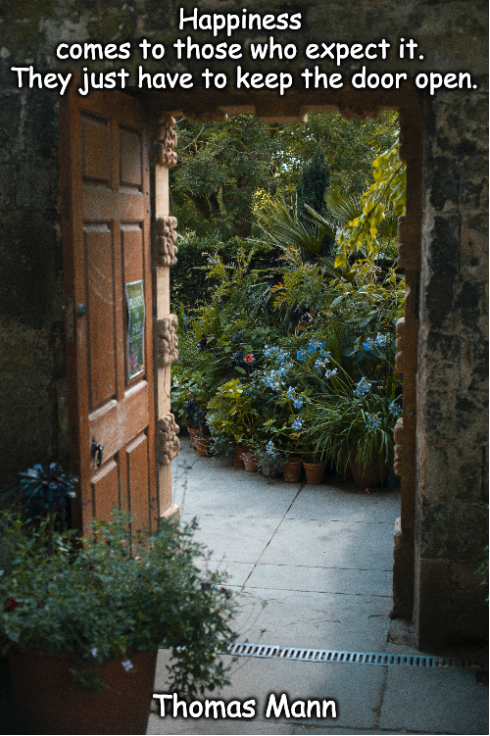
This quote connects two ideas:
1. “Happiness comes to those who expect it”
– Those who go through life with an inner sense of anticipation and a positive outlook are more likely to perceive moments of happiness. Those who expect nothing good often miss it when it appears.
2. “But they must also keep the door open”
– Mere expectation or hope is not enough. One must actively remain ready and open so that happiness, when it “knocks,” can enter. It is therefore a plea against passive waiting and for an open, receptive attitude toward life – happiness as something that requires both opportunity and inner readiness.
This idea is part of a long tradition of similar imagery (happiness as a guest who knocks; the door/gate as a metaphor for openness), as can also be found in the works of other authors.
Authorship:
In German-speaking countries, this sentence is consistently attributed to Thomas Mann – for example, in the common quote collections (zitate.de, zitate7.de, gutezitate.com, bestenzitate.com) and also in a dedicated merchandise product, “The Best Quotes by Thomas Mann,” which uses this sentence as its title quote.
Important caveat:
Unlike some other Mann quotes (e.g., sentences from “Doctor Faustus” or “Confessions of Felix Krull, Confidence Man,” which are provided with precise work references on the quote pages), this sentence lacks a single reliable source reference – no novel, no short story, no essay, no diary entry, and no page number is mentioned. This is a typical pattern with so-called “floating” quotes:
They are repeatedly attributed to the same prominent author in collections and calendars without any verifiable source within his actual work.
My honest conclusion:
I cannot verify the attribution to Thomas Mann
– I have found no evidence that the sentence actually appears in any of his works, letters, or diaries. It is quite possible that it is a so-called “wandering quote,” attributed to him later because it seems to fit his general style of thinking. Such misattributions are very common with popular aphorisms (similar to Einstein, Goethe, or Mark Twain).
If the exact source is important to you—for example, for a scholarly paper or a quotation in an official text—I would recommend consulting an annotated, critical edition of Mann’s works (e.g., the Frankfurt or the Great Annotated Frankfurt Edition) or, as a precaution, marking the sentence as “Author uncertain, attributed to Thomas Mann in German-speaking countries.”
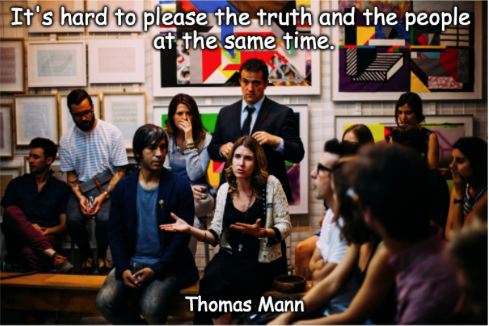
It’s hard to please the truth and the people at the same time.
Tolerance becomes a crime when applied to evil.