Marcus Porcius Cato Uticensis:
(“of Utica”; 95 BC – April 46 BC),
Also known as Cato the Younger (Latin: Cato Minor), was an influential conservative Roman senator during the late Republic. As a fervent advocate of liberty and the preservation of the principles of the Republic, he dedicated himself to the protection of traditional Roman values, which he believed were in decline. He was a renowned orator and a follower of Stoicism. His meticulous honesty and outspoken respect for tradition earned him a political following which he mobilized against powerful generals of his time, including Julius Caesar and Pompey.

The cowl does not make the monk.
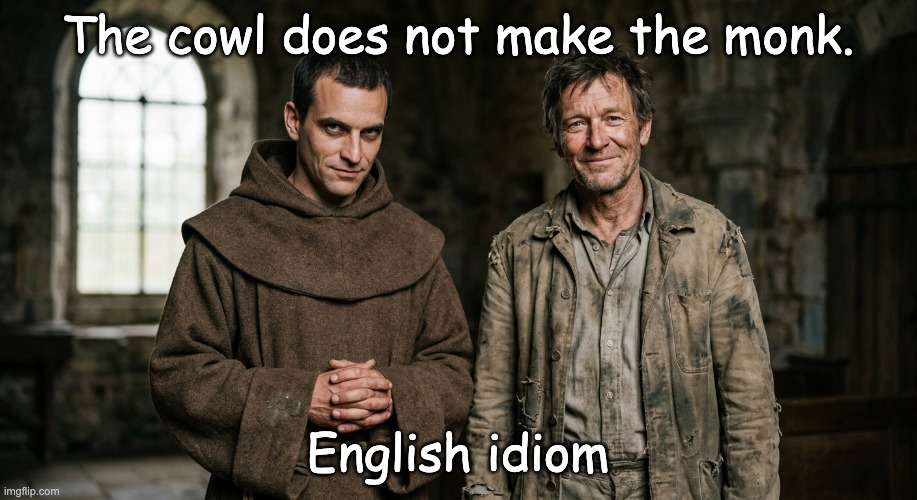
The phrase warns against judging people solely by their ‘external signs’, such as clothing, titles, or symbols. It emphasizes that ’true character is revealed through actions and inner qualities’, not superficial markers.
Origin: The phrase dates back to ‘medieval Latin’ and appears in the “Disticha Catonis” (or “Distichs of Cato”), a collection of moral maxims from late antiquity (likely 2nd–4th century CE).
Author: Traditionally attributed to Cato the Younger (or a later Pseudo-Cato), though the actual authorship is ‘uncertain’ and likely anonymous. The “Disticha Catonis” were widely used as school texts in medieval Europe.
Exact Source: The line appears in “Distich 1.36” of the “Disticha Catonis”:
> “Cucullus non facit monachum, sed in hoc est veritas.”
(Though the full line varies slightly in manuscripts.)
Modern Usage:
Today, the idiom is used in English and other languages to highlight ‘hypocrisy’, ‘deception’, or the ‘fallacy of judging by appearances’. For example:
> “Just because he wears a suit and drives a luxury car doesn’t mean he’s trustworthy. Cucullus non facit monachum.”
Related Concepts:
– “All that glitters is not gold” (Shakespeare): Similar idea about deceptive appearances.
– “Wolf in sheep’s clothing”: A more dramatic metaphor for hidden danger.
