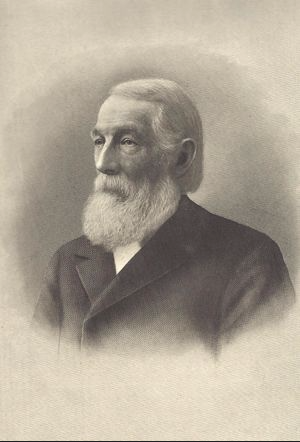
John Howard Bryant:
(1807–1902).
An American poet, farmer, politician, and newspaper editor in Illinois. He was the younger brother of the more famous poet William Cullen Bryant. His books of verse include “Poems Written from Youth to Old Age, 1824-1884” (1885) and “The Life and Poems of John Howard Bryant” (1894). A handwritten note from 1895 places him in Princeton, Illinois, where he lived late in life. His work is mostly out of print today, though it circulates through reprints and archive editions, and a few of his poems were anthologized in “The World’s Best Poetry” (1904).
Autumn: the last and most beautiful smile of the year.
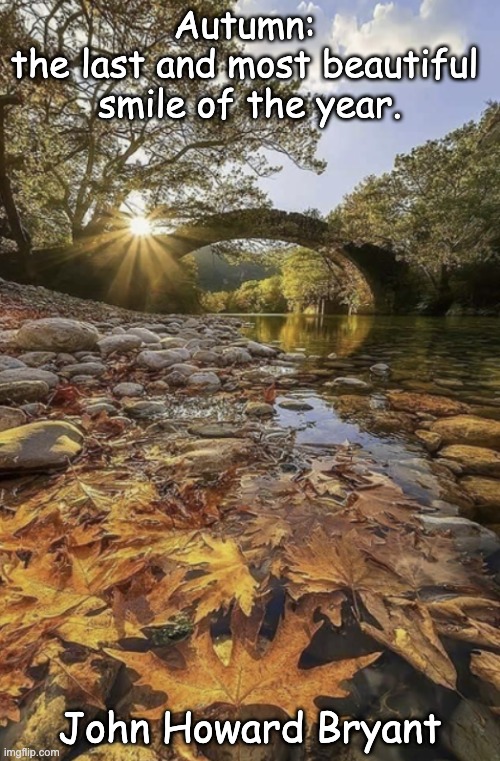
The line personifies autumn as a smile:
The last and loveliest expression the year shows before winter. One commentator notes there is wistfulness in the word “last”, since the lushness of spring and summer is quieting down, but also a sense of peace in the ending. In the poem itself, the tone is consoling. Indian summer, the warm spell in late autumn, is a gift that “fills the human heart with hope” and gives strength to endure the winter storms until the cold passes. So the image is beauty in decline, but also a comfort and a promise that winter will end.
Origin and author:
The words come from a poem called “The Indian Summer” by John Howard Bryant (1807–1902), the younger brother of William Cullen Bryant. The poem begins “That soft, autumnal time” and includes the lines “The year’s last, loveliest smile, / Thou com’st to fill with hope the human heart, / And strengthen it to bear the storms awhile, / Till winter’s frowns depart.” It appeared in Rufus Wilmot Griswold’s anthology “The Poets and Poetry of America” (1843 edition), and it’s not known exactly when John Howard Bryant first wrote it. Authorship is often credited, incorrectly, to his brother William Cullen Bryant, the Romantic poet and longtime editor of the New York Evening Post. The mix-up is easy to see:
the two brothers shared a surname, and William was by far the more famous. William did write about autumn (for instance “The Death of the Flowers”), but this line isn’t his.
Note that the original is “Autumn, the year’s last, loveliest smile” as a fragment addressed to the season, and the version you quoted (“the last and most beautiful smile of the year”) looks like a paraphrase or translation of it.
