Easy come, easy go.

The saying “Easy come, easy go” suggests that something acquired easily can also be lost easily, especially when it comes to money or possessions. It implies that people often don’t value or work hard for things that come easily, making them more prone to squandering or losing them. It can also refer to situations or opportunities that arise quickly and disappear just as fast.
Origin:
‘The exact origin of the saying is unclear’, but it’s likely a variation of a much older expression, “Lightly come, lightly go,” which was common in the 16th century. The phrase “Easy come, easy go” itself seems to have gained popularity in the 19th and 20th centuries, possibly through folk songs and literature.
Author:
There is ‘no single known author’ of this saying. It is a piece of folk wisdom and a common idiom, likely passed down and modified over centuries.
To go west.

The expression “to go west” is an idiom that has several meanings depending on the context:
1. ‘To die or pass away’:
This is the most common historical and literary meaning, often used as a euphemism for death.
2. ‘To fail or break down’:
In a more modern and colloquial sense, it can mean that something has gone wrong, failed, or ceased to function (e.g., “The plan went west”).
3. ‘To disappear or be lost’:
It can also refer to something vanishing or being irretrievably lost.
🕰️ Origin and Author:
The phrase ‘does not have a single known author’ but rather evolved over time from several cultural and historical sources.
1. ‘Ancient Mythology and Symbolism’:
The most profound origin lies in ancient solar symbolism. Across many cultures (including Celtic and Egyptian), the West—where the sun sets—was symbolically linked to the evening of life, completion, and the journey to the afterlife. The setting sun represents the end of the day and, by extension, the end of life.
2. ‘Historical/Geographical Context (The American Frontier)’:
In the 19th-century United States, “Go West, young man” (often attributed to Horace Greeley) was a rallying cry for expansion and opportunity. While this usage generally meant seeking fortune, the journey was arduous and dangerous. For some, “going west” became synonymous with the final journey or facing the unknown, reinforcing the connection between the West and a definitive destination.
3. Military Slang (WWI):
The phrase gained significant popularity and its specific association with death during World War I. Soldiers in the trenches frequently used “went west” as a respectful and slightly indirect way to report that a comrade had been killed in action. This usage solidified the idiom in modern English.
A forgetful head makes a weary pair of heels.

Forgetfulness often causes extra work or unnecessary journeys.
For example, if you leave home without your keys, you must walk back to get them—your poor memory (“head”) makes your feet (“heels”) tired.
More broadly, it teaches that ‘carelessness or poor planning creates additional effort later’.
📜 Origin:
It is a ’traditional British proverb’, often described more specifically as ‘Scottish or northern English’. Variants have circulated orally for centuries and appear in proverb collections from at least the ’18th century’.
Similar sayings exist in several European languages, such as the German:
> ‘Was man nicht im Kopf hat, muss man in den Beinen haben.’
> “What one does not have in one’s head, one must have in one’s legs.”
✍️ Author:
There is ‘no known individual author’. It should be attributed simply as:
> ‘Traditional proverb’
> or
> ‘Traditional Scottish/English proverb’
It is not reliably attributable to any famous writer or historical figure.
To hammer on the same anvil.
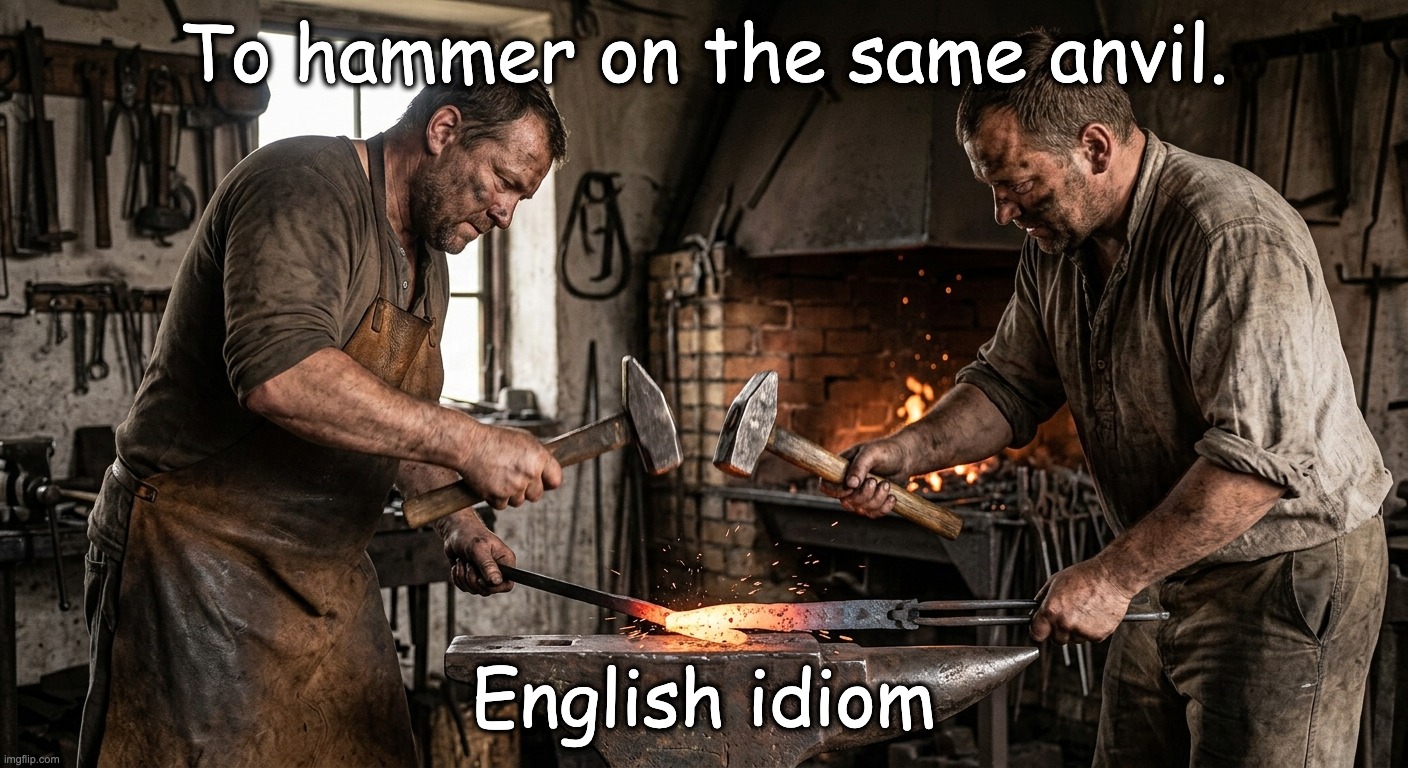
– ‘To keep focusing on the same point or idea.
– ‘To repeat the same argument or action’
– Often implies ‘persistence without progress’, like not adapting or not changing strategy.
Common nuance:
– Slightly ‘negative/ironic’:
“You’re going over the same thing again and again.”
Origin 🌍:
This sentence is a ‘metaphorical proverb’ drawn from the image of a blacksmith:
– A smith ‘uses a hammer on an anvil’ to shape metal.
– If you keep hitting the same spot, you’re ‘staying with the same target’—or, in a figurative sense, ‘staying with the same idea’.
> Note:
Latin has the expression “eandem incudem tundere” (‘to hammer on the same anvil’), and there was a similar expression in Greek. Erasmus included it in his *”Adagia*”(under the entry “Eandem incudem tundere”), whereby it became part of the European common heritage through humanist anthologies.
Author 👤:
– ‘No single definitive author’ is widely agreed upon for this exact wording.
– It is best treated as an ‘anonymous proverbial/figurative expression’ rather than a quote with a known author.
Quick example ✍️:
– “He just kept ‘hammering on the same anvil’—the same complaint, the same evidence, no new angle.”
You’re not drunk if you can lie on the floor without holding on.

This humorous saying is a classic piece of barroom philosophy. It playfully (and inaccurately) sets an extremely high bar for what constitutes being “truly” drunk.
– Literal Meaning:
It suggests that as long as you can manage to lie down flat on the floor and not have to grip onto something to keep from rolling or sliding, your level of intoxication is still “acceptable.”
– The Joke:
The humor comes from the absurdity of the standard. Lying on the floor is already a sign of significant impairment. The saying isn’t meant to be taken as serious advice; it’s a way to downplay one’s state of inebriation and continue the night. It presents a comedic “test” that is almost impossible to fail, even in an advanced state of drunkenness.
🕰️ Origin and Author:
Author: This phrase is ‘anonymous’.
Like many witty observations and folk sayings, its exact creator is lost to time. It’s the kind of line that is born in pubs and passed down through generations.
Origin:
The saying has been in circulation for many decades, likely gaining popularity in the mid-20th century. It falls under the category of “drinking folklore” or “barroom wisdom”—sayings that are shared among friends and regulars in social drinking settings. It’s a humorous way to normalize or justify continuing to drink.
Don’t settle for crumbs.
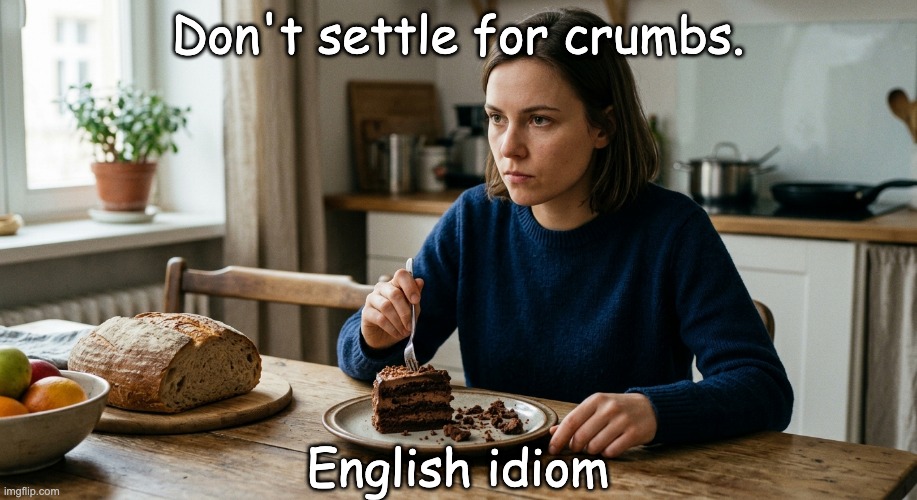
– Refusal to Accept Less:
It’s a call to action to not accept less than what you deserve or what you are capable of achieving.
– Striving for Abundance:
It encourages individuals to aim high, seek full opportunities, and demand respect and fair treatment.
– Self-Value and Self-Respect:
At its core, it’s about valuing yourself and your contributions, refusing to be content with leftover or insufficient rewards.
– Ambitious Pursuit:
It inspires people to pursue their dreams, goals, and desires with determination, rather than being satisfied with small, insignificant gains.
Origin:
‘The exact origin of the phrase is difficult to pinpoint’, as it’s a ‘common metaphorical expression’ that has likely evolved over time. However, the metaphor of “crumbs” representing insufficiency or leftovers is deeply ingrained in language and literature.
– Biblical Allusions:
The idea of crumbs falling from a table is a recurring motif in religious texts, often symbolizing humility or the acceptance of divine provision. However, the modern interpretation of “don’t settle for crumbs” emphasizes a proactive rejection of insufficiency.
– Folklore and Idioms:
The metaphor of crumbs as a symbol of poverty or lack has long been present in folklore and idiomatic expressions.
– Evolution of Language:
The phrase has likely evolved organically as a way to articulate the desire for more and the rejection of inadequacy.
Author:
‘There is no single, attributed author’ for the saying “Don’t settle for crumbs.” It is a widely used expression that has entered the common lexicon. Its power lies in its universal resonance and its ability to inspire individuals to seek greater fulfillment.
In no time.

The idiom “in no time” means very quickly, rapidly, or almost immediately. It suggests that an action or event will happen so fast that it will seem to take up no time at all.
🕰️ Origin:
The ‘exact origin of the phrase is not definitively known’, but it’s likely a figurative expression that evolved naturally in English. It emphasizes extreme speed by hyperbolically claiming that an event will occupy ‘no time’. Similar expressions exists in other languages, suggesting it’s a common linguistic way to convey rapid action.
✍️ Author:
There is ‘no single, credited author’ for the idiom “in no time.” It’s a product of ‘common language’ usage and has been in circulation for a long time, evolving from everyday speech rather than being coined by a specific individual.
Who says A must say B.
– General meaning:
There’s ‘no reason or rule’ that if someone is saying/doing ‘A’, they also must say/do ‘B’.
– In other words:
– ‘No obligation’ or ‘causal link’ is assumed between A and B.
– You can choose, act, or speak independently.
– Common paraphrases:
– “Just because someone says A doesn’t mean they have to say B.”
– “A and B aren’t necessarily connected.”
– “There’s no requirement to follow both.”
📜 Origin:
– This line is ‘widely used as a proverb-style saying’, but ’there isn’t a single universally agreed “origin date” or “first published source.” ‘
– It often appears in ‘moral/philosophical’ and ‘religious/etiquette’ contexts as a way to emphasize ‘independence of thought’ or ’the absence of assumed obligation’.
– Important note:
The exact wording “Who says A must say B” is likely a ’translation/paraphrase’ of a proverb found in other languages (often Dutch/French/Arabic/Hebrew-style proverbial structures), rather than a single famous quote with a clearly documented author.
🧑💼 Author:
– ‘No single confirmed author’ is reliably documented for the exact phrasing “Who says A must say B.”
– Because it’s proverb-like and commonly translated, many websites attribute it differently (or not at all), but there is ‘no definitive canonical attribution’.
To hold an eel by the tail.
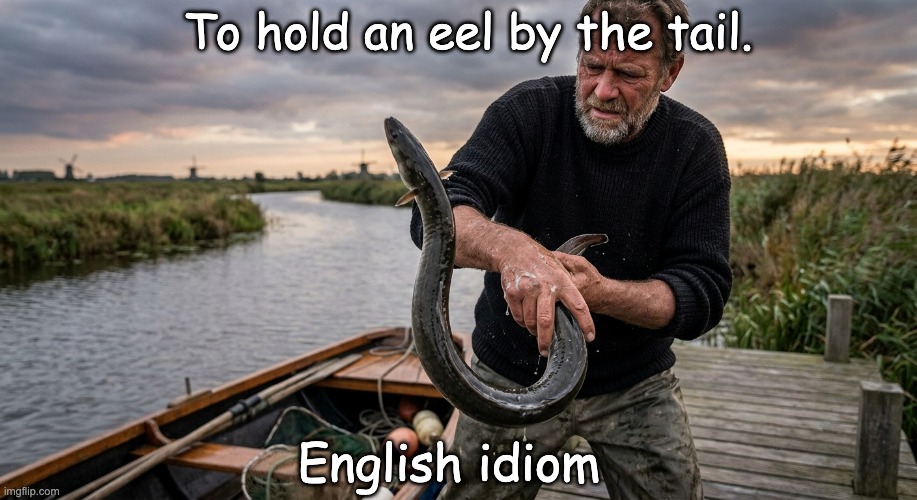
– To try to keep control of something slippery or hard to manage
– Often implies the attempt is ‘futile’, because the thing will ‘slip away or escape’
– Can also suggest ‘a risky or uncomfortable situation’ where you can’t easily “keep hold” of what’s causing trouble.
📌 Typical Usage:
You’ll usually see it in contexts like:
– Trying to ‘control a difficult person’
– Trying to ‘manage an unstable/volatile problem’
– Handling a ‘sneaky or evasive situation’
– Attempting to ‘deal with something that won’t stay in your control’.
🌍 Origin:
– This is an ‘old proverb/saying’ found in ‘English’ and also reflected in other European folklore traditions.
– The imagery is very natural:
An ‘eel is famously slippery’, so holding it by the tail is inherently hard and unstable.
But:
Unlike some proverbs, the exact earliest documented author/source for ’this exact phrasing’ is often ‘unclear’ in commonly available references. Many proverb databases describe it as ‘a traditional figurative expression’ rather than something tied to a single famous writer.
✍️ Author:
– ‘No single well-established author’ is consistently credited for this specific sentence.
– It’s best treated as an ‘anonymous traditional saying / proverb’ rather than a quote from one notable person.
