Adriaan van Dis:
(Bergen (NH), 16 December 1946).
Dutch novelist and essayist. In 2015, he received the Constantijn Huygens Prize for his entire oeuvre and the Libris Literature Prize for his autobiographical novel Ik kom terug. His also autobiographical novel Indische duinen was awarded the Golden Owl in 1995. The novel Naar zachtheid en een warm omhelzen (To softness and a warm embrace) won him the NS Publieksprijs in 2024.

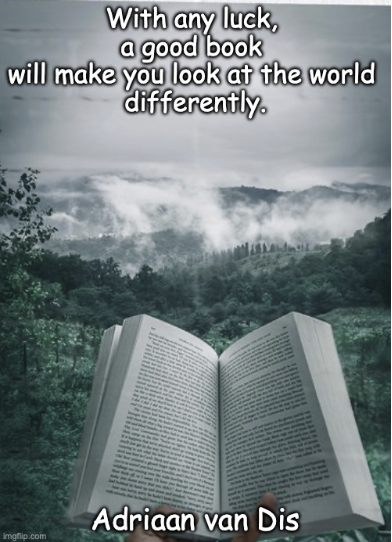
With any luck, a good book will make you look at the world differently.
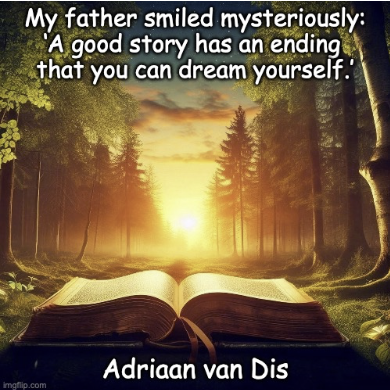
My father smiled mysteriously: ‘A good story has an ending that you can dream yourself.’
Freedom is worth a lie.
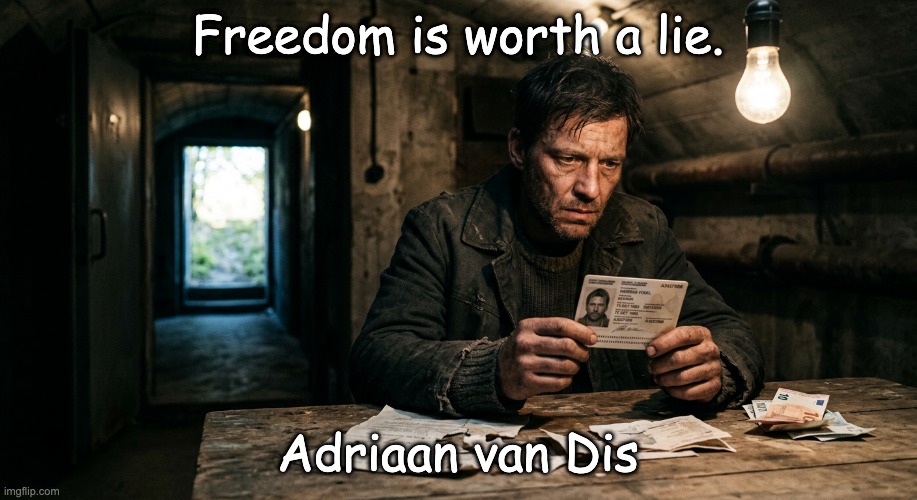
“Freedom is worth a lie” is a paradoxical, aphoristic one-liner. A plausible interpretation has three layers:
– Freedom sometimes requires self-deception:
To feel free — from expectations, duties, a past, a relationship — you sometimes have to maintain an illusion, lie to yourself or to others.
– Freedom is itself a kind of construct:
It may not be an absolute given, but a story we tell ourselves to make life bearable or meaningful. That “lie” is worth it, because the sense of freedom it yields is precious enough to hold onto, even if it is illusory.
– The lie as the price of freedom:
Sometimes you have to lie — to the world, to conventions, to a system — to conquer or preserve your freedom. The lie is then the price, and that price is worth it. This ambiguity, in which freedom and lies both contradict and enable each other, fits the type of paradoxical sentences Van Dis often plays with (compare his related statement: “Mildness is a lie. It is a way to hide your anger.”).
Origin:
Despite extensive searching — in the DBNL archive, on the Atlas Contact publishing house website, and in the podcast “Van Dis Ongefilterd” — I could not find a concrete source text: no title, year, or interview in which the sentence appears literally. The statement circulates only on quotation sites, without source attribution. This suggests that it likely comes from an oral source (TV appearance, lecture, interview) that has not been digitized or is searchable.
Information has since been requested from Van Dis – Atlas Contact; as soon as more is known, this will be added. On 11 July 2026, my question was discussed on the podcast ‘Van Dis Ongefilterd’. Adriaan couldn’t remember whether, or where, he might have said or written this, but he certainly agreed with the saying.
Author:
Adriaan van Dis (b. 1946), Dutch writer, journalist, and television presenter — known for, among others, “Nathan Sid”, “Indische duinen,” and “Tikkop.” The attribution to him is consistent across multiple citation sites, even without verification via a primary source.
