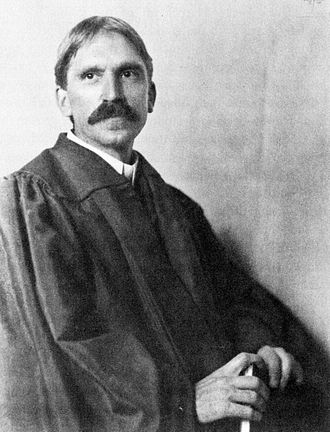
John Dewey:
(Burlington, 20 October 1859 – New York, 1 June 1952).
American philosopher, psychologist and educator.
His work made important contributions to educational science, educational philosophy and the philosophical movement of pragmatism, among other things.
Dewey is also often regarded as the father of functionalism. This is a school of psychology that focuses on the function of conscious experience and behaviour. Some also consider him to be one of the most important philosophers of the 20th century.
The most important attitude that can be formed is that of desire to go on learning.
The self is not something ready-made, but something in continuous formation through choice of action.
The mystery is that the world is as it is — a mystery that is the source of all joy and all sorrow, of all hope and fear, and the source of development both creative and degenerative. The contingency of all into which time enters is the source of pathos, comedy, and tragedy.
This quote explores the profound nature of reality and our human experience within it. Here’s a breakdown of its key themes:
– The Mystery of Existence:
The first sentence emphasizes the inherent mysteriousness of the world just being as it is. This simple fact – that anything exists at all, and in the specific way it does – is a source of awe and wonder.
– The Source of Emotion:
This mystery is not just an abstract concept; it’s the root of our deepest emotions. Our joy, sorrow, hope, and fear all stem from this fundamental uncertainty and the unpredictable nature of the world.
– The Source of Change:
The quote suggests that this mystery is also the driving force behind development, both positive (creative) and negative (degenerative). Our attempts to understand and navigate this mystery lead to growth and decline.
– The Role of Time and Contingency:
The second sentence introduces the crucial concepts of time and contingency. “Contingency” means that things could have been different; nothing is guaranteed. Time’s passage ensures that everything is temporary and subject to change.
– Pathos, Comedy, and Tragedy:
This combination of uncertainty and temporality is the source of the core elements of human experience:
-Pathos:
The feeling of pity and sadness, often related to the transience of life.
– Comedy:
The humor found in the unexpected twists and turns of life, the absurdity of our attempts to control the uncontrollable.
– Tragedy:
The suffering and loss that inevitably occur in a world marked by contingency and the passage of time.
In essence, the quote suggests that the very unpredictability and impermanence of existence are what make life so rich, complex, and filled with both beauty and suffering.
Origin and Author:
This quote is attributed to the American philosopher and educational reformer John Dewey (1859-1952).
It is found in his work titled “Experience and Nature” (1925). In this book, Dewey explores the relationship between human experience and the natural world, arguing that philosophy should be rooted in everyday experience and that the world is a process of constant change and development. This quote perfectly encapsulates his view of the world as a dynamic, contingent, and ultimately mysterious place.
