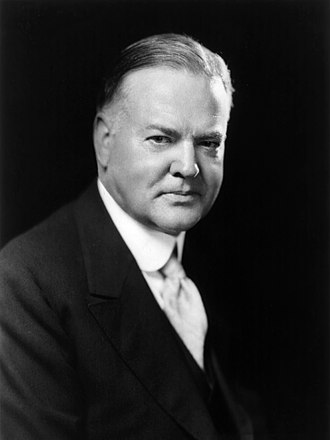
Herbert Clark Hoover:
(West Branch, Iowa, August 10, 1874 – New York, New York, October 20, 1964).
31st President of the United States from 1929 to 1933.
Hoover was already famous for his humanitarian actions during World War I, particularly the provision of food aid to occupied Belgium. From 1921 to 1928, he served as Secretary of Commerce under President Warren G. Harding and, after his death, under his successor Calvin Coolidge. As president, he faced a severe economic crisis that would become known as the Great Depression. As a result, Hoover lost his reelection bid in 1932.
Economic freedom cannot be sacrificed if political freedom is to be preserved.

Freedom is the open window through which pours the sunlight of the human spirit and human dignity.
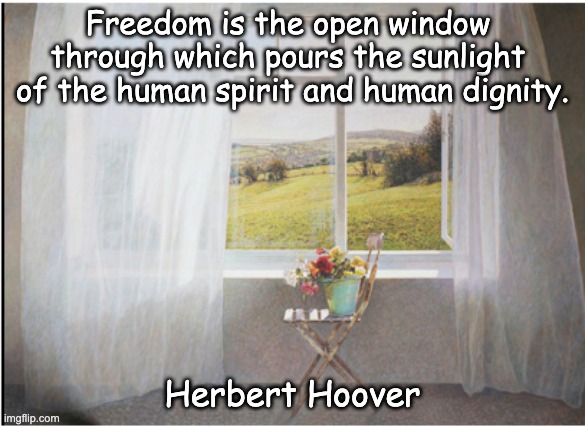
The metaphor is straightforward but rich:
– “Freedom” is cast not as a possession but as a ‘condition’ — an “open window.”
– A window doesn’t create light; it simply doesn’t block it. In the same way, freedom doesn’t manufacture human dignity or spirit — it just refuses to obstruct them.
– “Sunlight of the human spirit and human dignity” suggests these qualities are already present in people, like sunlight already exists outside. What freedom does is ‘let them in’ — allow them to reach a room (a society, a life) that would otherwise stay dark.
– The implicit contrast is with a ‘closed’ window — oppression, tyranny, or restriction — which doesn’t destroy the human spirit so much as shut it out, leaving people in the dark despite the sun still shining.
It fits Hoover’s broader political philosophy, which emphasized individualism and limited government — the idea that liberty’s job is to get out of the way and let human potential and dignity flourish on their own, rather than being engineered or granted from above.
Origin:
The most commonly cited source for this line is a posthumous compilation of his sayings, “The Wit and Wisdom of Herbert Hoover: A Compilation of Many of His Quotations” (1995). I wasn’t able to pin down the original speech or document where Hoover first said or wrote it — it circulates widely online as a Hoover quote, but its earliest documented appearance seems to be in that collection rather than a specific dated address. If you want, I can dig further to see if it traces back to a particular Hoover speech or writing.
Author:
This quote is attributed to Herbert Hoover (1874–1964), the 31st President of the United States, who served from 1929 to 1933. Before his presidency, he trained as a mining engineer, was raised a Quaker, led U.S. food relief efforts during World War I, and became known for humanitarian work in wartime Belgium, later serving as Secretary of Commerce under Presidents Harding and Coolidge.
