Ludwig Andreas Feuerbach:
(Landshut, 28 July 1804 – Rechenberg-Nuremberg, 13 September 1872).
German philosopher. His father was the well-known jurist Paul von Feuerbach.

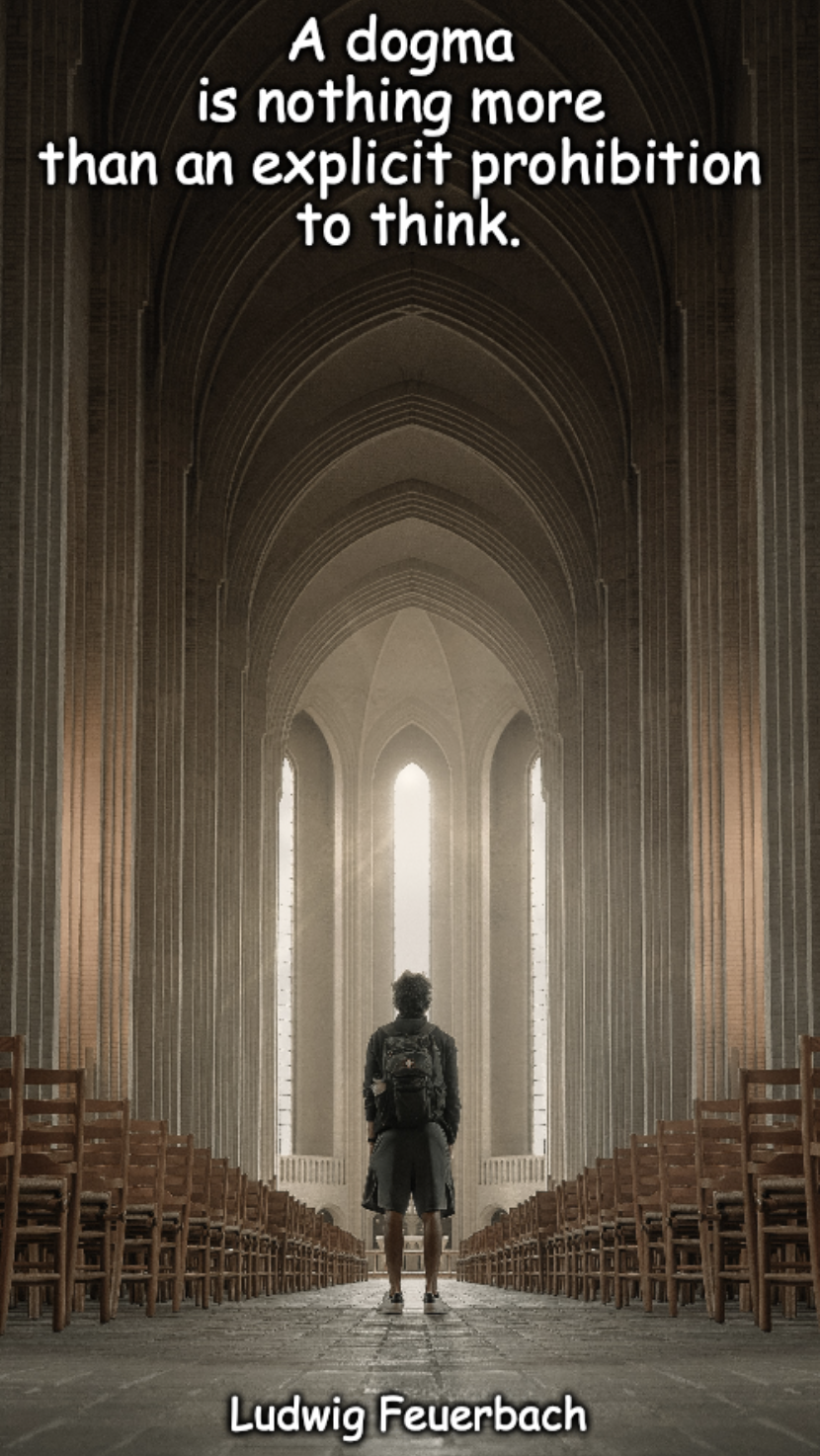
A dogma is nothing more than an explicit prohibition to think.
Literally:
– a “dogma” is a doctrine imposed as ‘undoubtedly true’;
– whoever accepts the dogma is ‘not allowed to think freely about it’;
– the dogma thus functions as a ‘prohibition on critical thinking’.
In plain words, Feuerbach means roughly:
– as soon as something is fixed as absolute truth,
– and one is ‘no longer allowed to investigate, question, or contradict it’,
– then real thinking stops.
Philosophical implication:
The statement is a critique of:
– ‘authority above reason’;
– ’truths of faith that may not be tested’;
– systems in which ‘obedience is more important than the investigation of truth’.
👉 In other words:
‘dogma requires consent, thinking requires freedom.’ 👤 Author: Ludwig Feuerbach
Ludwig Andreas Feuerbach (1804–1872) was a German philosopher.
What is he known for?
– criticism of traditional religion;
– emphasis on ‘man’ rather than God as a point of projection;
– great influence on later thinkers such as ‘Marx’, ‘Engels’, and indirectly on modern religious criticism.
Why does this quote fit him?
Feuerbach believed that religious dogmas often:
– project human characteristics onto God;
– subsequently impose those projections back on man as absolute truths;
– thereby alienate man from his own thought and essence. 🏛️ Origin :
The statement is usually associated with:
– Ludwig Feuerbach, “Das Wesen des Christentums”
– 1841
Important nuance:
There are different versions of the quote, such as:
– “Das Dogma ist nichts anderes als ein ausdrückliches Verbot zu denken.”
– or similar formulations with minor differences.
That means:
– the ’thought is authentically Feuerbach’;
– the ‘exact word form’ may differ slightly per edition, translation, or anthology.
🇩🇪 Original formulation:
> “Das Dogma ist nichts anderes als ein ausdrückliches Verbot zu denken.”
Although Feuerbach primarily criticizes religious dogmas, you can read it more broadly:
– political dogmas;
– ideological dogmas;
– moral or cultural dogmas;
– even scientific orthodoxy when criticism becomes impossible.
Key insight:
As soon as a system says:
– “this is fixed”,
– “you do not discuss this”,
– “doubt is forbidden”,
then doctrine turns into “dogma”.
👉 ‘dogma limits free thinking by withdrawing something from criticism.’
Where there is no love there is no truth.

No one judges more harshly than the uneducated. He knows neither reasons nor counter-reasons and always believes he is right.
Books are like glasses through which you look at the world.

The will is nothing but the ability to affirm and deny.

For God did not create man in his own image, as the Bible says, but man created God in his own image.
Science and humanity can only flourish under the protection of tolerance. – Where there is no truth, there is no tolerance. Fear is the source of intolerance, but fear is not in the truth.
It is precisely the simplest truths that people always discover the latest.

Intolerance is the natural daughter of the devil, the doctrine of the evil principle, the doctrine of lies.

A perfect human being requires the power of thought, the power of will, the power of heart.

Humanity has as many powers, as many characteristics as there are humans.

Justice resides in history, not in individual human lives.

