Lin Yutang:
(10 October 1895 – 26 March 1976).
Chinese writer, linguist, and inventor.
A prolific bilingual writer in both Chinese and English, he was celebrated for pioneering a humorous prose style in modern Chinese literature and for serving as a cultural bridge between China and the West, most notably through My Country and My People (1935) and his English translations of Chinese classics. As a linguist, he compiled a series of ESL textbooks for Chinese learners in the 1930s and later produced an English–Chinese dictionary in the 1970s. As an inventor, he designed a Chinese typewriter, which was patented in the United States in 1952, though it was never mass-produced. From 1940 to 1973, Lin received six nominations for the Nobel Prize in Literature.

I like spring, but it is too young. I like summer, but it is too proud. So I like best of all autumn, because its tone is mellower, its colors are richer, and it is tinged with a little sorrow. Its golden richness speaks not of the innocence of spring, nor the power of summer, but of the mellowness and kindly wisdom of approaching age. It knows the limitations of life and its content.
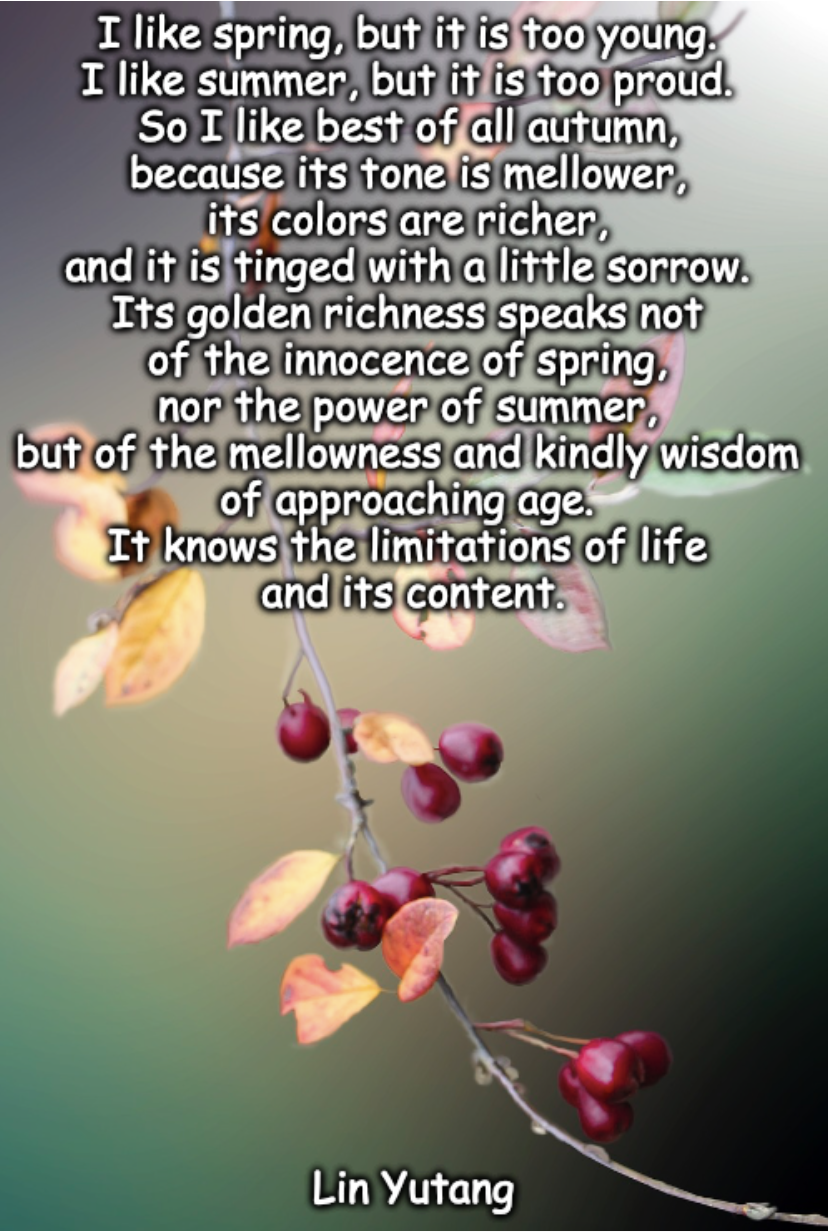
Lin Yutang personifies the four seasons as stages of human life:
– “Spring”:
represents youth, innocence, and inexperience—beautiful, but “too young.”
– “Summer”:
represents strength, ambition, and confidence—impressive, but “too proud.”
– “Autumn”:
represents mature age: experience, restraint, wisdom, and acceptance.
– The “little sorrow” reflects awareness that life is finite; winter, symbolically old age and death, is approaching.
His preference for autumn expresses admiration for ‘maturity rather than innocence or power’. Autumn understands life’s limits and is therefore calm and content. The passage is melancholy, but not pessimistic: it celebrates the richness and serenity that can come with age.
✍️ Author and origin:
This passage is by Lin Yutang (林语堂, 1895–1976), the Chinese writer and philosopher. It appears in his English-language book:
> “The Importance of Living” (1937)
Lin wrote the book originally in English, so the passage is not simply a translation of an ancient Chinese saying. It reflects his characteristic combination of Chinese philosophical attitudes—especially acceptance, balance, and harmony with nature—with a Western essayistic style.
Page numbers differ between editions, so the book title and publication year are the safest citation.
📝 Textual correction:
The final words in this version — “and its content” — are probably a transcription error. The commonly printed wording is:
> “It knows the limitations of life and ‘is content’.”
The passage is also often followed by this sentence:
> “From a knowledge of those limitations and its rich autumnal content, its wisdom, its unhurried pace, it is preeminently the philosophical season.”
Thus, “is content” means that autumn accepts life as it is, while “autumnal content” refers to the season’s accumulated richness.
