George Santayana:
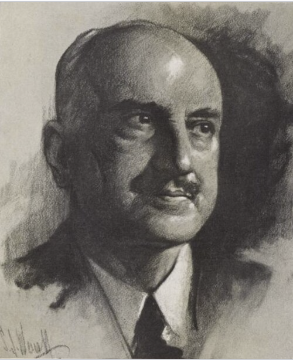
Born Jorge Agustín Nicolás Ruiz de Santayana y Borrás (Madrid, December 16, 1863 – Rome, September 26, 1952). Spanish-American writer, poet, and philosopher. He retained his Spanish nationality throughout his life, but wrote all his works in English.
Theory helps us bear our ignorance of facts.
Variation is a consequence of freedom, and the slight but radical diversity of souls in turn makes freedom requisite.
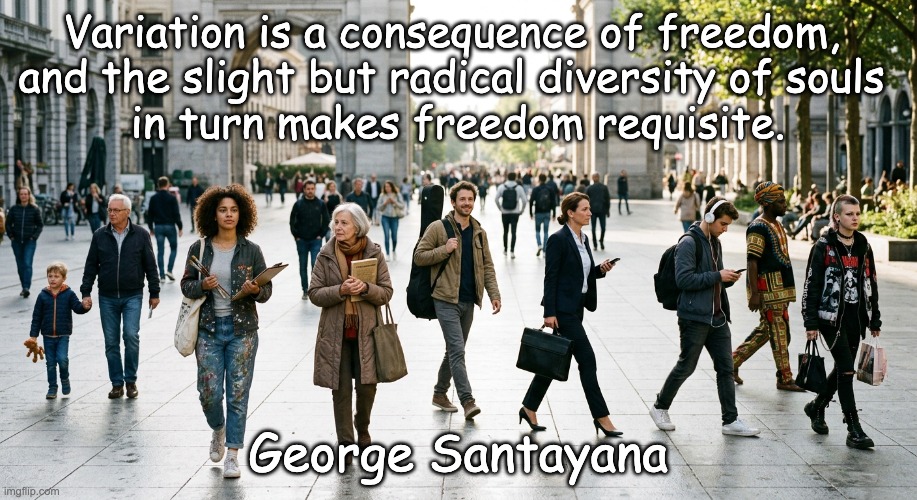
The quote by George Santayana expresses a reciprocal relationship between “freedom” and ‘human diversity’:
> “Variation is a consequence of freedom, and the slight but radical diversity of souls in turn makes freedom requisite.”
Core idea:
– Freedom leads to diversity: when people are free, they develop different views, characters, choices, and ways of life.
– Diversity makes freedom necessary: because people are not inwardly identical, freedom is needed to do justice to those differences.
– Even small differences between people can be fundamental; therefore, coercion or uniformity is contrary to human nature.
Simply put:
– People are not all the same.
– Precisely for this reason, they need “freedom.”
– Without freedom, ‘conformism’ arises rather than true individuality.
Origin 📚:
– The quote comes from “Character and Opinion in the United States”.
– This book was published in 1921.
– The text is based on lectures Santayana originally delivered to a ‘British audience’.
– The work is written from the perspective of a ‘detached, critical observer’ of American society.
Author 👤:
George Santayana (1863–1952)
– Philosopher
– Poet
– Essayist
– Literary critic
Background:
– Santayana was a major figure in ‘classical American philosophy’.
– He was of Spanish descent and possessed a strong European character in thought and temperament.
– He taught at ‘Harvard’, but was known for his sharp, ironic, and somewhat detached view of American culture.
– His philosophy is often associated with ‘naturalism’, cultural criticism, and attention to ‘imagination’. Relevance to this quote: This quote fits Santayana’s style well:
– philosophical
– elegantly formulated
– keenly observant
– focused on the tension between ‘individuality’ and ‘social order’.
