Lea Malot:
( born: Annecy, France ).
French author from Annecy, France. She moved to London at the age of nineteen, where she’s still residing. She self-published her first book, One Glance (2014), at the age of seventeen. She has now moved on from novels to poetry, self-publishing three poetry collections, Lilith (2017), Coffins & Rhinestones (2019), and 26 (2022).
September was a 30-day long goodbye to summer―to the season that left everybody both happy and weary of the warm, humid weather and the exhausting but thrilling adventures. It didn’t feel like fresh air either, it made me suffocate. It was like the days would be dragging some kind of sickness, one that we knew wouldn’t last, but made us uncomfortable anyway. The atmosphere felt dusty and stifling.
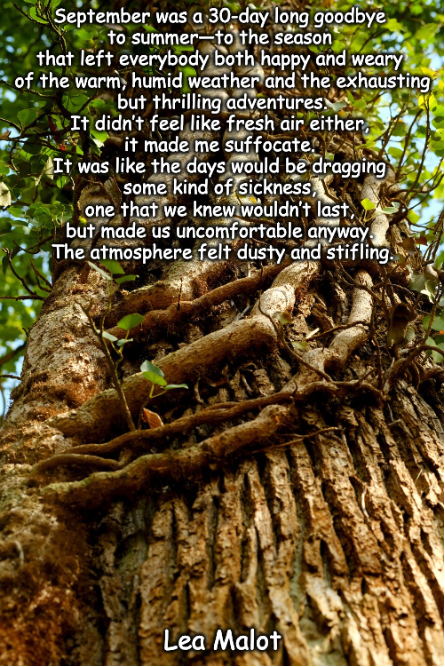
This passage is describing ‘September as a “departure” from summer’—not a clean, refreshing transition, but a ‘slow, uncomfortable fade-out’.
– “30-day long goodbye” → September feels like summer doesn’t end abruptly; it lingers.
– “both happy and weary” → People are glad summer is ending (or glad it happened), but tired of the ‘heat, humidity, and effort’.
– “It didn’t feel like fresh air either, it made me suffocate.” → The author feels ‘emotionally/physically trapped’ by the atmosphere; it’s not refreshing like you’d expect at the start of fall.
– “days would be dragging… one that we knew wouldn’t last” → The discomfort feels ’temporary’, like an illness you expect to recover from, but it still makes you miserable while it lasts.
– “dusty and stifling” → The air feels ‘stale, heavy, and irritating’, not clean or breathable.
👉 Overall, it’s a ‘sensory/atmospheric description’ of seasonal transition—summer ending, but with lingering oppressive heat that feels sickening.
🧩 Origin:
From the text you provided, it looks like ‘a literary excerpt’ (or a passage from a book/story), but:
– I ‘don’t have reliable access’ to databases or the original publication that would let me confirm the exact ‘source’ or whether it’s from Lea Malot.
– There’s also a real chance it could be:
– a ’translation’,
– a ‘rewritten/pastiched line’, or
– text taken from a ‘fan upload / repost’.
✍️ Author: Lea Malot?
I ‘can’t confirm authorship’ from the sentence alone.
– Lea Malot may be correct, but I’d need ‘context’ (source page / publication info) to verify.
– My source:
‘https://www.quoteambition.com/september-quotes’
does not mention any book, article or interview by Lea Malot.
