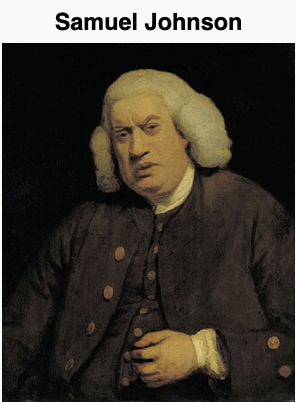
Samuel Johnson:
(Lichfield, 18 September 1709 – London, 13 December 1784). Called Dr Johnson, was an English lexicographer, poet, essayist and literary critic. In his time, Johnson was one of the leading figures of London’s literary and intellectual milieu. He was a hard worker, who constantly complained about his laziness, a socially minded man, weighed down by enormous guilt and a heavy-handed tea drinker. He was extremely compulsive and suffered from his obsessive-compulsive disorder and tics. He would probably have been diagnosed with Tourette’s syndrome in modern times.
Liberty is, to the lowest rank of every nation, little more than the choice of working or starving.

Friendship, like love, is destroyed by long absence, though it may be increased by short intermissions.
Poverty is a great enemy to human happiness; it certainly destroys liberty, and it makes some virtues impracticable, and others extremely difficult.
Friendship is not always the sequel of obligation.
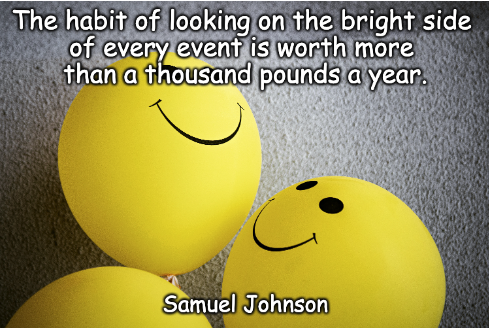
The habit of looking on the bright side of every event is worth more than a thousand pounds a year.
No one can taste the fruits of autumn while his smell delights in the flowers of spring.
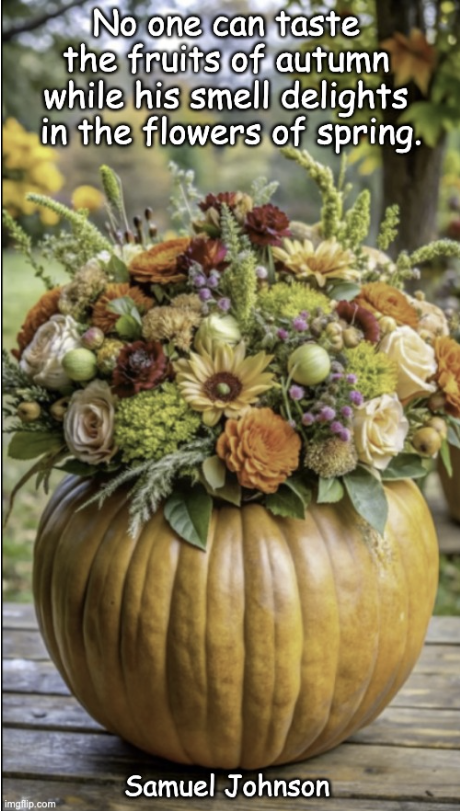
You can’t have everything at once. Each stage of life, and each choice, has its own pleasures, and incompatible pleasures can’t be enjoyed together. Someone who lingers over the blossoms of spring (youth, novelty, promise) can’t also harvest the fruit of autumn (maturity, results, accomplishment). The companion image in the original, that no one can fill his cup from the source and the mouth of the Nile at the same time, makes the same point. Choosing a path means giving up others, and wanting every kind of happiness together leads to disappointment.
Origin:
The line comes from “The History of Rasselas, Prince of Abissinia” (1759), a philosophical tale about a prince who leaves the “Happy Valley,” where every pleasure is provided, to search for the “choice of life” that will make him truly happy. Along the way, people living in very different ways all turn out to be dissatisfied, and the book’s central theme is that no single state of life delivers complete happiness. The line fits that theme: every choice involves trade-offs.
The fuller wording, as I recall it, is:
“No man can taste the fruits of autumn while he is delighting his scent with the flowers of the spring: no man can, at the same time, fill his cup from the source and from the mouth of the Nile.”
The version here quoted is a modernized rendering.
Author:
Samuel Johnson (1709-1784)
The English writer, essayist, poet, critic and lexicographer, best known for “A Dictionary of the English Language” (1755). He reportedly wrote “Rasselas” in about a week to pay for his mother’s funeral and settle her debts.
