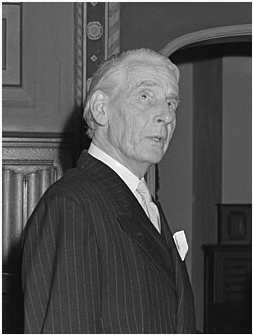
Charles Langbridge Morgan:
(22 January 1894 – 6 February 1958).
A British playwright and novelist of English and Welsh parentage. The main themes of his work were, as he himself put it, “Art, Love, and Death”, and the relation between them. Themes of individual novels range from the paradoxes of freedom (The Voyage, The River Line), through passionate love seen from within (Portrait in a Mirror) and without (A Breeze of Morning), to the conflict of good and evil (The Judge’s Story) and the enchanted boundary of death (Sparkenbroke). He was married to Welsh novelist Hilda Vaughan.
There are moments, above all, on June evenings, when the lakes that hold our moons are sucked into the earth, and nothing is left but wine and the touch of a hand.
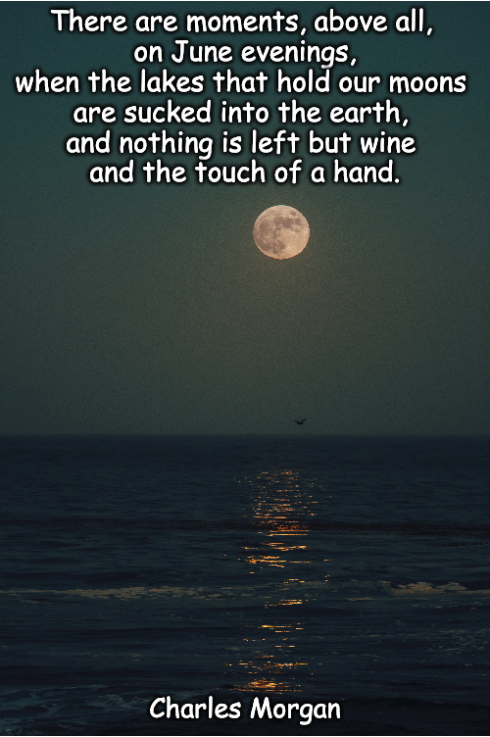
> There are moments, especially on sultry June evenings, when dreams, ideals, and romantic imagination vanish, and only the direct, sensory moment remains: wine, touch, and human closeness.
The images work symbolically:
– “June evenings” evoke warmth, longing, and romance.
– “The lakes that hold our moons” refer to reflections, dreams, illusions, or inner desires.
– “Drawn into the earth” suggests that that dreamy or sublime atmosphere is disappearing.
– “Wine and the touch of a hand” represent physicality, intimacy, pleasure, and human connection.
In short:
> ‘The quote is about a moment when poetry and imagination give way to tangible intimacy.’ 📚 Origin:
The English phrasing reads:
> “There are moments, above all on June evenings, when the lakes that hold our moons are sucked into the earth, and nothing is left but wine and the touch of a hand.”
This version circulates online, including via ‘BrainyQuote’.
⚠️ Important: ‘BrainyQuote’ usually lists ‘no original source’, such as a book, essay, play, or page number. As a result, the precise primary origin of the quote has not been established with certainty. Therefore, it is best described as:
> ‘An English-language literary quote attributed online to Charles Morgan, but without a known exact source.’
👤 Author: The quote is attributed to:
> Charles Morgan
> likely Charles Langbridge Morgan (1894–1958)
He was a British:
– novelist,
– playwright,
– literary critic. His style is often romantic, philosophical, and poetic, making the quote fit his literary tone well.
