Otto Eduard Leopold von Bismarck-Schönhausen:
(Schönhausen, April 1, 1815 – Friedrichsruh, July 30, 1898).
Bismarck, was a German 19th-century statesman and a dominant figure in world history. As Prime Minister of Prussia from 1862 to 1890, he oversaw German unification.
In 1867 he became Chancellor of the North German Confederation. He designed the German Empire in 1871, became its first Chancellor and dominated state affairs until he was overthrown in 1890 by the new Emperor, Wilhelm II of Germany. His realpolitik diplomacy and authoritarian exercise of power earned him the nickname the “iron chancellor”. As Henry Kissinger has noted, “the man of blood and iron” wrote prose of extraordinary directness and clarity.
Bismarck was a loner in politics. He was a complete conservative, but could collaborate with all kinds of parties and politicians when it suited him. He called himself a ‘Realpolitiker’: a realistic politician who made use of the opportunities offered. In that respect he was not very principled and for him the end always justified the means. His method of government was authoritarian and often confrontational. When he took office as Prime Minister of Prussia, he provoked the liberal deputies in his first speech with the statement that political goals could not be achieved by majority decisions and speeches, but ‘durch Blut und Eisen’, in other words: by force.
Lies can start a war, the truth, on the other hand, can stop entire armies.
Freedom is a luxury that not everyone can afford.
A little friendship is worth more than the admiration of the whole world.

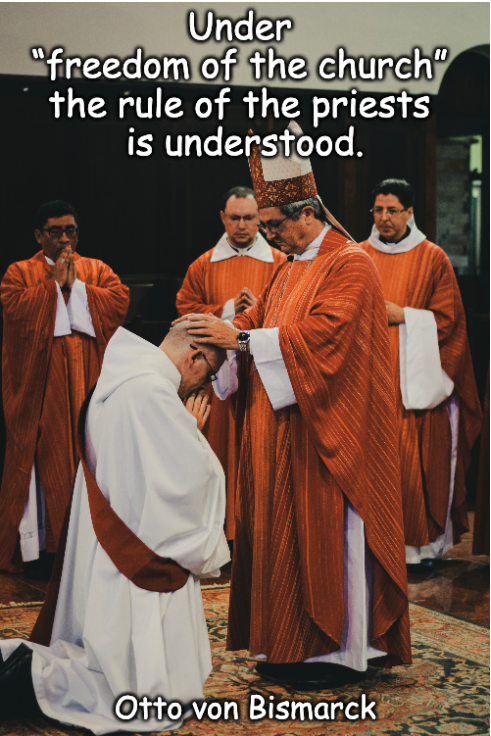
Under “freedom of the church” the rule of the priests is understood.
Freedom is a vague concept.

The sentence, taken out of context, has become a kind of political aphorism, but in the original it means something concrete: Bismarck argues against the liberal concept of freedom, which brands state social policy as a restriction of freedom.
His argument:
– “Freedom” is not an absolute concept, but one that can be interpreted in any way – everyone understands it differently.
– A purely formal freedom (e.g., “freedom not to take out insurance”) can, in practice, mean being completely unprotected in an emergency – to put it figuratively:
the “freedom to starve.”
– Therefore, compulsory state insurance is not a violation of freedom, but rather creates the very conditions for using it effectively.
In the rest of his speech (documented in the same document), Bismarck becomes even more fundamental: He criticizes the fact that “hardly any word nowadays” is as misused as the word “free,” and that everyone usually understands freedom only as their own freedom, coupled with the expectation that others must restrict themselves for their sake. In doing so, he exposes the concept of freedom as a rhetorical weapon, often concealing tangible power interests.
Today, the sentence is usually quoted in abbreviated form and without its original context—often as a general skeptical remark about the vagueness of the concept of freedom, less frequently with its original socio-political reference to compulsory insurance versus formal freedom.
Origin: Bismarck uttered the sentence on March 15, 1884, in a speech to the Reichstag during the debate on the ‘Accident Insurance Act for Workers‘—a central component of his social legislation (alongside health and later disability insurance). Representative Bamberger had objected that the proposed organization of accident insurance did not align with the concept of freedom, as it involved too much coercion, essentially saying: “If you are not willing, then I will use force!”
Bismarck’s reply, in full, was: “Gentlemen, freedom is a vague concept; the freedom to starve is of no use to anyone.” He further explained that the proposed regulation would allow for freedom of choice in the organization of the service, but would make the service itself mandatory, and saw no contradiction between this and freedom.
The exact source: Stenographic reports on the proceedings of the Reichstag, 5th legislative period, 4th session 1884, 6th session, March 15, 1884.
Author:
The quote is indeed from Otto von Bismarck. It is not a spurious attribution, but can be precisely dated and verified in its original context.
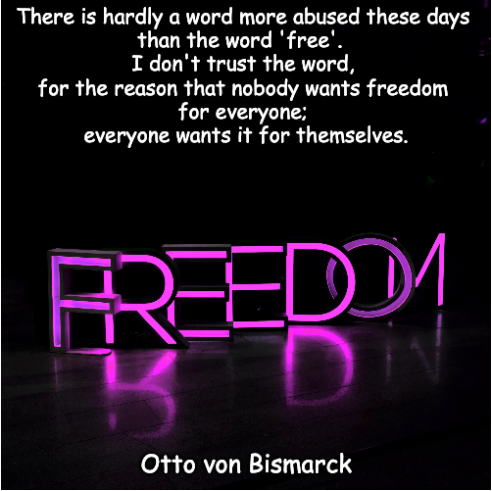
There is hardly a word more abused these days than the word ‘free’. I don’t trust the word, for the reason that nobody wants freedom for everyone; everyone wants it for themselves.